About 100 years ago, during the first weeks of February 1926, a new Chevrolet Series V Touring car sat outside the showroom at the Atwell Auto Company on West Main Street. Drivers slowed as they passed. Some grinned. Others pointed. Atwell Auto was the authorized Chevrolet dealership in Chillicothe, and the “new and improved” touring car was causing quite a sensation. Drivers weren’t slowing and gawking at the shiny new cars parked outside other dealerships, though, and the city was filled with them.
On Main Street, the Lynch Motor Company sold new Fords while the Richardson Motor Company displayed the latest models from the Dodge Brothers. On Water Street, Ed Schwaerzler showcased Jewett Sixes and the Ratcliffe Brothers’ brand-new Pontiacs. There were about half a dozen other new automobile dealerships spread across the city where residents could drive away in a new Chandler, Cleveland, Durant, Essex, Franklin, Hudson, Lincoln, Oakland, Oldsmobile, Packard, Page, or Studebaker. They seemed to be everywhere, each one trying to outdo the other with their rows of new cars, chrome gleaming in the sun and paint polished as smooth as glass. So, what made that new Chevrolet parked outside Atwell Auto so special?

The Chevrolet Series V Touring car was General Motors’ answer to Ford’s Model T, which Americans had fallen in love with largely because of its affordability. And in 1926, a new Model T touring car could still be had for $310 in Chillicothe. The Chevrolet Series V offered similar affordability, selling for $510, but included modern features such as electric starting and lighting systems, balloon tires, three-speed manual transmission, and a more stylish-looking body design. Chevrolet was betting that Americans were willing to pay a little extra for a more modern car than Ford’s increasingly outdated Model T.
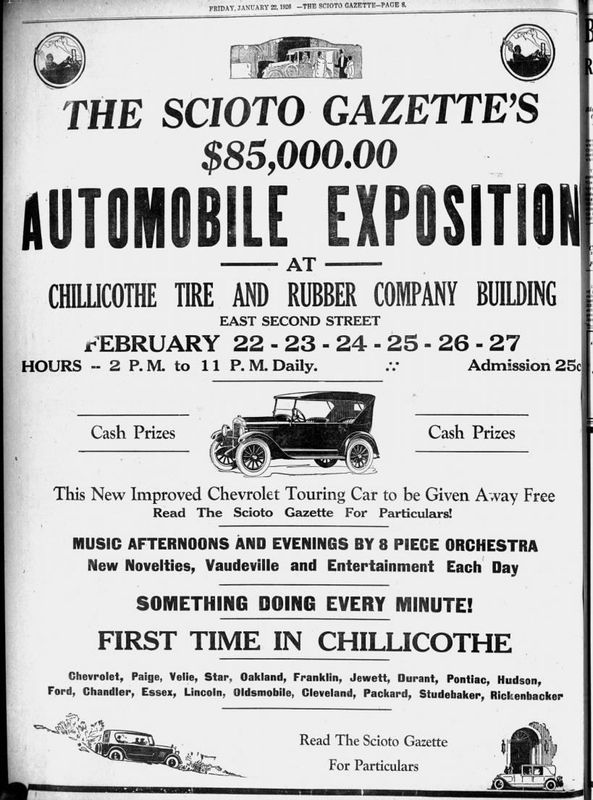
Still, as attractive as the new Chevrolet must have been, it didn’t explain why drivers were causing a traffic jam in front of Atwell Auto just to get a glimpse of it. The real reason was that the Chevrolet was being given away at the Gazette’s mammoth $85,000 car show, and drivers were already dreaming of winning it.
During the last week of February 1926, Chillicothe held its first-ever indoor auto show where residents had the opportunity to view the latest car models directly from the famous National New York Auto Show. In the 1920’s, car shows were all the rage, but the exposition in New York City was the Mecca of automobile lovers. For local dealership owners, it was a major industry gathering, and they flocked to the show to see the newest models they would be selling back home. In past years, all Chillicothe’s dealership owners could do was admire the new cars until they appeared in their showrooms sometime in late spring. Something happened at the 1926 show, though, because the dealers had somehow arranged with manufacturers for the newest models to be promptly shipped to Chillicothe, three or four months ahead of schedule. The city’s automobile dealers were on cloud nine, and after returning from New York, they were determined to display the new models by staging a flashy automobile exposition of their own.
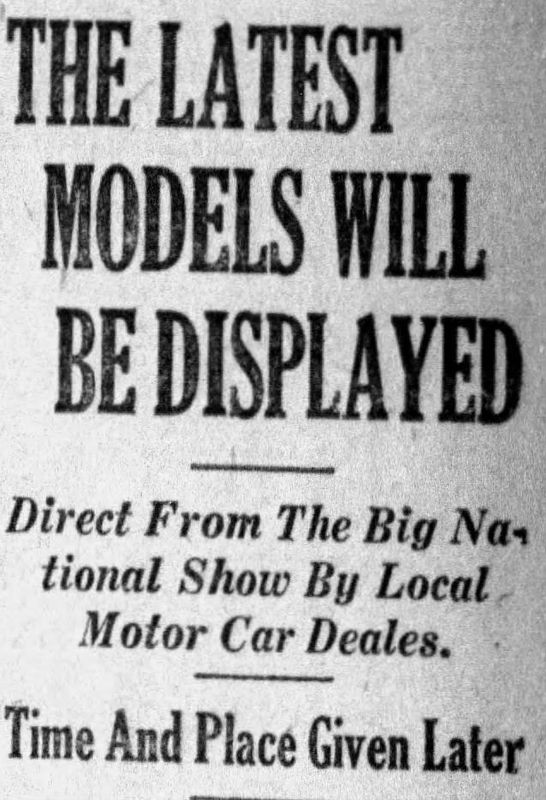
The dealers’ excitement was contagious, and before an indoor venue or dates had even been set, they persuaded the Gazette to sponsor the show. “The Latest Models Will Be Displayed: Direct from the Big National Show by Local Motor Car Dealers,” the paper promised. “Time and Place Given Later.” In previous years, Chillicothe had held a big car show in the fall, outdoors under a gigantic tent erected on South Paint Street. But now faced with the winter cold, a building large enough to display the new cars indoors had to be found, and quickly. It was. Less than a week later, organizers secured the perfect location and finalized the dates: “Gazette’s Big Motor Show on Washington’s Birthday February 22: Logan Auto Plant Scene for the Show,” the headline read.
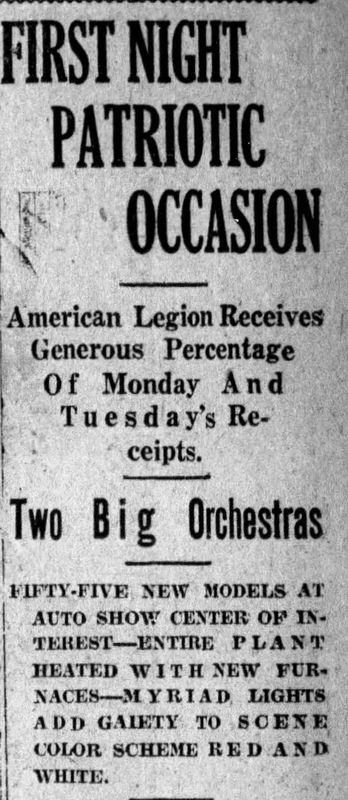
In fact, the building had been occupied by the Chillicothe Tire and Rubber Co. since 1919, but residents still called it the “Old Logan Plant,” because it was where Chillicothe’s famous Logan automobile had once been manufactured. Located on East Second Street, a stone’s throw away from Paint Street, it was considered the ideal location with plenty of parking for the large number of automobile lovers expected to attend. The building site was critical not only because it had to have adequate space to display 55 new cars, but also because it had to accommodate musical entertainment, novelty acts, dance contests, and other attractions designed to draw huge crowds. Car shows in the 1920’s were more than a simple display of automobiles; they were grand extravaganzas, and organizers promised to convert the old building into a “veritable fairyland.”
Over the next month, crews of carpenters, painters, decorators, and other workers rushed to transform the old factory. Its 11,000 square feet of floor space had to be cleared of equipment and the floors and walls scrubbed and painted. Since the grand opening of the exposition was on Washington’s birthday, the building was decorated in patriotic red and white. “Even the price cards on the various makes of automobiles will follow this color idea and the whole interior changed from a barren factory to a colorful, inviting exhibition hall,” promised the Gazette. More importantly, John Zeigler, a well-known furnace man in the city, installed three large Caloric heaters, and he promised attendees at Chillicothe’s first indoor car show would be as “warm as a bug in a rug.”
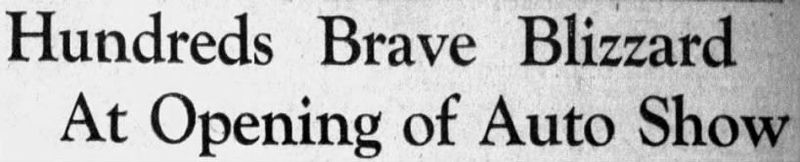
The investment in the three large furnaces paid off when a blizzard swept through the city the night of the grand opening, dropping almost four inches of wet snow and sending temperatures tumbling. Despite the blinding storm, the American Legion Drum Corps, led by Mayor Robert Gunning, paraded through the largely empty streets from City Hall to the Second Street building, where the mayor threw the switch that flooded the place with hundreds of sparkling lights. The show was on!
Visitors entered the toasty building, where what had originally been the office now served as headquarters for the numerous dealers. It was also where attendees bought their tickets and were encouraged to save the stubs for a chance to win a $300 Freed-Eismann cabinet-style console radio or, even better, that new Chevrolet Series V Touring car.
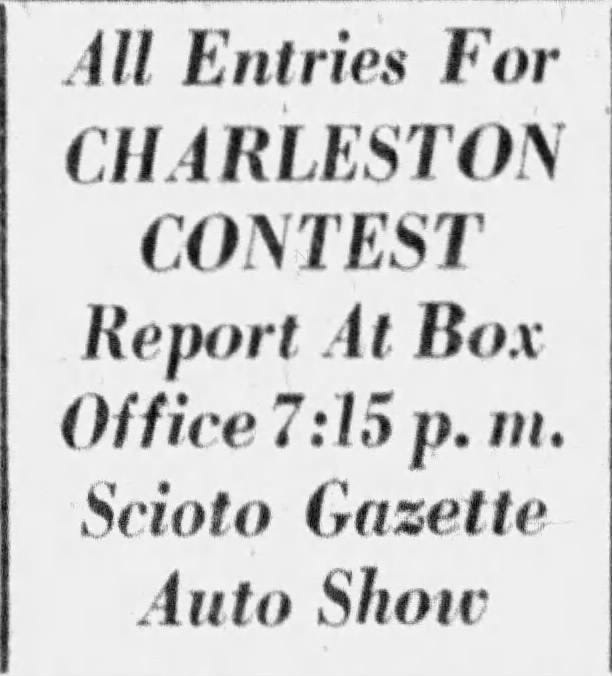
From there, attendees entered the first of three large exhibition rooms, where row after row of the show’s 55 new automobiles gleamed under the bright lights. Between the exhibits, visitors stopped at booths set up by the Ross County Automobile Club and various insurance companies, where they collected complimentary novelties. Passing through the engine room, which had been converted into an arbor for the occasion, they continued into the main exhibition hall, where an eight-piece jazz band played every afternoon and evening while Charleston dance contests and other “snappy” entertainment ensured that there was always something new to see no matter which night of the week visitors attended. An archway led to still another exhibition room featuring even more of the new automobiles and a stage that hosted a changing lineup of entertainment throughout the week.
On the final night of the show, the Gazette reported, “A crowd, said to be a record for an indoor exhibition, crowded the big building from noon until nearly midnight.” Still more people waited outside, where the line stretched “out into Second Street, almost to Hickory.” At precisely 11 p.m., the drawing for the new Chevrolet finally began.
When the winning ticket was announced, 21-year-old Walter Willis must have felt as though he was dreaming. Willis, an employee of the Union Coal Company, had just become the owner of a brand-new Chevrolet Series V Touring car. The same automobile that hundreds had admired outside Atwell Auto was now his to drive through the streets of Chillicothe.
This article originally appeared on Chillicothe Gazette: Looking Back: How a 1926 car show became a ‘fairyland’ event
Reporting by Tim Vollet, Special to the Gazette / Chillicothe Gazette
USA TODAY Network via Reuters Connect
By Tim Vollet, Special to the Gazette | USA TODAY Network