May 1 was the official dedication day for the restored West Courtroom in the Licking County Courthouse. That day has also been “Law Day” since the 1950s, so it makes sense as a time for judges, lawyers, elected officials and perhaps a few historians to come together and celebrate this central space in our county’s central structure.
In Europe, the central building of a city is usually a palace for nobility or a chief civic officer’s place of operations. They may be castles or towers, usually with a military history attached to them.

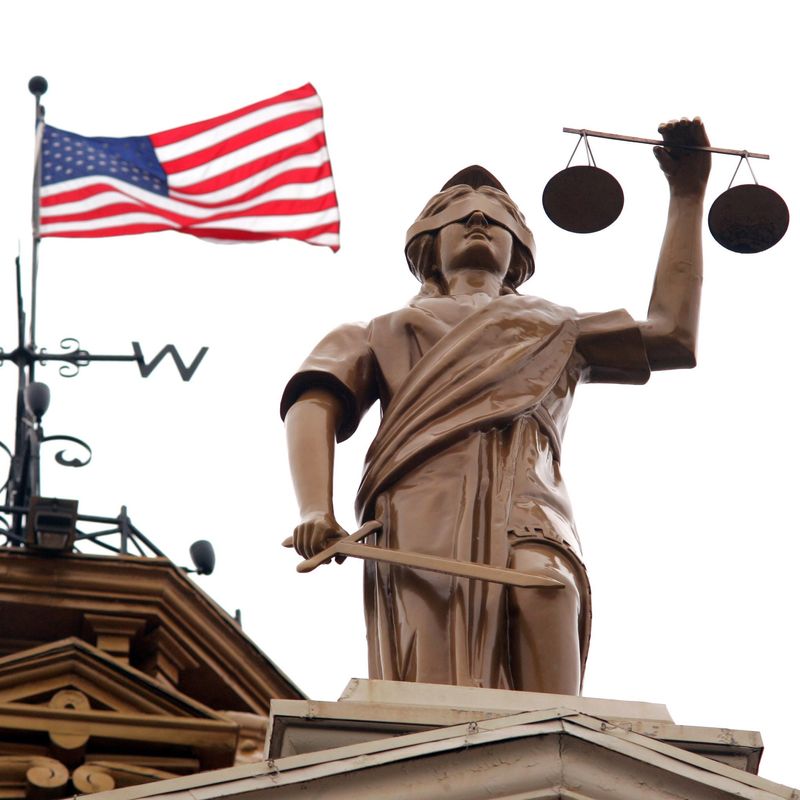
Our pattern from early on in the United States, and certainly in the Midwest, is to build our county seats around courthouses. That says something specific about how we saw our governmental organization, of laws and justice at the center, not of a central executive or even legislative location. We can take the commonality of Courthouse Squares as just how it’s always been, but there’s a particular message here: “Equal Justice Under Law,” as the Supreme Court in Washington has carved over the main door; in Newark, we have Lady Justice, blindfolded, with sword in one hand and scales in the other, to say the same thing.
A Cleveland architect, H.E. Meyer, designed our fourth courthouse in 1876, after our 1832 Greek Revival structure burned down in 1875. He laid out a Second Empire style on the exterior, then popular, echoing the transformation of Paris between 1850 and 1870 into the city we know today of broad boulevards and striking public buildings like the Paris Opera. Inside, though, his touch was light.
Our west courtroom, for some 25 years, was similar to the courtrooms on the first floor, with steel framing for flat ceilings and pressed tin panels. By 1903, there was growing interest in having a more finished main courtroom, but county finances were tight. Needed repairs on the ceilings on the second floor, however, opened up the possibility of refinement, and Nov. 9, 1903, the county commissioners’ journal records, “It was further decided by said committee to change six panels in the ceiling of Court room from steel to plastering.” They also contracted with a local firm, Pratt & Montgomery, to furnish wood finishings in the courtroom as per specifications for $623.25. This was the beginning of what would become the West Courtroom as we know it.
By March 14, 1904, though: “In the matter of remodeling the Court room / In view of the fact that the Building fund is now overdrawn, be it therefore resolved that no new contract be entered into to complete Court Room repairs, and no outstanding contracts to commence, unless in the judgment of the Commissioners such work is necessary to protect work already done, until funds are available for such work.” All three commissioners vote, “Yea.”
However, since the previous October, they had been purchasing piecemeal, on a square foot basis, round stained-glass medallions from Kyle Art Glass of Springfield. By July 1904, they installed four, and the plastered, coffered ceiling was done, but the vast expanses of walls and ceiling were largely empty, at which point the Bryant Bros. of Columbus were called.
To be continued!
Jeff Gill is a writer, storyteller, and preacher in central Ohio; he’s had fun turning the huge pages of commissioners’ journals to trace this story. Tell him what history you’re curious about at knapsack77@gmail.com, or follow @Knapsack77 on Threads or Bluesky.
This article originally appeared on Newark Advocate: Knapsack: Why our courthouses are central, practically and symbolically
Reporting by Jeff Gill / Newark Advocate
USA TODAY Network via Reuters Connect