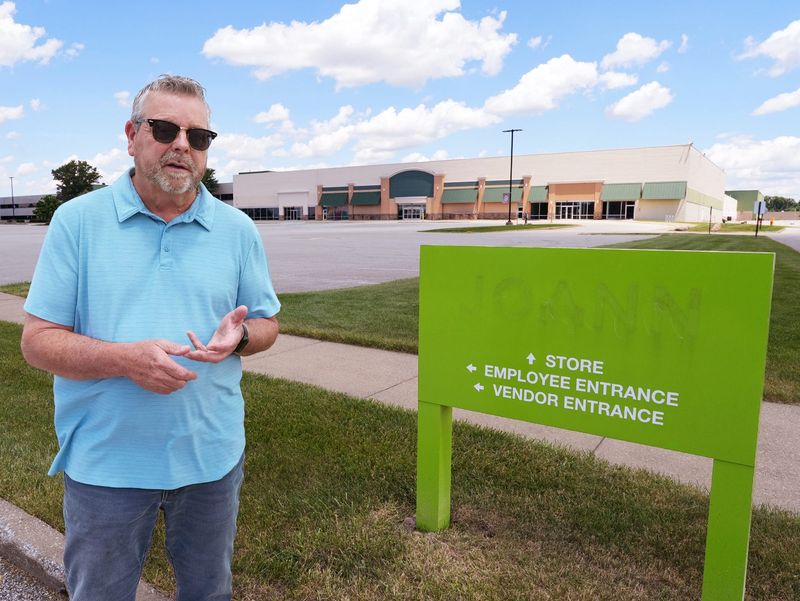
A group of Hudson residents is collecting signatures with hopes of placing a citywide referendum on the ballot concerning a new zoning district encompassing the former Joann headquarters.
Residents Philip Leiter, Todd Zedak and Mike Juppe make up the committee seeking to revise the District 11 plan. The district, created by a Hudson City Council ordinance approved last month, includes the former Joann headquarters and nearby properties.

Although Hudson City Council moved away from what Leiter called “the most contentious issues – the dense housing and the grocery store,” he said his remaining concern is that the ordinance permits a minimum-50-acre “planned development” in District 11.
Leiter said planned developments “give a lot of wiggle room” to developers to build what they want.
Debate surrounds what would constitute a new ‘planned development’
City language addressing planned developments and variances is included in Hudson’s land development code, Leiter said. The code outlines that a planned development allows “the mixing of permitted uses and/or modification or variation from otherwise applicable zone district and development standards.”
Leiter said he and other residents believe such a development in District 11 could compete with Hudson’s downtown and harm downtown retailers’ profits. He said he doesn’t oppose all planned developments, though; he cited First & Main in downtown Hudson as one he supports, in part because it complements the activity and architectural features of the rest of downtown.
“Those merchants largely are small mom-and-pop type,” Leiter said. “There are a handful of national retail, but most of it’s locally owned and operated. And those people have a hard enough time making ends meet. They just don’t need … essentially a second downtown at the southern end of town.”
Zedak called planned development “a term of art” that means “everything but the kitchen sink.”
“It’s got retail, restaurants, shopping, residential, condos, hotels – it’s its own little zone,” Zedak said.
City spokesperson Kathleen Sullivan said via email that some of these uses would not be permitted and others would be limited.
“The Land Development Code expressly prohibits a property owner or applicant from proposing a use that is not permitted within the underlying district in section 1204.03g so it would not be possible under the zoning passed for a developer to incorporate uses in a planned development that are not listed in District 11,” she said.
Sullivan said Hudson City Council changed plans for District 11 after receiving community feedback, to ensure they are more in line with the city’s comprehensive plan. She said amendments passed by Council in May removed allowances for residential housing and a grocery store of up to 40,000 square feet. The amendments also limited locations and maximum sizes for restaurant, retail and service uses.
Light industrial and commercial office uses are also included in the new District 11 zone. District 11 was previously zoned District 8 for industrial and business park uses.
Hudson City Council President Michael Bird said during the June 16 Council meeting that “… it just seems like there’s a big disconnect between what is out there and what we think is in place.”
Addressing District 11 critics, he said, “We can tell you the consequences of what would happen if that was repealed and went back to D8. I think it’s worse for you – I think you guys would think it was worse. But that would help maybe with some understanding. And then we can continue further dialogue along that line.”
At-Large Hudson City Councilwoman Amanda Weinstein said via email that she understands resident concerns about the retention of the city’s “small-town character.”
She added, “As an economist who works on local economic development, my own view is that more flexibility here, not less, is what will actually make this corridor competitive.
“Employers we want to attract to replace Joann, particularly office as well as light industry tenants, increasingly choose locations based on whether their workers have access to amenities like fast-casual food, fitness, and housing options for young professionals nearby. Communities that can’t offer that are at a real disadvantage in an increasingly competitive office market. My worry is that without more flexibility, this site risks sitting vacant for longer, which has its own costs to the tax base in Hudson (and our ability to fund local government services residents want) and to the area.”
Michele Kiernan is vice president and asset development manager at IRG Realty Advisors, an arm of Industrial Realty Group, which owns the former Joann property and seeks to bring in tenants. The site has 1.4 million square feet of vacant building space.
Kiernan said via email that increased flexibility for allowable uses at the Joann site “would provide a better environment for companies to thrive in Hudson and allow the project to grow in a way that benefits the community.”
“At the end of the day, uses that don’t fit Hudson won’t succeed here, so our focus is bringing in quality companies that will revive the site and benefit the community,” Kiernan said. “The planned development framework will involve collaboration and require public input and City Council approval. That collaboration will help us find the sweet spot; creating jobs and economic activity in a way that fits Hudson.”
What does the referendum effort entail?
The petitioners have 30 days from the passage of the May 19 District 11 ordinance to file signatures with the city, in line with the Ohio Revised Code. If they gather enough signatures, Leiter said they plan to file their petition with the city June 18; but if they don’t meet the signature requirement, they may not file the petition, he said.
For Zedak’s part, he said he would like to keep gathering signatures beyond the 30-day deadline.
Referendum committees must gather a number of signatures at or above 35% of the number of ballots cast in the city in the most recent gubernatorial election, according to the city charter, which aligns with the Ohio Revised Code.
That means the current requirement in Hudson is 4,225 signatures, Sullivan said.
Leiter said he and other residents began collecting signatures the weekend of June 6-7.
As of mid-afternoon June 16, Leiter said that he and his wife had together collected about 100 signatures and that at least a dozen other petitioners were actively gathering signatures.
Zedak said in the late afternoon June 17 that he estimated the group had collected about 500 signatures.
“It’s not a good time to gather petitions,” Leiter said. “In fact, half the people that are willing to do petitions were actually on vacation when we asked them to help us with this.”
Zedak said the District 11 topic is complicated, so numerous door-knocking efforts have resulted in the petitioners explaining the subject to fellow residents for about 10 minutes.
There are a couple of ways ordinances can be rescinded through a referendum effort, Leiter and Sullivan said.
City Council can rescind an ordinance within 30 days of the date the committee sends the petition to the clerk of council, they said.
If City Council does not rescind an ordinance within 30 days – mid-July in this case – the clerk of council determines legal sufficiency of petitions after signatures are gathered, Sullivan said. If the petition is legally sufficient, the clerk sends the petition to the Board of Elections to validate signatures and place the referendum on the ballot, she added.
“If it goes to a vote, then it’s just a simple vote of the people, up or down, in November,” Leiter said.
Patrick Williams covers growth and development for the Akron Beacon Journal. He can be reached by email at pwilliams@gannett.com or on X @pwilliamsOH. Sign up for the Beacon Journal’s business and consumer newsletter, “What’s The Deal?”
This article originally appeared on Akron Beacon Journal: Hudson group seeks to block redevelopment strategy for Joann site
Reporting by Patrick Williams, Akron Beacon Journal / Akron Beacon Journal
USA TODAY Network via Reuters Connect

By Patrick Williams, Akron Beacon Journal | USA TODAY Network