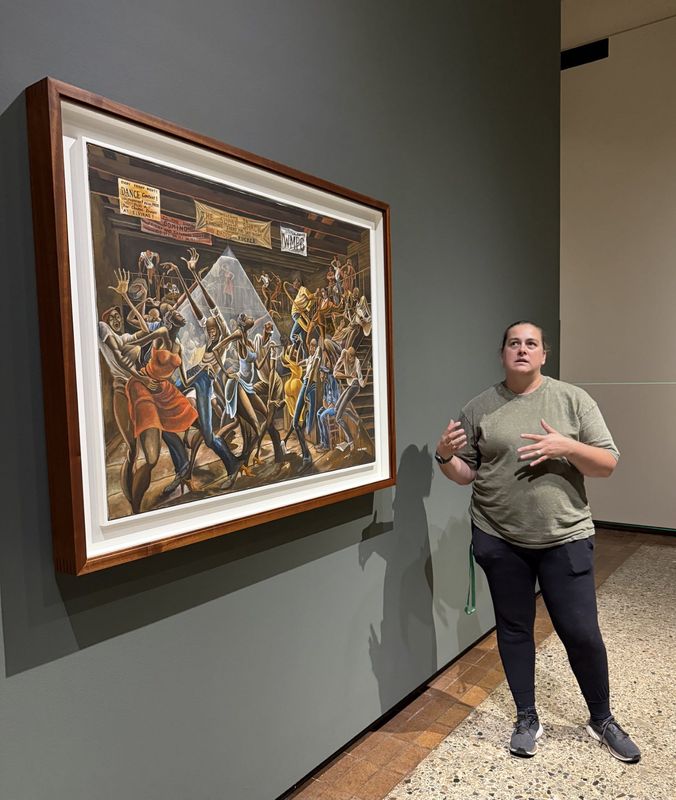
CANTON − Christy Davis stood next to the prized “Sugar Shack” painting by Ernie Barnes, marveling at the coup it was for the Canton Museum of Art to be housing it temporarily.
“If you’re not familiar with Ernie Barnes, you’re really missing out,” the museum’s curator said inside the main gallery. “I had the privilege of curating an exhibit of his artwork in 2014 at the Pro Football Hall of Fame, so this has really been a work in motion ever since I started here at (the Canton Museum of Art), and it feels great to not only have it here but on the 50th anniversary of ‘Sugar Shack’ being featured on (the TV show) ‘Good Times.’

“We have all these pieces in this room and all this energy. This whole space … has kind of that ‘Sugar Shack’ vibe surrounding the actual piece with pool players and dancers and air guitarists, and we’re going to have a little bit of everything. His football art is also featured. It’s definitely a can’t miss exhibit and I’m so excited we can have it here.”
“Good Times: The Artistic Journey of Ernie Barnes” will open at the museum Aug. 18 and continue through Nov. 1. An opening reception will be 5 to 7:30 p.m. Aug. 21.
‘For many, it’s a Mona Lisa.’
The late Barnes is an artist whose excellence of work permeated pop culture.
He was a former professional football player whose juke joint, segregation-era dance scene painting “The Sugar Shack” is renowned, with the original version owned by actor and comedian Eddie Murphy. The painting was adapted for the cover of Marvin Gaye’s 1976 album, “I Want You.”
The painting was inspired by what Barnes witnessed in his youth at the Durham Armory in Durham, North Carolina.
The Canton Museum of Art is displaying the second version, which was featured in the opening and closing credits of ‘Good Times.'”
Max Barton II, the museum’s director and CEO, said the piece is among the most famous American paintings.
“For many, it’s a Mona Lisa,” he said. “It’s inspirational. I think his work speaks to everybody no matter what color you are; it doesn’t matter where you’re from.”
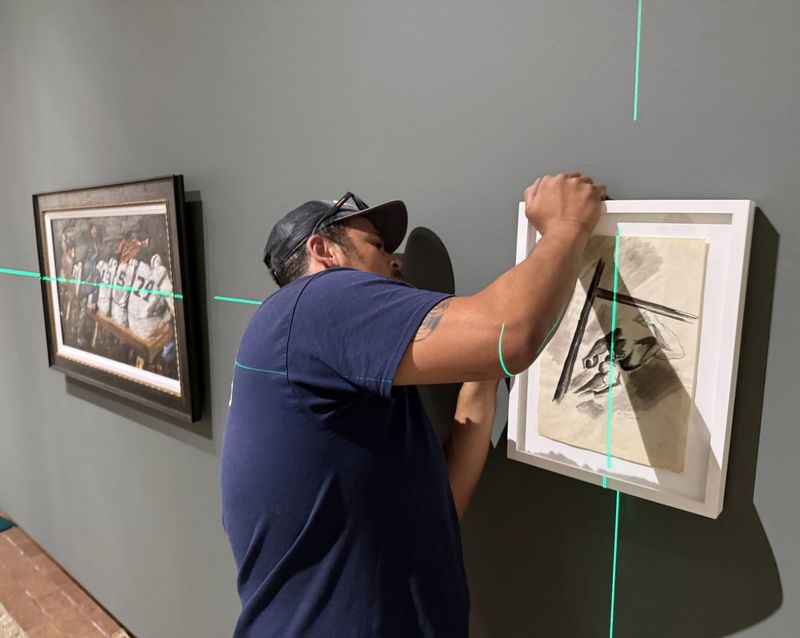
Barnes’ work is shown and collected internationally. The roughly 40 pieces for the local exhibition are on loan from museums, galleries and private collections from across the country. There are sketches, preliminary drawings and finished paintings.
“I also consider Ernie Barnes to be a celebration of America 250 stories that are not told or under told,” Barton said of the country’s 250th birthday this year.
The exhibition is also timed with the Black College Football Hall of Fame Classic Weekend in Canton, which starts Aug. 22 with The Classic Kickoff 6K and continues into September, with a variety of events, including a college fair, the Habitat for Humanity Day of Service, a battle of marching bands, gospel concert and the Clash at the Classic football game as the Albany State Golden Rams face the Johnson C. Smith Golden Bulls at 4 p.m. Sept. 6.
Barnes was the official artist for the 1984 Olympics
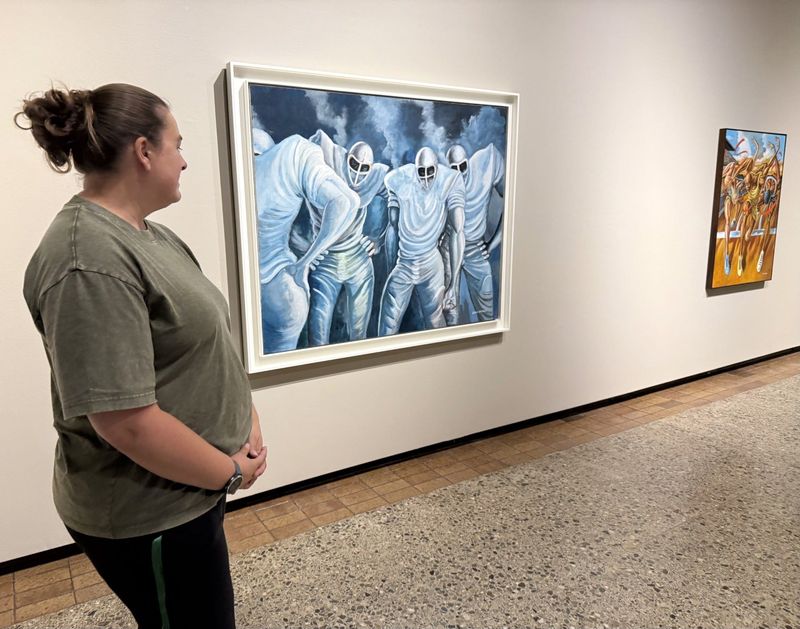
Works often depicted scenes of Black joy and dignity with elongated human figures embodying motion and energy.
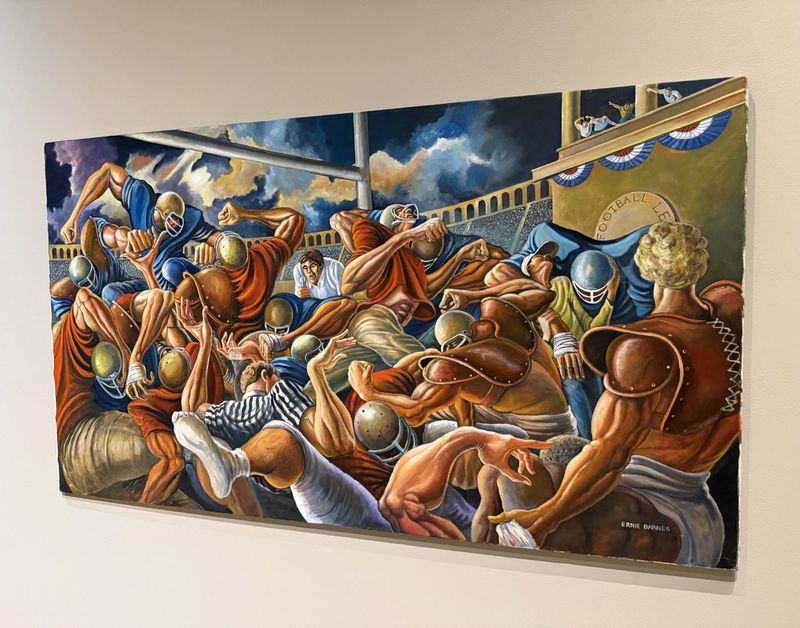
Other art portrayed football players and the brutality of the sport, born of Barnes’ time as an offensive lineman for six seasons in the 1960s in the AFL and NFL for the Baltimore Colts, San Diego Chargers, Denver Broncos and New York Titans.
A leading figure in the Neo-Mannerist movement, Barnes’ artwork overshadowed his football career. The style traces to 16th century master painters Michelangelo and Raphael.
“Ernie Barnes never really planned on playing football,” said Davis, the art museum’s curator of exhibitions. “It was in high school when the coach came and approached his mom and then he kind of happened into football. And he was always at his roots an artist.”
“You could see movement in all of his work,” she added. “And he intentionally painted any figure with their eyes closed because of the spirituality of everything.”
Barnes was also the official sports artist for the 1984 Olympics. He died in 2009 at age 70.
Football-themed artwork
Emotions resonate profoundly in his paintings.
“Dreams, joy, struggle, resilience … these are themes that come to mind when one views the art of Ernie Barnes,” Barton said. “From star high school football player to the NFL, he never let the game interfere with his love for art.”
“All his life, Barnes said he hated the violence and the physical torment of the sport,” Barton said. “However, his years as an athlete gave him unique observations that imbued his artistic style − power, motion and physical vitality but also storytelling that illuminated and celebrated Black culture, pride and achievement at all levels.”
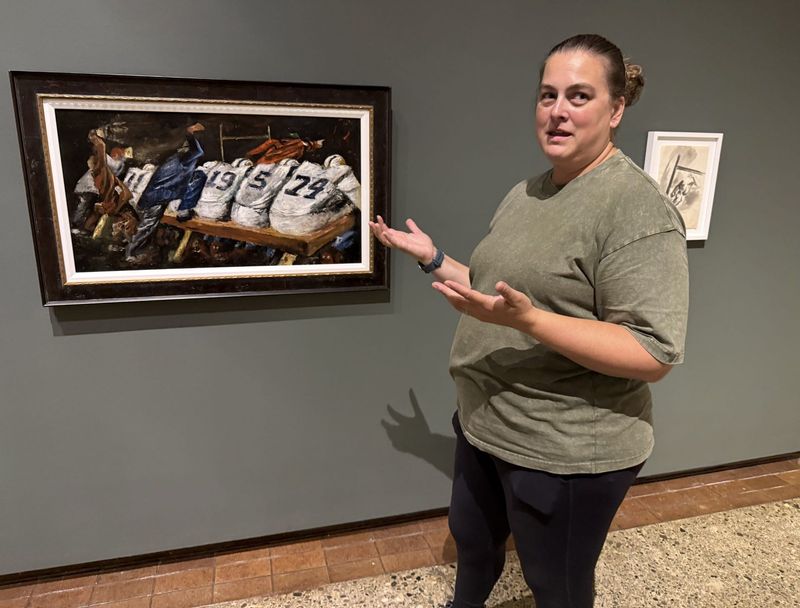
Football-themed pieces include “The Bench,” on loan from the Pro Football Hall of Fame in Canton.
“This was his first foray into professional football,” Davis said. “He came home from seeing the ’58 championship game, (featuring the) Baltimore Colts, and immediately was so moved he got up, got a blank canvas and started furiously working. This is one of the rare paintings that he actually painted without doing a preliminary sketch first; it was straight paint to canvas, and he painted what he saw from behind the bench.”
“And this was a painting that he kept in his possession all his life,” she explained. “He took it with him to training camp. He had the painting under one arm, the suitcase in the other. He wasn’t too concerned with the fact it made him look less masculine to have a painting with him, and he was offered $25,000 for this painting and refused it.”
‘So much energy and joy.’
Beyond sports, Barnes’ paintings of the Black experience in the rural South are captivating, influenced by the artist growing up in North Carolina, Barton said.
Paintings capture the soul and spirit of the time while transforming struggles and adversity into beautiful art, he observed.
“‘The Sugar Shack’ has so much energy and joy,” Barton said. “And it’s so engaging.”
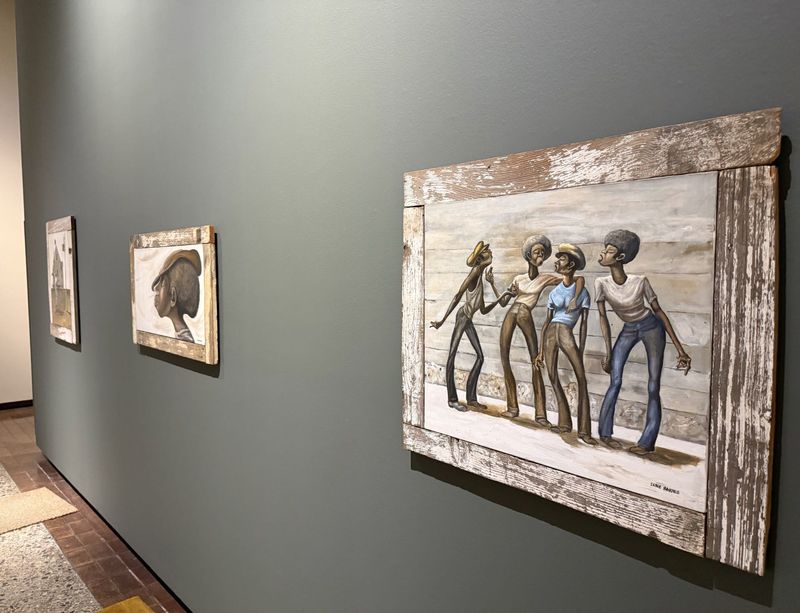
Barnes’ Southern roots are reflected in much of his artistry, including in the pieces exhibited in his first solo exhibition at age 28, Davis explained.
“His father suffered a stroke … so he went to North Carolina and painted a little bit each day in preparation for the show,” she said. “And he didn’t have time to frame them. He actually used the fence post from his father’s white picket fence, and that’s what you see on some of those pieces, so there’s a truly a story in all (of his artwork).”
‘His work is meant to be everywhere.’
Barnes’ artwork is “highly approachable,” Barton said.
Although some of his pieces are highly valued monetarily, Barnes also made artwork affordable for residents of the South.
“Barnes’ art was something they could see in their own house,” Barton said. “It wasn’t like buying a Monet.”
Barnes’ association with the hit TV show of the ’70s, “Good Times,” also expanded the reach of his art.
“It’s recognizable,” Barton said. “It’s there for everybody. I think it sends different messages to everybody. His work is meant to be everywhere.”
Reach Ed at ed.balint@cantonrep.com and 330-580-8315. Follow on Instagram at ed_balint.
If you go
What − “Good Times: The Artistic Journey of Ernie Barnes”
Where − Canton Museum of Art, 1001 Market Ave. N
When − The exhibition opens Aug. 18 and runs through Nov. 1
Opening reception − 5 to 7:30 p.m. Aug. 21 at the museum. The event is free and open to the public. The EN-RICH-MENT drumline and Dave Marchione Jazz Quartet will perform.
Tickets − Admission during regular museum hours costs $8 for adults; $6 for those older than 60; and children 12 and under are admitted free. Admission is free every Thursday through a sponsorship from the PNC Foundation, and on the first Friday of each month as part of the downtown Canton event.
Hours − The museum is closed Monday and open 10 a.m. to 8 p.m. Tuesday through Thursday; 10 a.m. to 5 p.m. Friday and Saturday; and 1 to 5 p.m. Sunday.
This article originally appeared on The Repository: From ‘Good Times’ to Marvin Gaye. Canton art museum opens exhibition
Reporting by Ed Balint, Canton Repository / The Repository
USA TODAY Network via Reuters Connect
By Ed Balint, Canton Repository | USA TODAY Network