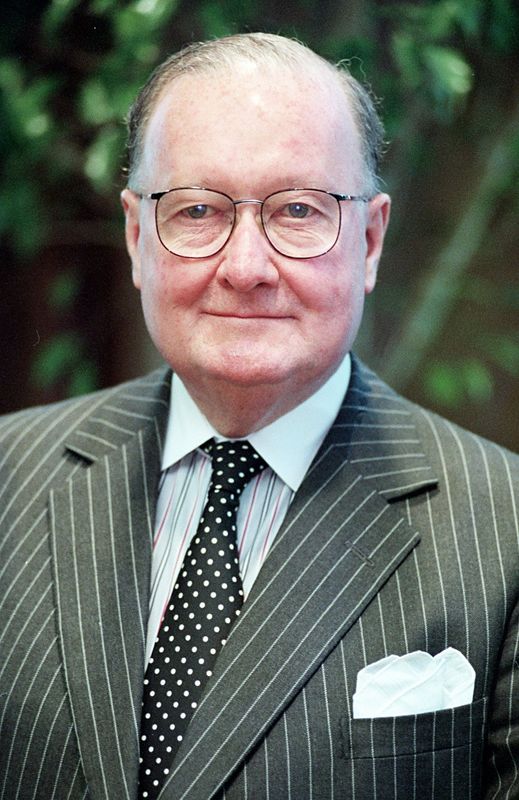
Businessman, philanthropist and civic leader John D. Ong, the former chairman and chief executive officer of B.F. Goodrich Co. in Akron and the former U.S. ambassador to Norway, died June 4 at age 92.
He had been hospitalized for kidney failure.

“There is more to say, and I will eventually say it, about this remarkable person, but in the meantime may the chorus of angels receive him and may he have everlasting rest,” son John Ong posted on Facebook.
Ong joined Goodrich in 1961 and held a variety of positions during his 36-year tenure at the Akron company that Dr. Benjamin F. Goodrich founded in 1870.
He was elected president in 1975 and chief executive officer in 1979, serving as chairman and CEO until 1996.
Ong transformed Goodrich, taking it out of the tire and polyvinyl chloride business and moving it into aerospace and specialty chemicals.
As Akron rubber plants began to shut down in the 1970s and 1980s, Ong addressed public apprehension.
“People here do have concerns and fears about the future,” he told the Beacon Journal in 1982. “But they are mostly based on a faulty appreciation of history and, by extrapolation, a faulty view of future events.”
The industry needed to create an atmosphere that would bring in entrepreneurs in new technologies, he said.
“And it would be smarter to look at the technologies just down the road, those that are just coming into prominence,” he said.
He was stunned when his successor relocated Goodrich’s corporate headquarters out of Ohio in 1997.
Early life of John Ong
John Doyle Ong, the son of Louis and Mary Ellen Ong, was born Sept. 29, 1933, in Uhrichsville. He received a public education and graduated from Uhrichsville High School in 1951.
Ong graduated from Ohio State with bachelor of arts and master of arts degrees in 1954. He received a law degree from Harvard University Law School in 1957.
He married Ohio State graduate Mary Lee Schupp, a teacher from Dennison, on July 20, 1957, and served four years in the U.S. Army.
Ong moved to Akron in 1961 after accepting a position at Goodrich. He and his wife raised their three children in Hudson.
At its peak in 1950, B.F. Goodrich employed 14,700 production workers in Akron. The company reduced its workforce over the next 25 years until there were around 6,500 workers by 1975.
Ong served as group vice president, executive vice president and vice chairman before being elected president.
As chairman, Ong was recognized as the executive who led Goodrich out of its core business of tires, downsizing the company so it could prosper.
Like it or not, Goodrich was part of a global economy, he noted.
“We must strive to compete in the markets we serve and many will be outside the U.S.,” he noted.
Transformation at B.F. Goodrich
Ong moved the company’s headquarters in 1986 from downtown Akron to Bath Township and then to Richfield.
In 1987, Goodrich announced it would stop making tires in Akron, laying off 790 workers, closing three manufacturing divisions and transferring work to nonunion plants in North Carolina and Florida.
The restructuring led to the 1993 spinoff of Geon Co., its PVC business. The company used the $650 million generated by the deal to buy aerospace companies and small specialty chemical firms.
Goodrich made such products as landing gears, wheels and brakes for Boeing aircraft; sensors that measured fuel for McDonnell Douglas jets; a special plastic used to make roller blades; and additives that kept the hydrogen peroxide and baking soda uniformly dispersed in toothpaste.
Ong retired as chairman July 1, 1997, at age 63.
A year later, his successor, David L. Burner, announced that B.F. Goodrich would relocate to North Carolina after purchasing Coltec Industries, a Charlotte manufacturer of aircraft and industrial parts.
Ong was highly critical of the move, calling it “not necessary” and of “no financial benefits” to B.F. Goodrich shareholders.
“I very much regret the losses this move will cause to our community, and to the many loyal and long-service employees who will lose their jobs,” Ong said in 1998. “I’m still intensely loyal to the company. It was a big part of my life and almost all of my career. I just dislike to see people treated this way.”
Leader on global stage
Ong was a respected leader on the national and international stages.
President Ronald Reagan appointed him in 1983 to the President’s Commission on Industrial Competitiveness, where he served as co-chair of the international chair committee and retired as chairman in 1997.
In 2001, President George W. Bush nominated Ong as a lead U.S. envoy to Scandinavia.
“John has a long and distinguished record as a leader in the business world and in his community,” Bush said. “His commitment to public service makes him an excellent choice to serve the United States as ambassador to Norway.”
Receiving bipartisan support in the U.S. Senate, Ong won a unanimous confirmation vote in 2002 and served his post until 2005. The ambassador praised Norway as “one of the most staunch, dependable allies we have in the world.”
Ong was a major contributor to Republican causes and campaigns, and proudly identified himself as a conservative.
“A conservative is somebody who understands that things have to change, that change is inevitable, that we live in a dynamic world, but who wants to change things in such a way as to preserve as many of the values of the past as possible,” he explained.
Other achievements
In 1995, the Akron Community Foundation awarded Ong the Bert A. Polsky Humanitarian Award for outstanding commitment to community service.
“I’m very pleased because it is the one award in town where you’re selected by your peers — people who have been selected in the past,” Ong said. “And I’ve known most of them.”
Sometimes being a civic promoter can be frustrating and unpleasant, Ong told the audience at the ceremony, but America’s way of life is worth preserving, he said.
He urged others “to improve on and do more than I have done because the rewards are great; they come in many strange and indirect ways.”
Ong served as a trustee at Ohio State University, Kent State University, the University of Chicago and Hudson’s Western Reserve Academy, which named its library for him.
He also was a trustee at the John S. and James L. Knight Foundation and the National Inventors Hall of Fame. He led the effort to fund and build Inventure Place.
Ong served as chairman at the Business Roundtable, the National Alliance of Business and the Ohio Business Roundtable and led Akron Community Trusts, the predecessor of Akron Community Foundation.
He also maintained leadership roles at Blossom Music Center, United Way of Summit County, Boys Hope of Northeast Ohio, Hudson Library and Historical Society, Akron Regional Development Board, Akron Development Corp., Bluecoats Inc. and the Musical Arts Association of Cleveland.
Ong was preceded in death by his wife, Mary Lee Ong, who passed away July 24, 2019, at age 84. They were married for 62 years.
Survivors include sons John F.H. Ong and Richard P.B. “Diccon” Ong, daughter M. Katherine C. “Katie” Ong and grandchildren Sophia H. Ong, J. Finley Ong, Simon L. Ong, Elliot O. Ong, F. Henry Ong and Matthew L. Landini.
Mark J. Price can be reached at mprice@thebeaconjournal.com
This article originally appeared on Akron Beacon Journal: Former B.F. Goodrich CEO and U.S. Ambassador John D. Ong dies at 92
Reporting by Mark J. Price, Akron Beacon Journal / Akron Beacon Journal
USA TODAY Network via Reuters Connect
By Mark J. Price, Akron Beacon Journal | USA TODAY Network