If kids learned about radon in science class, their teachers would tell them there’s wide agreement on what the radioactive gas is, how it gets into buildings and the harm it can do to someone’s health.
The consensus in the scientific community is clear: Radon is dangerous stuff.

But that simple science lesson is not guiding policy for many Ohio school districts, or for the local and state officials who oversee them.
Instead, despite years of research and government recommendations, Ohio schools operate under a patchwork of testing and mitigation policies that may be putting thousands of students at risk of serious illness.
An investigation by The Columbus Dispatch and The Enquirer found that whether a student is inhaling radon in the classroom is a matter of miles, school funding and district priorities.
Some districts test regularly and extensively. Some test occasionally, or when an HVAC system is replaced. Some test only ground-level or basement rooms because those are at highest risk for radon contamination.
And many don’t test at all.
“This could really be a terrible thing,” said Stuart Lieberman, a New Jersey-based environmental attorney. “Young children are not just small people. Their bodies react differently to toxins and so it’s very important to test schools.”
When The Enquirer asked Greater Cincinnati’s 12 largest school districts about their radon policies, two districts, Fairfield and Sycamore, said they had tested for radon in their schools within the past three years.
Five others said they don’t test: Oak Hills, Mason, Princeton, Milford and Northwest. Three did not answer the question: Lakota, Forest Hills and Hamilton City Schools.
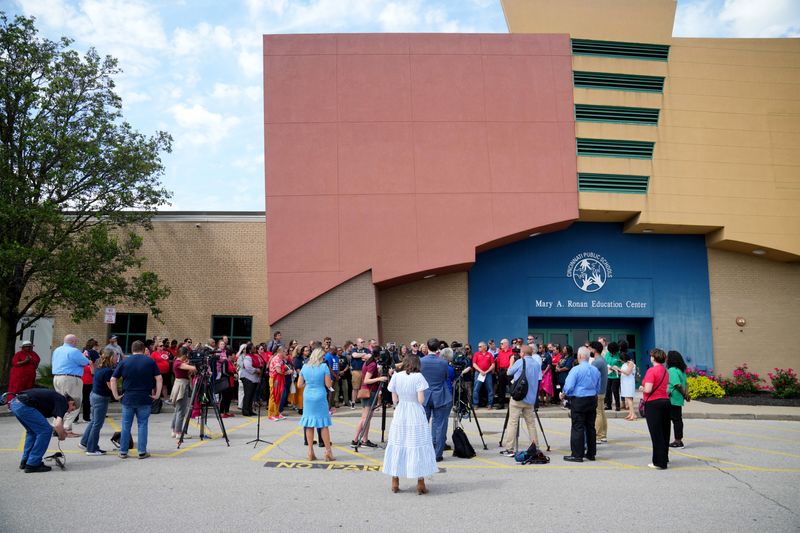
The region’s largest school district, Cincinnati Public Schools, has not tested since 2010, though a district spokesman said testing will resume next summer. And West Clermont district officials said they also are considering testing buildings in 2026.
The largest district in northern Ohio, the Cleveland Metropolitan School District, began radon testing in 2024. The largest district in the state, Columbus City Schools, does not regularly test.
Why so much variation, both here and across the state?
Because no Ohio law requires schools to test. And that, in turn, leaves the decision to individual districts, where tight budgets and other priorities often make radon testing an afterthought.
Several districts cited the lack of a state law or limited resources in their response to the question about testing.
Milford Exempted Village School District spokesperson Parker Brown explained the decision not to test by saying the district “follows all environmental health and safety regulations required by the State of Ohio.”
In Mason, where school buildings also are not tested, spokesperson Tracey Carson said the operations team “evaluates and prioritizes preventative maintenance projects and environmental testing based on state requirements, safety considerations, and available resources.”
And in Cincinnati, CPS spokesperson Joe Wessels said “budget restraints” and a focus on the response to the COVID-19 pandemic are to blame for the district’s decision not to test until next year.
It’s ‘critical to get all schools to test’
Most states follow a model similar to Ohio’s, leaving the decision with local school districts. But 11 states now require radon testing in schools, including West Virginia and Iowa in the Midwest, where radon levels tend to be higher than many other parts of the country.
The argument for testing is a simple one. Radon is an odorless, colorless gas that has been linked to leukemia and is considered the second-leading cause of lung cancer after smoking.
Researchers say children are especially vulnerable because their bodies are developing and are less able to tolerate radon exposure.
“It speaks to the lack of awareness of radon as a serious health issue,” said Matthew Bozigar, an environmental epidemiologist at Oregon State University who led a study that found a link between leukemia and radon. “Children’s health is so much more sensitive to radiation.”
That’s why he said it’s “critical to get all schools to test.”
Testing for radon in schools is simply “good public policy” and something that should be done to promote “the greater good” of children, said David Hill, president of the nonprofit Indoor Environments Association.
No district, Hill said, would leave its students exposed to other dangers, such as lead in drinking water, mold or asbestos.
“Every one of those except radon is going to be taken care of,” Hill said. “We don’t want them exposed to solid things like asbestos, lead and mold, but radioactive air is perfectly fine.”
In September, an elementary in Solon, Ohio, was closed for several days to remediate after testing found high levels of asbestos in the building. And when it comes to asbestos, both state and federal law set standards for identifying and removing or managing the toxic substance.
Ohio lawmakers pass on chance to mandate testing
Ohio lawmakers have been resistant to mandating radon testing. Just this year, Ohio lawmakers declined to act on a request for $15 million to help test schools for radon.
A year earlier, however, legislators approved more than $430,000 to abate radon, asbestos and other toxic substances in state buildings where they work.
The state does recommend testing, especially in basement or ground-floor classrooms, or in buildings with a history of high radon levels. But with no requirements, penalties or funding to go along with that recommendation, schools often don’t follow the advice.
In Reynoldsburg, for example, radon testing in schools was put on hold after a levy failed despite previous testing that found high levels of the gas requiring mitigation, a spokesperson said.
And at Columbus City Schools, a spokesperson said the district had not conducted widespread radon testing in 35 years because its schools are well-ventilated. But documents obtained through a public records request showed Beck Street Elementary tested high for radon in 2016 before it was taken over by South Columbus Preparatory Academy in 2020.
The testing that schools do conduct shows why scientists believe regular testing is necessary. Results vary from district to district, from school to school and even from classroom to classroom.
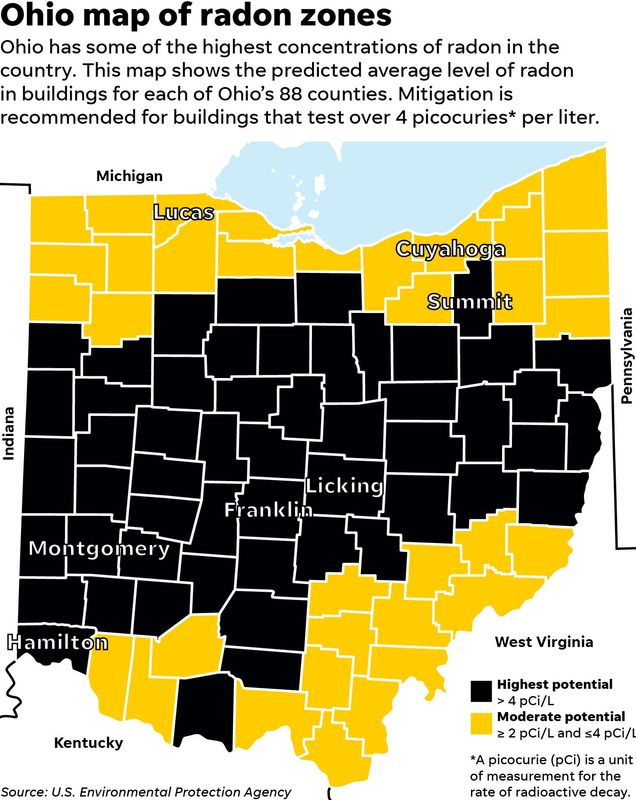
Sycamore school officials said their last round of testing in 2022 found no radon levels higher than 4 picocuries per liter, the level at which the U.S. Environmental Protection Agency recommends mitigation.
Fairfield school officials, who said they conducted 786 tests in the past year, found 14 areas above 4 picocuries, three of which were above 6 picocuries.
The school district performed mitigation work, which, as in private homes and businesses, can include improved ventilation systems and units that actively remove radon gas from the environment.
The price tag wasn’t high. The cost of bringing all 14 areas of concern in Fairfield schools back to acceptable levels was $2,000.
Until testing is more widely performed in schools, an untold number of Ohio children may be breathing in toxic air every weekday. Like testing in homes, Hill said, one school may test high for radon and another might not have much of the gas at all.
A classroom in Massachusetts, where Hill said testing is mandated, tested at more than 1,000 picocuries per liter. That’s 250-times EPA’s recommended remediation level of 4 picocuries per liter.
The risk of such an exposure is exactly why every district should test every five years at a minimum as state guidelines suggest, said Dr. David Carbone, an oncologist at Ohio State University’s James Cancer Hospital.
“The big unknown is exposure in schools,” Carbone said. “People spend a lot of their lives at work or at school and many of those locations are not tested at all.”
A cancer diagnosis leads to unanswered questions
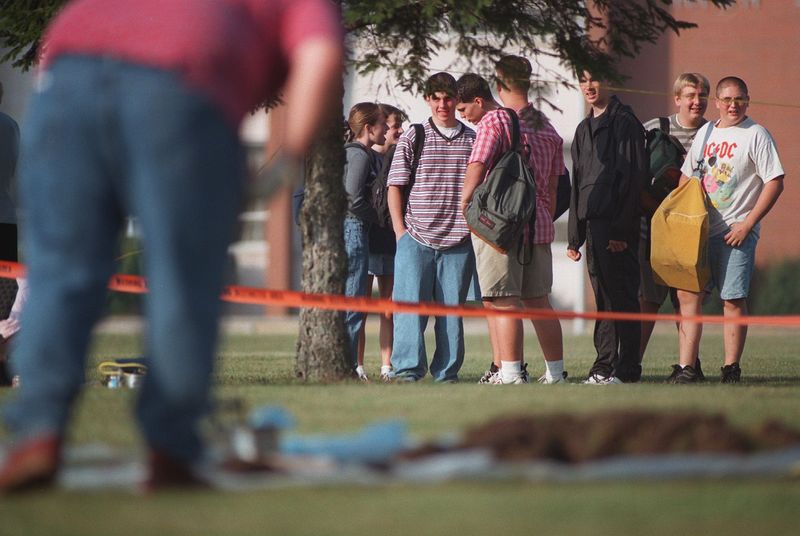
Kim Tolnar has lived with that uncertainty for decades. A 1983 graduate of the original River Valley High School in Marion in northern Ohio, Tolnar spent years searching for an explanation for her cancer diagnosis 10 years after graduating high school.
Now, more than 30 years later, Tolnar may finally have an answer: radon.
“There’s no question in my mind,” Tolnar said. “We were exposed to something that ultimately gave us cancer.”
Tolnar, now 60, was diagnosed with chronic myelogenous leukemia in the early 1990s. So, too, were at least nine other students or graduates.
At the time, many questioned whether radon or a former military depot at the site of the high school and middle school was the culprit.
At least four schools tested positive for high levels of the gas, including Tolnar’s elementary school and the high school she attended. The highest levels found in one of the Marion schools was 23.9 picocuries per liter, or nearly six times the EPA’s remediation level of 4.
At the time, just one 1990 study had linked radon to leukemia in Great Britain. Since then, the Oregon State study led by Bozigar found a connection between leukemia and radon, even in areas where radon levels were lower than what the EPA recommends for mitigation.
“No matter how we looked at it, there seemed to be a persistent association,” Bozigar said.
In Marion, no conclusive cause – be it the radon or the military depot – was ever provided for the leukemia cases. Tolnar’s high school was closed in 2003 and moved to a new location after the federal government agreed to pay $15 million toward a new $43 million campus.
Leukemia deaths in Marion increased 122% between 1966 and 1995, according to one study by the Ohio Department of Health.
When Tolnar was growing up, she said she loved going to school. Looking back on it now, her feelings have soured and she wishes more had been done to make sure classrooms in Marion were safe.
After Tolnar was diagnosed with leukemia, she was forced to uproot her life and move to a Seattle hospital where she spent more than a year fighting off the disease. She underwent a bone marrow transplant and lost her hair.
Though decades have now passed, Tolnar still feels everything her cancer has stolen from her.
Her leukemia struck the year after she and her husband married, cutting short their honeymoon period. Radiation used to treat her cancer prevented her from ever having kids. And she had to get both of her hips and knees replaced because the cancer and treatment for it wore them down.
Tolnar said school districts should do anything they can to make sure what happened in Marion never happens again.
And if districts are unwilling to shell out the necessary funds to test their buildings for radon, Tolnar said students and their families will suffer.
“We’re exposed to things and we have no idea.” she said. “You may pay the price for it later.”
This article originally appeared on Cincinnati Enquirer: Few southwest Ohio schools test for deadly radon gas. State law doesn’t require it
Reporting by Max Filby and Dan Horn, Cincinnati Enquirer / Cincinnati Enquirer
USA TODAY Network via Reuters Connect