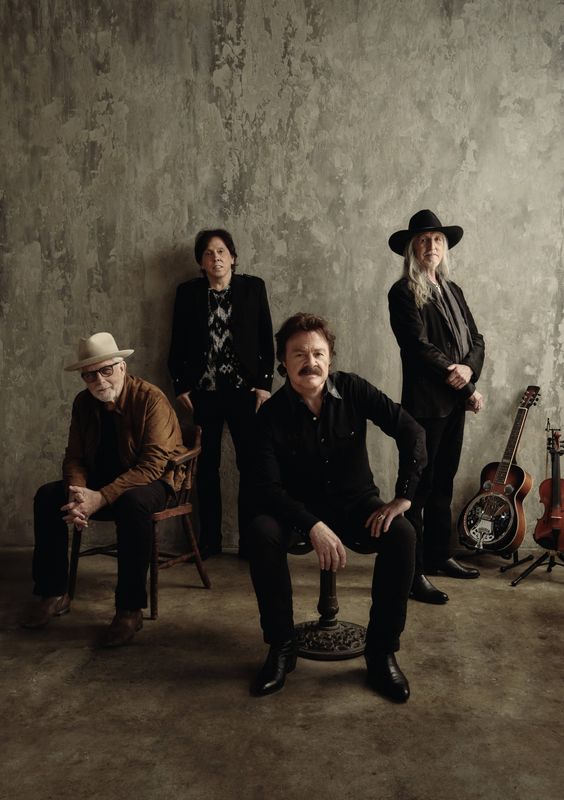
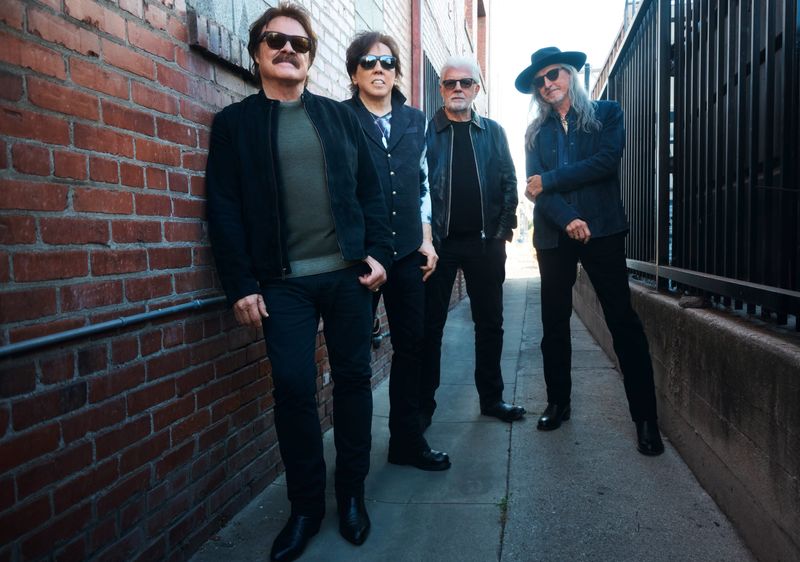
After more than five decades, a legendary classic rock band is still encouraging fans to “Listen to the Music.”
Grammy-winning and platinum-selling soft rock band The Doobie Brothers perform at Riverbend Music Center on Sept. 12 as part of its Walk This Road tour, which supports its newly released album of the same name.

According to the venue’s website, the 2025 tour features members Patrick Simmons, Tom Johnston, John McFee and Michael McDonald, who all recently reunited in 2021 for a 50th anniversary tour.
Four years later, the Rock & Roll Hall of Fame inducteees have returned to center stage to share music from their first new album in over 40 years.
The Enquirer sat down with guitarist, vocalist and songwriter Tom Johnston to discuss the 2025 Walk This Road tour and album, and what keeps The Doobie Brothers going after all these years.
These excerpts have been edited for length and clarity.
Q: What can readers expect from your Walk This Road tour and upcoming Cincinnati show?
Johnston: Just knocking the edges off and seeing how this set list works because we’re doing something kind of unknown for us. And that is doing four songs off a new album in a set. We don’t ever do that. Maybe one, maybe two, or usually one and maybe two, never four.
And I have to say the people have been great. They’re responding to all four tracks, which took me by surprise, pretty amazing. So over the pond, it worked great. I think it’ll do the same here.
We’re doing “Walk This Road,” the song. We’re doing “Learn to Let Go,” we’re doing “Call Me” and we’re doing “Angels and Mercy,” and the crowd loves them all, which is great. And we’ll have that surrounded by tracks people are more familiar with. The reason I’m excited about that is because that means somebody’s actually listening to the album.
Q: “Walk This Road” is the first studio album by The Doobie Brothers featuring yourself, Patrick Simmons, John McFee and Michael McDonald. What was the process of creating this project?
Johnston: We did the album with John Shanks, who co-wrote all the songs. He’s a producer. He’s had quite a bit of success. We worked with him on the album previous to this, where we didn’t have Mike, and that was the first time I’d ever worked with him.
It came out really well. Mike did this album with us, the current one, and that’s the first time I’ve really done an album with Mike, per se. I had a song on “Takin’ It to the Streets,” but I really wasn’t there a lot.
And another thing about this way of writing I should also say is that you’re the only guy there, whoever it is, Mike, Pat, me. Whoever is there, is working with John one-on-one. That’s how the songs get laid down. Then everybody comes in later to do either backgrounds or instrumentation, whatever that might be. It’s a different way of working. It really is. It’s pretty cool. I enjoyed it. I think everybody did.
Q: Is the outcome what you expected?
Johnston: I don’t think anybody knew what to expect, because you’re writing in the manner I just described, which is you’re on your own while you’re doing it. It’s not like all the previous albums we’ve done, where you come in as a band. You invade the studio and you’re all there.
It’s a very different style from that.
The way it came out, to me, is you got three distinct writing styles. Mike’s definitely got his own thing, his own voice and everything. Pat, same, and same for me. It’s just a matter of fitting those songs together, like in sequence, for instance, where they are in the album, to make sense of the whole thing.
John did a really good job of that. A lot of good ideas for writing. Also, he is a studio-quality guitar player, and he comes up with a lot of great parts for songs. So all in all, it’s a very positive way to do it. I’m glad people are really thrilled with the album. We didn’t know what to expect. We had no idea. It was more of an experiment. We were just going to do three or four songs and just see how it sounded. We kept writing and kept writing and pretty soon, (we said), “We might as well do it now. We got enough songs.” So, we did that.
Q: In addition to your recent album, you’ve also written some of the band’s most iconic hits. What is your creative process when it comes to writing music?
Johnston: It’s kind of a mood you get in, for lack of a better way to put it. Just you and the guitar or keyboards, whatever. You have an idea, and you sit down and start noodling with it.
Even when I wrote “Listen to Music,” … that was just me and a guitar in my room on 12th Street in San Jose.
We were in the middle of the Vietnam War at that point. I said, “It’d be really great if the people who are running this whole nightmare could use music instead of words because the other stuff isn’t working.” So, maybe if they listen to music, smoked a fat one or something, I don’t know.
Instead of doing it the other way, perhaps we’d have a much more positive outcome on this situation. That was kind of the way I was thinking.
Q: What are some of your biggest musical inspirations? How have they shaped your sound?
Johnston: When I started playing guitar at the ripe old age of 12, I listened to a lot of Little Richard, Jimmy Reed, B.B. King. Later on, Freddie (King) and Albert King was a big influence. Chuck Berry. Elvis Presley for a minute. Not a lot, but for a minute. I just kept going in that direction.
Blues was a huge part of my background, which is not unusual. It’s real. It’s earthy. It’s all about real life, and I think that’s one of the reasons it appealed to me. But also the styling of it. And R&B, the same thing, everybody from Otis Redding to James Brown.
I went and saw James Brown live when I was 14 years old. I think I was 14 or 15. I was a freshman in high school. That was a life-altering moment. I’d never seen anything like that. I’d never heard anybody play like that. I was just blown away at the energy expended on the stage. It was unreal.
So, I kept going with those influences throughout life. I’ve had a lot of others, a lot of jazz cats. Even (went) off into Bob Dylan and other people. I’ve gone in a lot of different directions, folk blues. But that’s how I came up.
Q: How do you think your perspective as an artist has changed over all these years? Do you think the subject matter of your songs has changed at all?
Johnston: I think it changes in as much as you’re reflective of what’s going on around you. But to a certain point, you’re still writing from where you’ve kind of always come from musically. I come from a strong blues, rock and roll and R&B background, so it’s still in play.
Q: For more than five decades, you’ve witnessed the music industry change in numerous ways. How do you adapt to those changes while staying true to your core identity as an artist and as a band?
Johnston: As long as you’re a writer, you’re always gonna be yourself. That’s never gonna change. Say what you want, but you’re still coming from wherever you were a long time ago. Not necessarily the song itself, but just where you were coming from when you first started this.
Yeah, you change with the times. Yeah, there (are) a lot of things influencing the way you think —the news that’s going on, musically that’s going on. But I’m still that guy that I was, (in the) early ’70s writing and stuff, maybe even the ’60s when I was a kid. What you learn is how to use the studio. I’d say that to the band as well, how to use (the studio) to your advantage and how to change the way songs are treated.
The music business has changed so much. It’s incredible. With the advent of streaming, but also the styles of music that people are using. It’s interesting. It keeps you on your toes as far as writing and the rest of it.
Q: You’ve also faced a lot of challenges as a band, including the deaths of a few group members. You also had your Las Vegas residency halted due to the COVID-19 pandemic. What do you think keeps the band connected and going strong despite these obstacles?
Johnston: We’ve been really lucky having people come in to replace members that were really solidly a part of the band. Some of that affected everybody deeply. I mean, different guys affected different people in the band. Keith Knudsen comes to mind. That tore me up when he died. I was really close with him, and we hung out together. We rode motorcycles together. We did a lot of crazy stuff together. He was just a great guy.
When you find somebody like that, it means a lot.
Q: What do you think is the secret to The Doobie Brothers’ ability to remain relevant for so many years?
Johnston: That’s a great question. I don’t have a super great answer for that. I think we’ve tapped into being positive without even meaning to. I think it just happened naturally, the way this whole band has worked. It just all happened. I hate to use the word organically, but I can’t think of anything else. Not a lot of forethought, no concept stuff, we just played.
I think people really respond to something that is positive. Some of the songs that have been around for 50 years, really nail it for people. It just blows me away. They could be people in their 20s, people our age, people in between. They know all the words. They’re singing out loud. It’s very gratifying. I gotta say, we are so lucky in that aspect that I don’t think you can plan on that.
Q: What does it mean to you to be a Doobie Brother?
Johnston: It sort of defined my adult life. I mean, this is all I’ve done, really, musically speaking. I’ve played in a couple of goofy bands in between, like when I was gone from the band. But it’s really the defining point of what I’ve done in my life. I looked back and said, “What’d you do?” I said, well, “I was a Doobie Brother. That’s what I did.”
I contributed songs. I performed endlessly. We have toured a lot, but we made people’s lives better. That, to me, is huge. Even if it’s just for an hour and a half, two hours, whatever, especially in this day and age, especially now. If people can come in hoping to have a good time, but walk out just stoked, singing one of the songs … you’ve made them happier and it doesn’t really matter what their political bin is or whatever else.
They had a good time. That’s the penultimate important part right there. The fact that they’re still coming, I think that’s why: They have a good time.
This article originally appeared on Cincinnati Enquirer: Doobie Brothers singer talks Cincinnati show and a ‘life-altering’ James Brown concert
Reporting by Haadiza Ogwude, Cincinnati Enquirer / Cincinnati Enquirer
USA TODAY Network via Reuters Connect