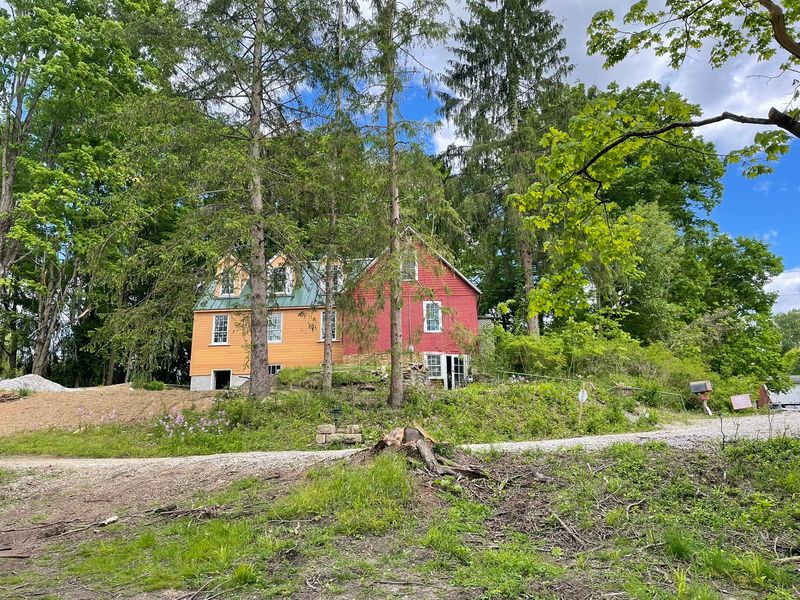
For more than 30 years, the forlorn, small, red-brick house sitting atop a hill on the East Side of Granville has been a source of wonder for those who pass by on Newark Granville Road.
It never seemed to change. The front porch, with its oversized columns in need of a coat or two of paint, leaned awkwardly. And English ivy, man-eating bushes and towering walnut trees seemed to take over the yard.

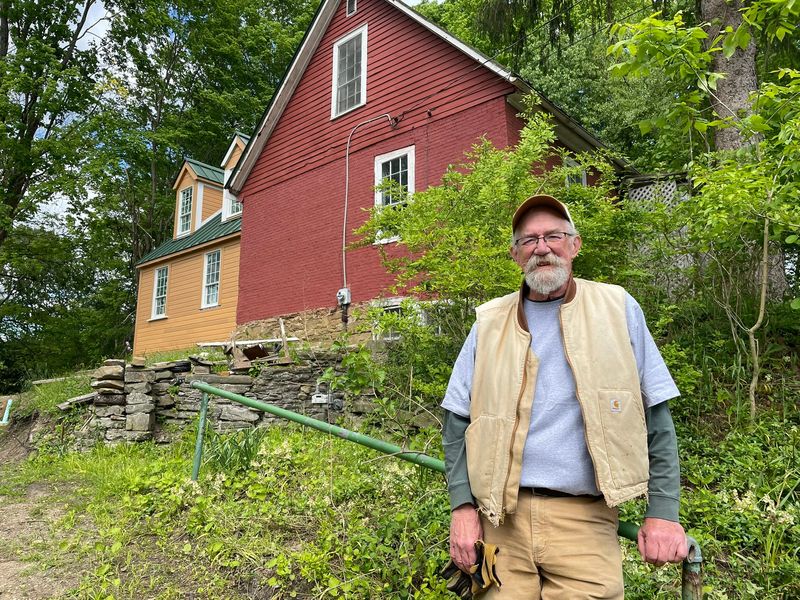
Tom Prieto, of Columbus, who inherited the property from his grandmother, understands and appreciates the interest, and in some cases, even the concern – concern because some folks knew the little building’s outsized history in Granville, and they worried about its future.
Some wondered about the house because they see it every day.
“One of the neighbors came by when I started working on it and said, ‘Tom, thanks for not making a liar out of me. I’ve been telling people for years [that] he’s going to restore it,’” Prieto said.
That little house is one of the oldest in Granville, and built a generation after the founding of the United States by pioneer Spencer Wright between 1806 and 1810, according to several historical accounts.
In all of those 220 years, the house and two acres in the heart of the Licking County village has been owned by three families – the Wrights, the Hayes family and George W. Evans and his descendants, who include Prieto, the great-great-grandson of Evans.
Prieto’s two acres once were part of a 100-acre farm, and its most prominent feature was a tannery Wright built in 1817, a place where animal hides were turned into leather in a process that involved soaking the skins in water steeped with finely ground bark from two readily available trees – oak and hemlock.
The tannery was part of the early industrial center of Granville – a gristmill, a sawmill or two and a furnace for manufacturing iron – all of which were along Clear Run, which cuts through what is now the Denison University golf course and runs south to Raccoon Creek.
Leather was incredibly valuable in the early 1800s because of its many uses, from door hinges to belts, harnesses and handbags. “It was the carbon fiber of the day,” Prieto said.
The tannery is long gone. The large, two-story barn of a building sat between the house and Clear Run on the North Side of Newark Granville Road, with big pits dug into the ground floor where the tanning happened.
Prieto had cut the grass and tended to fallen trees on the property in the years after his grandmother died in 1993, but he was busy with work and other responsibilities, so the time capsule that is his family home just sat there on its perch next to the Church of St. Edward the Confessor and overlooking Clear Run.
His grandmother was Minnie Hite Moody, a journalist who wrote for the Atlanta Journal-Constitution for two decades while her husband, W.O. Moody, taught high school physical education there. In 1960, they returned home to Granville, where they had met at Denison University, to care for the family home. She wrote local history columns for the Newark Advocate and the Granville Sentinel, occasionally discussing her family history and the history of the home that became known as Tannery Hill.
When Prieto finally had the time and money to begin restoration of the old home, he started by removing a deteriorated addition that had been tacked onto the back of the house, removing trees that had grown up like weeds and starting construction of a new addition.
He is sensitive to the history contained in the property – even as he is learning more of it every day by unearthing such artifacts as the tops of hand-blown glass bottles and a pair of scissors that are easily 150 years old. Each discovery creates a sense of wonder in him, and he often pauses to research his latest find.
Prieto has become a regular visitor at the Granville Historical Society Museum – to show the research staff the bits and pieces of local history – and to learn.
History in the house
Prieto is a retired shop teacher, so he knows his way around a hammer and saw. He is doing a lot of the work on the house himself, but he also has hired contractors who have helped frame up and build out a new addition to replace the one Prieto tore off.
A recent tour showed a strong similarity between the addition and the original structure: The new mirrors the old in terms of the layout. A visitor enters the new part of the dwelling through a basement-level door that opens into what will be a kitchen and a laundry room – and a staircase to what many people would call the first floor, where a living-dining room, bedroom and bathroom are roughed in.
The original house remains unrestored for now and looks much like Minnie Hite Moody left it. It has a basement-level kitchen, which was common in houses of that age because they were cooler places to cook with wood- or coal-fired fireplaces or stoves. It also has a utility room on that level.
The cut-stone foundation walls are visible behind the kitchen sink, and ivy has made its way into the basement through cracks around the window frame over the sink. Massive, hand-hewn beams overhead support the first floor.
The main living space in the original house is three rooms – a living room lined with bookshelves, a sitting room that also served at times as a bedroom and another bedroom.
There was no bathroom because pioneers used an outhouse that Moody said was demolished about the same time as the tannery. The outhouse became obsolete with the advent of indoor plumbing, which was in the addition Prieto removed. The tanning business was killed by competition from larger operations that used a faster process than the two years it took to soak hides in water and tree bark.
Prieto said he and his wife, Emily, hope to move from their current residence in Columbus to the old home in Granville by Christmas.
Prieto noted that they would live in the new addition while he restores the original house, which will be easier to do when he’s not commuting between Columbus and Granville.
Keeping the history alive
Prieto has big plans for the old place – to preserve as much as possible and return it to something close to its original look.
That means shoring up several foundational elements of the house – a split beam or two among the dozen or so of the old tree trunks that hold up the first floor and pushing a sagging brick wall on the southwest corner back into position.
While cutting down trees that had grown too close to the house, Prieto said he strategically left a large pine that he plans to use as a brace to push the front wall back into place – a wall of bricks that were handmade on site 220 years ago.
He plans to build a new barn behind the house. The original barn burned down in the 1930s, he said, and his mother, Mary Lou Prieto, witnessed it. “She was on the golf course and could see the smoke,” he said.
He’s also thinking about replacing those oversized porch columns with what old photos show were smaller posts more appropriate for the diminutive size of the building.
“My grandmother lived in the South for years, and she added those columns to the front porch because she always wanted a Southern mansion,” Prieto said with a laugh.
One of the biggest challenges Prieto faces in this ongoing project is the frequent – and welcome – distractions to dig into the latest artifact or structural marvel that sends him running to the historical society office.
These treasures, all with a story to tell, offer yet another chance to delve into the rich local history contained in the place called Tannery Hill.
Alan D. Miller is a former Dispatch editor who teaches journalism at Denison University and writes about old house repair and historic preservation based on personal experiences and questions from readers.
youroldhouse1@gmail.com
@youroldhouse
This article originally appeared on The Columbus Dispatch: Columbus man undertakes a restoration of old Granville home
Reporting by Alan D. Miller, Special to The Columbus Dispatch / The Columbus Dispatch
USA TODAY Network via Reuters Connect
By Alan D. Miller, Special to The Columbus Dispatch | USA TODAY Network