The Columbus Division of Police needs more training in dealing with disabled community members and is inconsistent in communicating with the city’s Civilian Police Review Board, according to attendees at a town hall meeting.
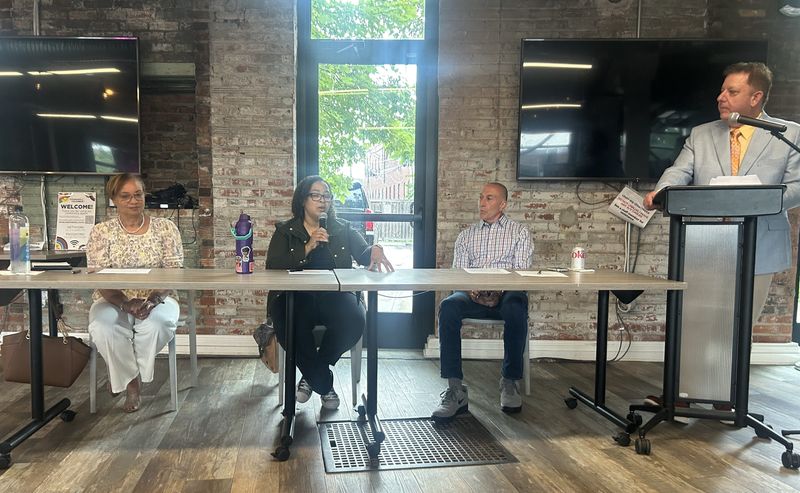
Nearly 50 people gathered on June 25 at Stonewall Columbus in the city’s Short North to listen to a panel discuss the city’s Civilian Police Review Board (CPRB), explain their duties and responsibilities, and field questions from the audience. The diverse crowd asked questions about the board’s powers and how it investigates complaints of suspected police misconduct.

The panel was comprised of Brooke Burns, a board member of CPRB; Jacqueline Hendricks, the city’s Inspector General; and Robert Tobias, who works at the City Attorney’s office in the civil division. Richard Blunt, deputy inspector general, moderated the panel.
The majority of the meeting was geared toward the three-member panel explaining what the board does and does not investigate, the role of the local police union in investigations, and the benefits of having a civilian police review board comprised of diverse board members and investigators.
Creation of the CPRB was a measure overwhelmingly approved by Columbus voters in 2020 to bring oversight to the Columbus Division of Police in the wake of racial justice protests that rocked the city and the country following the May 25, 2020, murder of George Floyd Jr. by Minneapolis police officer Derek Chauvin.
The CPRB reviews cases of suspected Columbus police misconduct and recommends discipline or policy changes within the division. The board does not recommend specific discipline and only deals with complaints concerning officers with city police.
Speaking to the audience, Burns said that she understands people’s frustrations that the board cannot hand down punishment, but said that having a record of complaints can be beneficial in the long term to establish potentially problematic patterns and actions by officers when they interact with the public.
“There’s immense power in making a record and bringing that level of accountability,” said Burns.
Belinda Spinosi, a disability advocate based in Columbus, said that one issue she has noticed with Columbus police officers is a lack of training on how to interact with disabled community members. By that same token, she also said that Columbus police officers “undergo a lot of stress” but are not taught how to handle it, leading to potential issues down the road.
“We’re hurting them, then punishing them when they hurt someone,” said Spinosi.
Burns agreed and recalled a ride along she took some time ago where the officer she was with said that an officer can respond to a range of calls — a homicide, a noise complaint, someone overdosing, and having to arrest people in between — then having to wake up the next day and do it again. Burns also acknowledged Spinosi’s complaint about police interactions with the disabled community and said that officers need more training across the board on how to interact with marginalized communities.
Other attendees asked questions about specific issues they have experienced and whether they could be brought before the board.
Lara Downing, program manager for Community Refugee and Immigration Services, told the panel that immigrant communities face a constant language barrier when interacting with police, and at times are afraid to submit complaints out of fear of retaliation.
Both Hendricks and Burns said they understood the fears and noted that complaints could be submitted anonymously. However, Tobias also pointed out that complaints submitted to the board are considered public records and are available to the public.
Diversity, consistency among issues with Columbus police
Greg Rush, a retired Columbus police officer who worked in the division’s patrol and homicide units for 35 years before retiring in October 2020, told the panel and The Dispatch after the meeting that Columbus police need more Black police officers to help build trust in the community, particularly among the city’s Black residents.
“The next time you watch the news, look and see how many Black officers there are when you see officers putting up crime tape,” said Rush. He also said that officers needed more training on how to properly interact with community members as a whole and “talk with them, not at them.”
At the same time, Rush also said that the Columbus Division of Police needs to educate the public on specific aspects of policing related to law enforcement. According to Rush, this would reduce the likelihood of situations escalating into something worse.
Kyle Strickland, another member of the CPRB who was in attendance, said that while Columbus police communicate with the board on cases brought to them, it’s not done consistently and it often takes months for the board to hear back on matters.
Strickland also said that there is still not enough transparency from Columbus police leadership when the board sustains allegations and sends it to leadership to determine what discipline will take place, if any.
‘They mean well’: Town hall receives positive reviews
Hendricks told The Dispatch after the meeting that the ultimate takeaway from the town hall was getting into the community and explaining the board’s roles while also getting feedback from Columbus residents.
“It’s all (about) education,” said Hendricks. “People still have questions about the board three years later.”
Hendricks says that the board will continue to have both their regular meetings and community engagement events, and would like to see more people in attendance each time. Rush agreed, saying that the board was still in its infancy and that they would continue to gain momentum in the coming years.
“They mean well,” said Rush.
Strickland said that the meeting was a good opportunity for a “one-on-one” with the community and that the board needs to have more community engagement events in the future.
Reporter Shahid Meighan can be reached at smeighan@dispatch.com, at ShahidMeighan on X, and at shahidthereporter.dispatch.com on Bluesky.
This article originally appeared on The Columbus Dispatch: Columbus Civilian Police Review Board says communication from police is often inconsistent
Reporting by Shahid Meighan, Columbus Dispatch / The Columbus Dispatch
USA TODAY Network via Reuters Connect