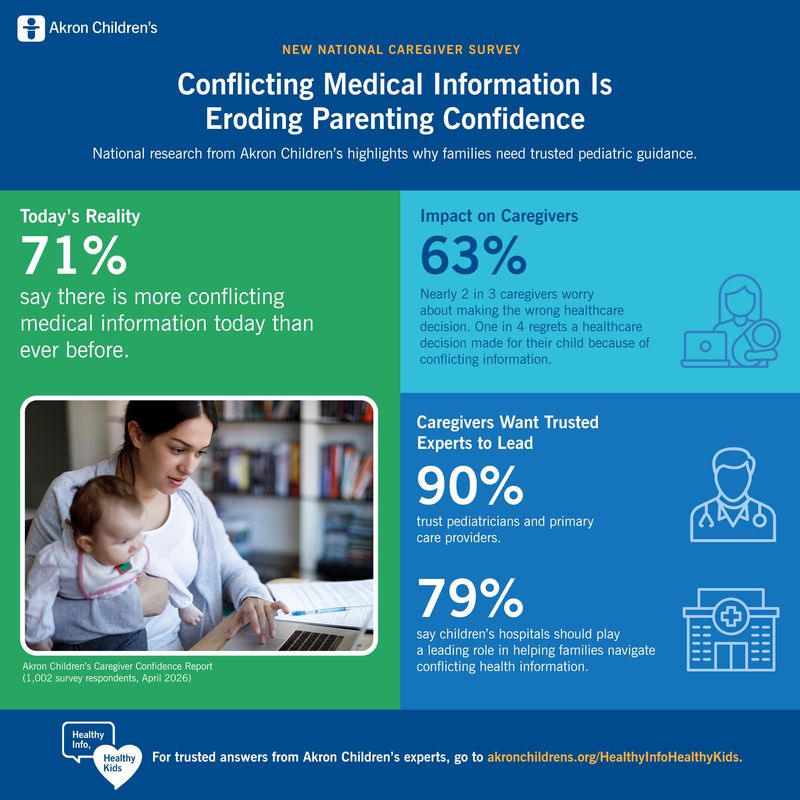
A recent survey conducted by Akron Children’s Hospital found that 71% of caregivers said there is more conflicting medical information today than ever before.
And because of this conflicting information, 1-in-4 caregivers said they later regretted or questioned a health decision they made for their child, a news release from Akron Children’s said.

The survey of 1,002 caregivers was conducted in April to understand how parents and guardians navigate health information coming from social media, online influencers, artificial intelligence and experts, and how Akron Children’s can help, the release said.
“Parents are trying to do what’s best for their children, but they’re being asked to navigate more health information and more conflicting viewpoints than ever before,” Dr. Shefali Mahesh, pediatrician in chief at Akron Children’s, said in the release. “When families aren’t sure what information to trust, it can make already difficult healthcare decisions feel even harder.”
Where do parents place their trust?
Of the 1,002 survey participants, 90% said they trust their doctors.
Another 87% said they prefer information that has medical expertise and research to back it up.
That information should be easy to understand, 90% said, and given alongside practical guidance, 87% said.
Caregivers appreciate health care workers who communicate using clarity, empathy and reassurance, the survey found.
What are caregivers saying about receiving conflicting information?
The survey found that 63% of caregivers worry about making the wrong healthcare decision for their child.
Just over 60% of caregivers don’t know who to trust for medical information, while 54% feel that conflicting information makes them second guess their instincts.
“In pediatrics, we often rely on parents’ observations because they know their children best,” Mahesh said in the release. “Families don’t need yet another set of data or information. They need trusted partners who can help them understand information in the context of their child’s unique situation.”
What do parents and guardians who receive conflicting information do?
While more than half of caregivers don’t know who to trust for medical information and can second guess their instincts when they encounter conflicting information, only 17% of caregivers actually change their health care approach after getting conflicting information, the release said. Here’s what that portion of caregivers did next:
Almost 80% of survey participants said children’s hospitals should take the lead in addressing confusion around children’s health information.
“We see that as both an opportunity and a responsibility,” Mahesh said in the release. “Our goal is to provide clear, evidence-based information that helps families make decisions with confidence.”
Akron Children’s Healthy Info, Healthy Kids campaign works to give clear, evidence-based support to caregivers so they can make informed decisions.
It works to combat misinformation and reduce confusion around health-related topics.
This article originally appeared on Akron Beacon Journal: Akron Children’s survey: Caregivers don’t know who to trust for medical info
Reporting by Lauren Cohen, Akron Beacon Journal / Akron Beacon Journal
USA TODAY Network via Reuters Connect
By Lauren Cohen, Akron Beacon Journal | USA TODAY Network