From multilingual translation to generating learning materials and grouping students by their progress levels, artificial intelligence tools have emerged as a source of support for both teachers and students in schools.
In one of Westchester County’s school districts, Pocantico Hills Central School District, in addition to districtwide initiatives in incorporating AI into classrooms and extracurricular activities, student input has also helped shape how AI tools are taught and used.

While the use of AI remains a subject of debate across the country, a rule of thumb at Pocantico Hills schools is that AI should serve as a tool to prompt students and help them organize their ideas, rather than simply feed them answers.
Alana Winnick, educational technology director at Pocantico Hills School District, said the goal is to prepare students to enter a workforce where AI has already been widely adopted.
“We feel our job as educators is to prepare students for their future,” Winnick said. “The reality is that in the world they’re graduating into, if they don’t know how to use AI, they are not going to get a job.”
AI tools help teachers generate teaching materials and guide students through problem-solving
Pocantico Hills School District launched its AI initiative in 2023, when a few tools were first introduced to teachers and staff.
The district later expanded the initiative to students, using tools such as SchoolAI, Google NotebookLM and Snorkl to generate learning materials, guide students through problem-solving and provide feedback on their reasoning.
For teachers, AI tools can generate worksheets, learning podcasts or videos, track students’ learning progress and group students based on outcomes.
Students can use certain tools to work through problems, receive feedback on their reasoning and guide their research. Unlike some general-purpose AI tools, the platforms adopted by the district are designed to prompt students’ thinking, rather than simply to generate answers. They can also limit searches and alert educators of inappropriate use, Winnick said.
“It’s like AI with training wheels,” Winnick said. “It’s a safe and secure space for our younger students to learn AI in a safe way.”
‘If you copy what AI gives you, that’s cheating’
For example, when prompted to write an essay about the transformation of a frog, SchoolAI did not write the essay for students. Instead, it prompted them to specify their topic and narrow their focus.
“Transformation from an egg to a frog is pretty wide. What’s the big picture you want your readers to walk away with,” SchoolAI responded.
Caroline Qian, a fourth grader at Pocantico Hills Central School, said she asks AI questions when teachers are not available.
When asked if using AI tools is considered cheating, some fourth graders said it depends on how students use them. They said using prompts based on knowledge they have already learned to work toward an answer is not the same as cheating.
“If you copy what AI gives you, that’s cheating,” Qian said. “But if you use it based on your knowledge and your own words, it’s not.”
Winnick said students are taught that AI is a powerful tool, but one that must be used ethically and responsibly. AI literacy and ethics are taught across classrooms and media literacy classes.
“We explained how AI models are trained so they understand what it is,” Winnick said. “We don’t want them to think it is a human.”
How AI tools help English language learners navigate school
The tools have also helped newcomers and English language learners translate instructions, communicate with teachers and create learning materials in their own languages.
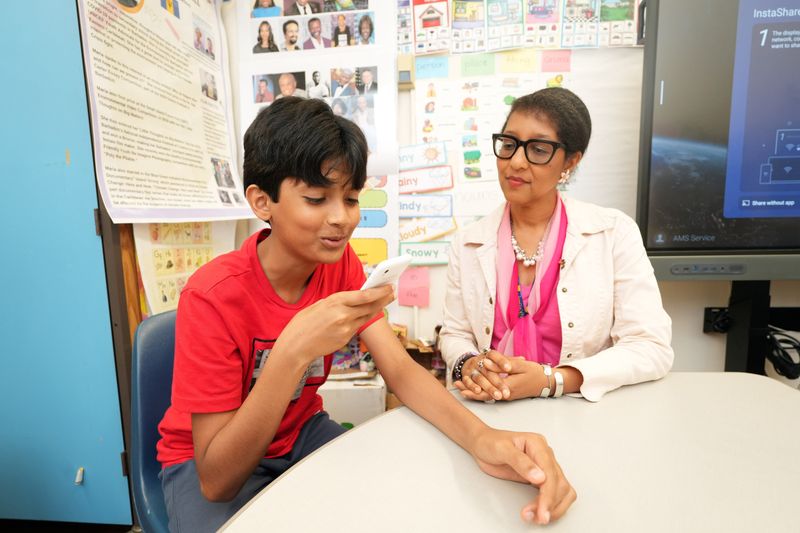
Seventh grader Muhammad Ali recalled how an AI translation tool called Pocketalk helped him navigate school when he first arrived in the country in October. The Pakistan native carried the device during his first three months to translate signs, find his way around and communicate with teachers. He also uses other AI tools to generate learning materials in his language.
His ENL teacher, Joy Scantlebury, said she has used the translation device for three years to help newcomers settle in. She also uses NotebookLM to create teaching videos in different languages, as well as study guides, flashcards and quizzes.
“It helps me prepare. My whole philosophy is how to make learning meaningful, comprehensible and engaging,” Scantlebury said. “AI is uncharted territory. I always have to think about students’ needs and how the tools enhance their understanding.”
Teachers shift attitude toward AI as students share input
Although AI tools were introduced to teachers three years ago, some were reluctant to use them until recently.
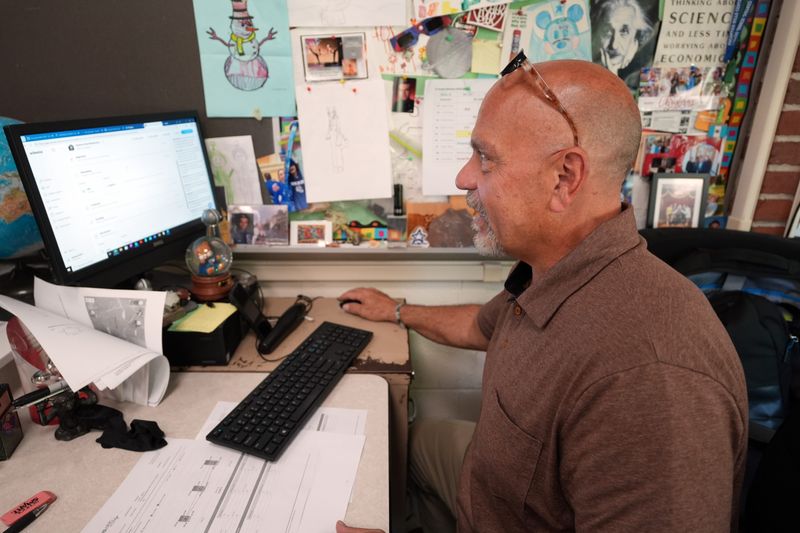
James Cioffi, a science teacher, was initially reluctant to use AI tools. Now, he uses them to generate worksheets, exams, review sessions and study guides based on the materials he provides. He can also identify which questions students find challenging by reviewing how they solve problems.
“I need to see the technology in action before I can jump in,” Cioffi said. “I’m always a bit afraid of AI because I don’t want it to give them answers. I want students to learn to write lab reports on their own, not just turn to SchoolAI. But it doesn’t do that, so I like it.”
Many of the district’s AI initiatives have also involved input from students. In some cases, students have helped teachers troubleshoot issues or learn how to use certain tools.
Students from after-school clubs, including the AI Junior Club, Innovation Club and TED Talk Club, have helped lead that effort. The clubs are open to students in third through eighth grades.
Winnick, who leads those clubs, said students who were exposed to the tools later helped teachers learn how to use them. They also spoke at school board meetings and other events to help shape the districtwide AI initiatives.
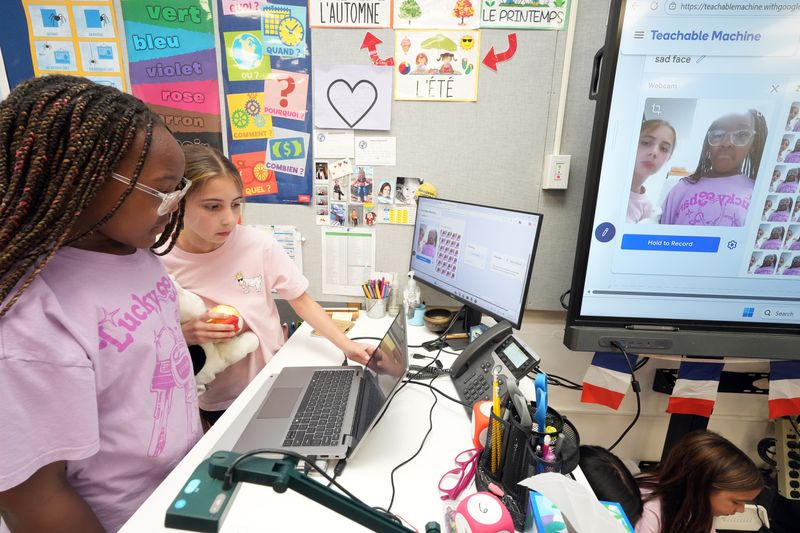
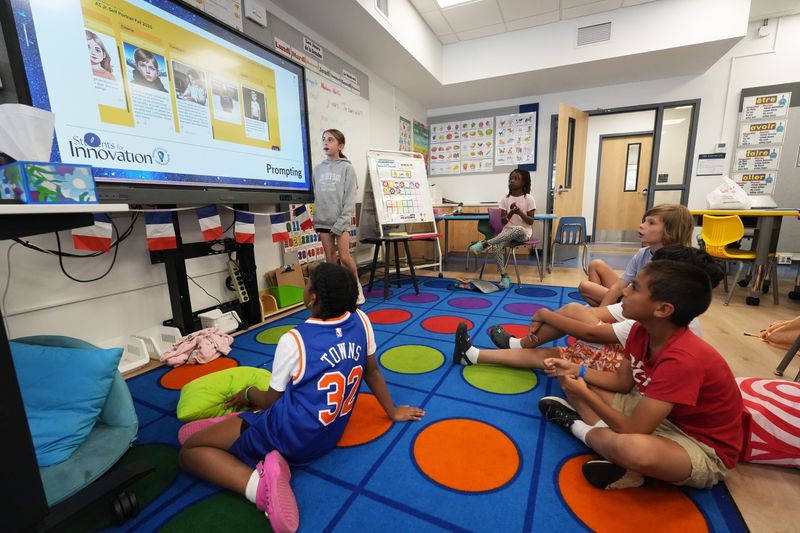
During a recent visit to the AI Junior Club, about a dozen third and fourth graders presented what they had learned about viewing AI as a tool rather than a human. They said AI can make mistakes and that users should rely on reliable sources of information, such as libraries and credible publications. Some used an app called Quick, Draw to train AI to guess their drawings, while others used Teachable Machine to train a computer to recognize images and sounds.
“AI is a very powerful tool. It comes with a lot of responsibility. They need to learn how to use it ethically,” Winnick said. “They have two jobs. The first is to be a detective, looking out for bias and misinformation. The second is to be a DJ and remix the information with their own thoughts and ideas.”
Helu Wang covers economic growth, real estate and education for The Journal News/lohud and USA Today Network. Reach her at hwang@gannett.com and follow her @helu.wangny on Instagram.
This article originally appeared on Rockland/Westchester Journal News: Why this Westchester school district is embracing AI in class
Reporting by Helu Wang, Rockland/Westchester Journal News / Rockland/Westchester Journal News
USA TODAY Network via Reuters Connect
By Helu Wang, Rockland/Westchester Journal News | USA TODAY Network