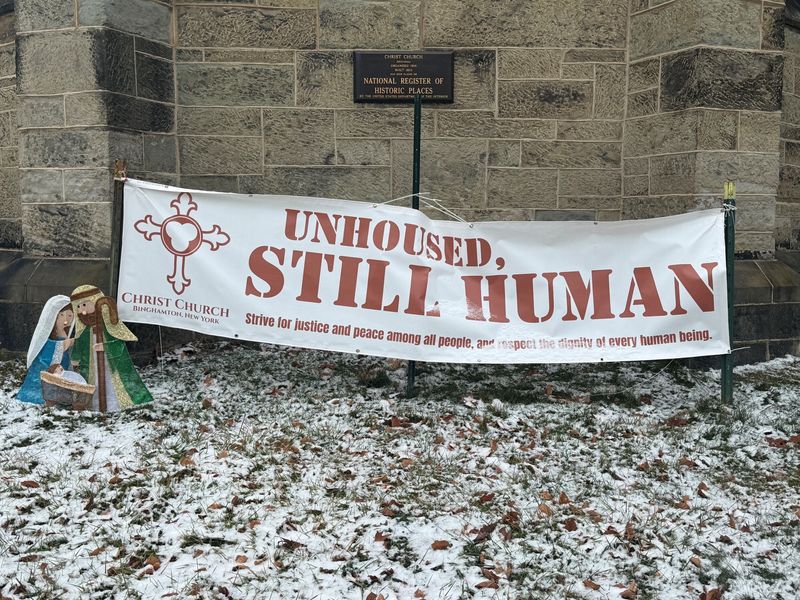
Christ Episcopal Church was at the center of a controversy last summer following disagreements with the City of Binghamton over a tent encampment located downtown on church grounds at 10 Henry St.
The encampment sat on what Rev. Scott Parnell described as the “largest private green space” in the City of Binghamton. The unhoused residents utilizing the space eventually dispersed after the city raised issues around zoning laws and public safety.

After the encampment cleared out, the people who sought refuge on church grounds were left with the decision to either enter the system for assistance or brave the outside elements.
“Where they go next, they don’t know, and neither do I,” Parnell said in a Sept. 29 Facebook post.
Now, after a long winter that featured extended stretches of freezing temperatures, volunteers and advocacy groups are taking stock of Binghamton’s homeless population and what challenges and opportunities for improvement remain in 2026.
Overall, Parnell says the encampment closure did not push individuals out of Binghamton.
“They’ve not gone anywhere,” he said in a follow-up interview with the Press & Sun-Bulletin.
The group seeking shelter at Christ Episcopal Church easily became members of the congregation; Parnell was outside every day asking, “What do you need? Everything okay?”
“We got on great,” Parnell said about the people and the relationships that were built over the summer.
The topic of homelessness is more complex than surface-level assumptions, he added. For Parnell, the hard pieces of the puzzle are centered around people who have become unhoused “for no fault of their own” rather than suffering the consequences of a bad decision.
“We can either perpetually punish people, or we can help them solve the problem,” Parnell said, adding that solutions “require meeting people where they’re at” while acknowledging that the process of reentering society after being unhoused for long periods can be a difficult transition.
The reverend described the closure of the encampment as a “tragedy” after building a relationship and giving the people some form of stability. During that short time residing on the church grounds, some people began to secure jobs and apply for educational programs, he said, and when the encampment closed, so did the opportunities that were becoming available as people switched back into survival mode.
Parnell does not have contact with all of the people who left the encampment, but those who do reach out have expressed gratitude for not being forgotten.
“Thank you for caring,” they say.
UP Comfort Center on the frontlines in Binghamton
The UP Comfort Center opened in 2023 after Barbara Donnelly reached out to the Addiction Center of Broome County (ACBC), introducing Dave Culbertson and Emily Culbertson from the Putting God First Foundation with ACBC Executive Director Carmela Pirich. Together, they brainstormed the idea of creating a shelter.
Pirich has been with the ACBC organization for the past 17 years after leaving her position at Johns Hopkins working in the Department of Psychiatry. Over the past 10 years, she has witnessed the crisis shift from the opioid epidemic to COVID, then a methamphetamine epidemic.
Between 2019 and 2020, the group started to see a surge in unhoused clients. The waiting room went from standard capacity to a situation where “people are wheeling suitcases in here,” Pirich told the Press & Sun-Bulletin during a recent interview.
The staff operating the UP Comfort Center has had a front row seat to how the system struggles to support people who fall through the cracks.
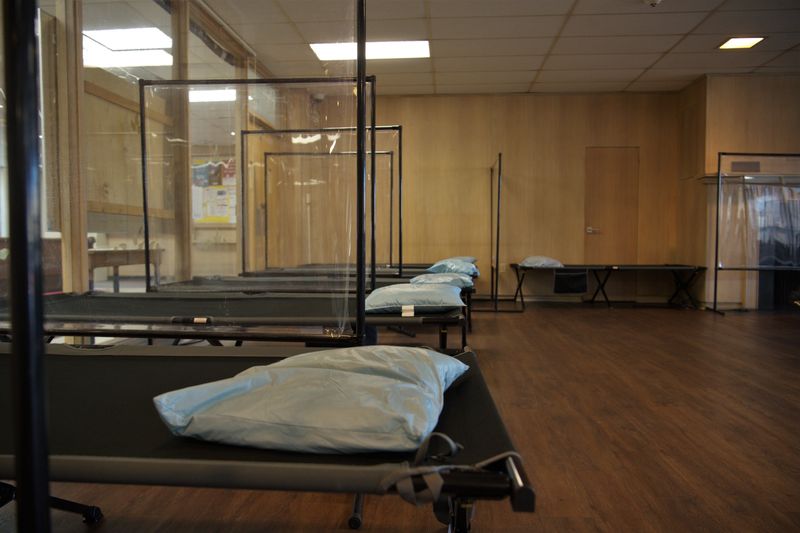
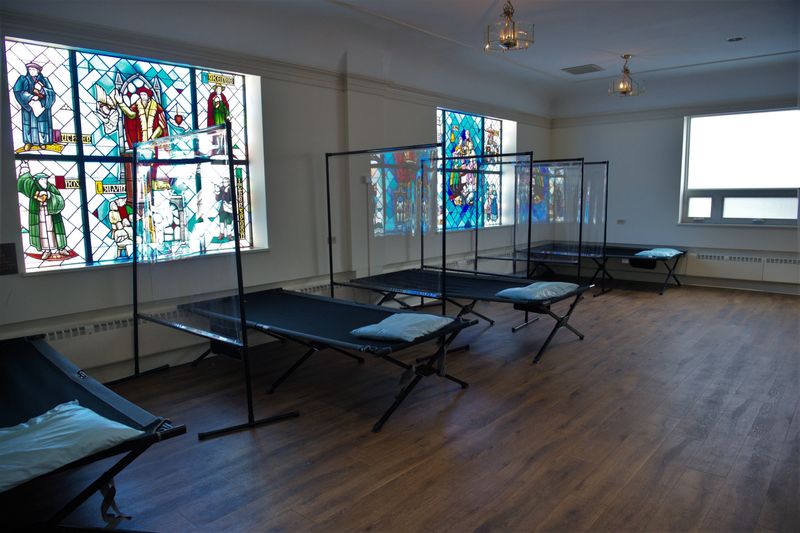
The ACBC has yet to track the exact number of unhoused individuals who utilize the UP shelter, but in 2025 it provided a place to sleep for 5,698 people. UP Comfort Center Supervisor MacKenzie Moore said the center has seen “larger numbers lately, getting up to like 27, 29” people coming in to secure a cot in the 34-bed facility.
In 2025, the ACBC served 1,700 clients within one of their programs, and out of that number, 323 of those individuals were unhoused. Moore has encountered clients who struggle with serious mental health illnesses, youth who have aged out of foster care, unmedicated individuals, people with severe medical issues, and pregnant women.
The spike in intravenous usage has caused the center to begin HIV testing once a month to provide individuals with information about their status, especially with cases rising in the Binghamton area.
Binghamton isn’t alone in marking a rise in homelessness. According to federal data, homelessness increased 18 percent, from 653,104 people during the 2023 Point-in-Time (PIT) Count to 771,480 people during the 2024 PIT, notes the National Alliance to End Homelessness.
The 2024 PIT count, the latest available data, recorded an overall homeless population of 800 in the Continuum of Care region covering Binghamton and other parts of Broome, Otsego, Chenango, Delaware, Cortland and Tioga counties. That was up from 676 in 2023 and 317 back in 2020.
Lack of funding, housing remain challenges
Moore has seen clients who have been out on the street for 10 to 15 years and finds it “really disappointing to see how far they’ve fallen down.”
Working at a shelter that can only afford to operate five days a week, staff know that expanding services to the weekend would be essential to the well-being of the people they serve. Unfortunately, they don’t have the staff or the money to maintain a seven-day-a-week facility. Support on the county and state level has allowed the facility to remain open until June, but after that it is dependent on available funding.
Others have tried to help fill the gaps. In 2025, the City of Binghamton approved $81,000 to expand the hours of the UP Comfort Center and support local homelessness prevention services. And over this winter, during one particularly cold stretch, United Presbyterian Church members opened their doors for an emergency pop-up shelter overnight, when other shelters were closed.
Pirich said Binghamton’s housing stock does not take into consideration people who are extremely low-income. They have clients who are working but can’t find a place where they would be able to maintain the expenses.
Most of the hotels in the area that are contracted with DSS are filled and have spilled over into surrounding counties. One thing that alarms Pirich is the number of youth who are growing up in dorm-sized hotel rooms.
“The hotel placements that our clients are in, sometimes they’re fine and they’re content and it works well. Other ones can be very drug-infested,” Pirich said.
According to the ACBC, if DSS paid $75 for each individual who slept at the UP Comfort shelter last year, the bill is estimated to be $427,350.
ACBC partners with Binghamton U. to survey community needs
Pirich said she would love to see a task force put in place to take a closer look at the numerous housing projects happening in the area to get a clear definition of what should be considered “affordable.” After years of working on the frontlines with the unhoused community and vulnerable individuals, the staff at UP Comfort Center confidently say most people are not living on Binghamton streets, exposed to harsh weather conditions and other challenges, by choice.
“I think we don’t have enough resources. We don’t have enough housing stock. DSS is overwhelmed,” Pirich said, reflecting on some of the extreme cases they have encountered at the center.
The center will be working with students from Binghamton University who are enrolled in the Masters of Public Health Program led by Associate Professor Miesha Marzell and conducting surveys with clients of the UP Comfort Center. The information they gather will give direct insight into what people within vulnerable communities need and an opportunity to share their experiences.
Marzell and her students will then present their findings to SUNY Upstate in April.
Kalyn Grant reports on public service issues for the Press & Sun-Bulletin, focusing on schools and community impact. Have a story to share? Follow her on Instagram @KalynCarmen and on Facebook under Kalyn Kearney. Get in touch at KCGrant@usatodayco.com
This article originally appeared on Binghamton Press & Sun-Bulletin: What the numbers and frontline advocates say about Binghamton homelessness
Reporting by Kalyn Grant, Binghamton Press & Sun Bulletin / Binghamton Press & Sun-Bulletin
USA TODAY Network via Reuters Connect