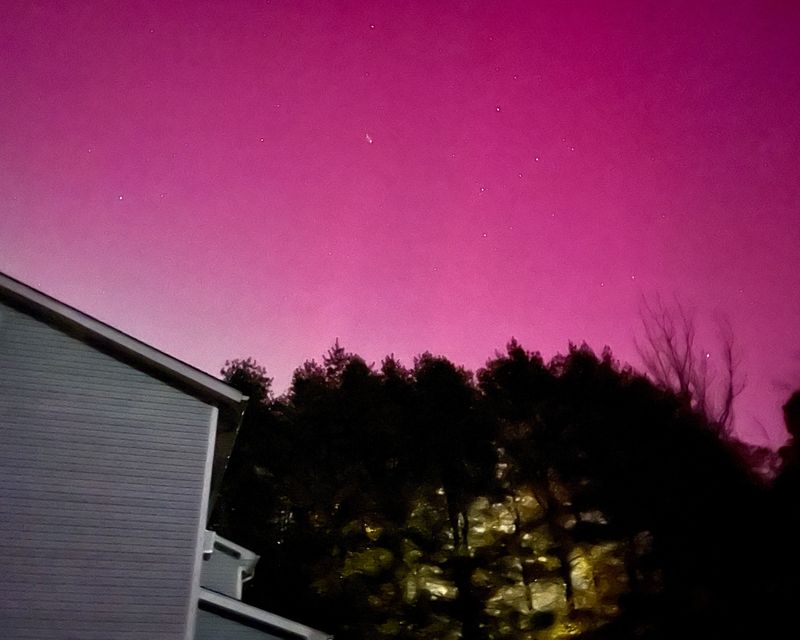
Will the aurora borealis light up Lower Hudson Valley skies on Tuesday night, Sept. 2?
It wasn’t immediately clear how visible the aurora, known as the northern lights, will be in our region, though some news reports suggested it may not be easy to spot from southernmost areas of the Lower Hudson Valley, such as Westchester County. A CBS News report said some areas north and west of New York City might fall with the range of possible visibility.

Tuesday’s forecast from the National Weather Service calls for mostly-clear skies in the Westchester, Rockland and Putnam County areas, which could make for some good nighttime skygazing in between clouds.
When can you see the northern lights?
An aurora “does not need to be directly overhead but can be observed from as much as 1,000 km [more than 621 miles] away when the aurora is bright and if conditions are right,” according to the National Oceanic and Atmospheric Administration’s Space Weather Prediction Center.
An aurora can often be seen somewhere on earth from just after sunset or just before sunrise. It’s not visible during daylight hours, the Space Weather Prediction Center website said.
“There is still a chance for aurora manifestation overnight again tonight, as the [coronal mass ejection] is still passing over Earth and we are now in the core of the CME,” said Shawn Dahl, a Space Weather Prediction Center service forecaster. “If the current magnetic core of the CME passing over Earth becomes favorably connected to Earth and the field intensity stays enhanced, the aurora becomes much more likely tonight.”
On Sunday night, Dahl added, the leading edge of the CME was passing over Earth, “but it was not favorably connected with Earth and so the aurora did not form to the extent that would have otherwise been possible.”
Last fall, the aurora was highly visible from much of the Hudson Valley region, creating red and green swirls in sky.
What is an aurora borealis?
An aurora is an indicator of geomagnetic storm conditions.
Aurora borealis results from electrons colliding with the upper Earth atmosphere, according to NOAA. The accelerated electrons follow the planet’s magnetic field down to the polar regions where they collide with oxygen and nitrogen atoms and molecules in the upper atmosphere, NOAA’s Space Weather Prediction Center said.
The electrons transfer energy to the atmosphere, which excites the atoms and molecules to higher energy states. When they relax back to lower energy states, they release their energy in the form of light.
“This is similar to how a neon light works,” the explanation said.
This article originally appeared on Rockland/Westchester Journal News: What are chances northern lights will be visible in Lower Hudson Valley Sept. 2?
Reporting by Michael P. McKinney, Rockland/Westchester Journal News / Rockland/Westchester Journal News
USA TODAY Network via Reuters Connect