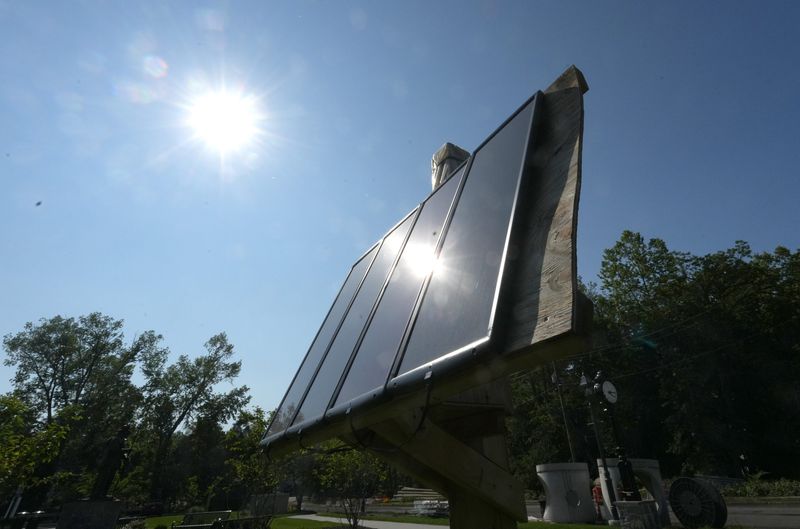
Did you know that rooftop and community solar, paired with battery storage, is a billion‑dollar energy affordability opportunity for New York?
I spend a lot of time talking to New Yorkers about our energy future, and I hear the same thing over and over: people feel caught between two competing narratives. One insists that building clean energy will drive up costs for families and businesses. The other says that scaling more solar and storage will lower bills. It’s no wonder so many people feel stuck in the middle, staring at a choice that feels impossible. But that choice is a false one. If we want to lower energy bills for every New Yorker—and keep them low—the single most effective step we can take is to rapidly build more solar and battery storage across the state.

We have the data to back that up. Earlier this year, Synapse Energy Economics released an analysis showing that if New York builds 20 gigawatts of distributed solar by 2035 and meets its energy storage targets, ratepayers will save more than $1 billion every single year in avoided energy costs. Those savings flow through the wholesale market to everyone — not just the households that have panels on their roof or a battery in their garage. That billion‑dollar benefit comes in addition to the hundreds of millions of dollars in direct bill savings already delivered to rooftop solar customers and community solar subscribers.
These savings aren’t speculative. Solar produces power during the hours when the grid is most strained and electricity is most expensive. Batteries amplify that benefit by storing low-cost power overnight and when the sun is shining and releasing it when families need it most. Reducing the most expensive hours on the grid lowers the average price of electricity for everyone. It is one of the strongest affordability tools New York has.
Beyond affordability, solar and batteries provide something I hear more and more New Yorkers ask for: stability. When geopolitical conflict erupts halfway across the world, we feel it at home. Oil and gas markets react instantly to global tension, long before any supply is disrupted. That volatility shows up as higher electricity bills, higher heating costs and spikes at the pump. We end up paying for decisions made in far‑off capitals.
Solar and batteries operate differently. Their “fuel” is free, local and immune to geopolitical turmoil. They’re powered by a source no foreign adversary can manipulate and no conflict can shut off. Solar is now the least expensive source of new electricity generation in the world, and pairing it with storage allows New Yorkers to capture that value around the clock. When we build clean energy here at home — on rooftops, in multifamily buildings, in schools and throughout our communities — we insulate families from global fuel price swings and make household budgets less vulnerable to crises we cannot control.
This is why the old narrative that clean energy is inherently more expensive no longer matches reality. Fossil fuels are volatile and require costly upkeep as infrastructure ages. Clean energy technologies have plummeted in price and their operational savings are well‑established. Distributed solar and storage reduce congestion on local wires, cut peak demand during the costliest hours of the year and provide resilience during outages. They deliver affordability, reliability and stability — not someday, but now.
Which makes this moment hard to ignore. As budget negotiations drag on and lawmakers weigh which choices will actually make life more affordable for New Yorkers, energy policy can’t be treated as something we can delay. The decisions made this spring will shape electricity bills for years to come.
Why New York needs the ASAP Act
That’s why the New York Legislature needs to pass the Accelerate Solar for Affordable Power (ASAP) Act. The ASAP Act provides the clear, practical path New York needs. It speeds the buildout of local solar and storage and modernizes our interconnection system, so we stop relying on 20th‑century technology to connect 21st‑century energy projects to the grid. By accelerating rooftop and community solar deployment and pairing it with storage, more New Yorkers — including renters and families in high‑burden neighborhoods — can share in the benefits of lower‑cost, more reliable power during the hours when the grid is most stressed.
Simply put, passing the ASAP Act will help New York capture the billion‑dollar annual savings already within reach while strengthening the grid and protecting families from global energy shocks. At a moment when world events continue to push fossil fuel prices higher, New Yorkers cannot afford to leave that opportunity on the table.
The choice between clean energy and affordability is a myth. The real choice is whether we continue paying for volatility or invest in stability. I’ve spoken with too many New Yorkers who are tired of choosing between affordability and reliability. The ASAP Act is our chance to finally give them both.
Jonathan Cohen is policy director at New York Solar Energy Industries Association.
This article originally appeared on Rockland/Westchester Journal News: Solar and storage offer NY a strong affordability strategy | Opinion
Reporting by Jonathan Cohen, Special to the USA TODAY Network / Rockland/Westchester Journal News
USA TODAY Network via Reuters Connect