Every year, 11 million tons of textiles — clothing, towels, bedding and more — end up in landfills in the United States.
It’s a staggering number, especially since only about 1% of textile waste is recycled. A team of researchers at Rochester Institute of Technology is looking to change that.

One of the biggest challenges to recycling textiles is removing impurities and extra material like zippers, buttons and screen printing. Most recyclers are looking for 99% purity in the cotton or nylon they extract.
To achieve this, the RIT research team at the Golisano Institute of Sustainability has crafted a machine, powered by artificial intelligence, to identify those contaminants and remove them. Building and testing the machine has taken more than two years but is now in the debug phase and is yielding results.
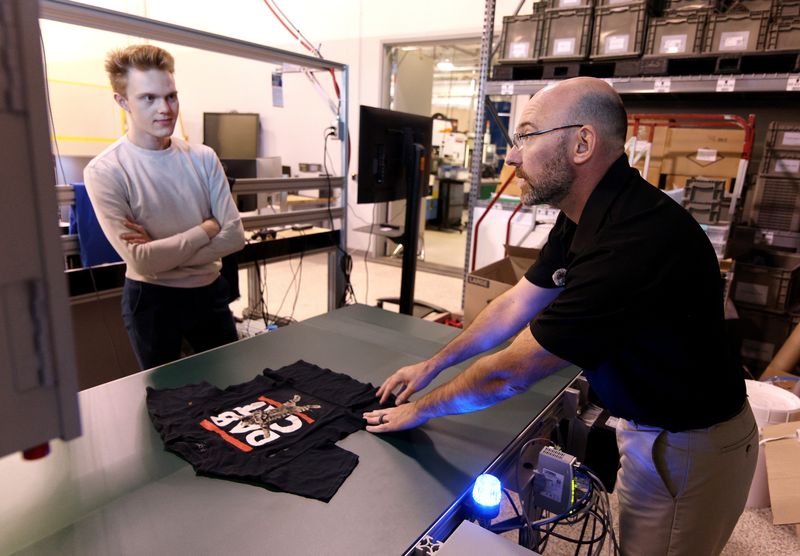
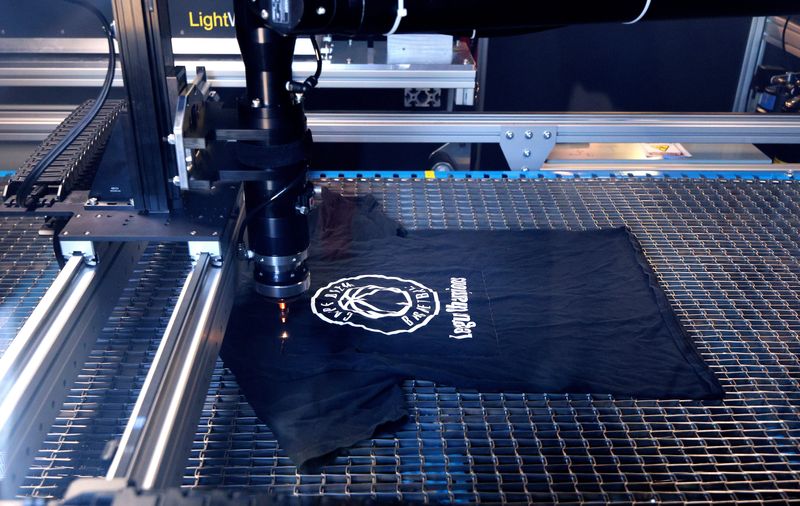
The machine — custom-built and powered by a computer worth more than $15,000 — starts its process on a conveyer belt. A piece of clothing like a screenprint T-shirt is laid on the belt where it is scanned by a camera for contaminants. Once the area of impurities is identified, the conveyer belt advances the shirt into a chamber. Waiting inside is a laser mounted on a mechanical arm.
The laser sends up little puffs of smoke as it traverses the AI-generated path, cutting through both layers of the shirt. Even a simple screenprint on a shirt could cause all kinds of problems in the recycling process if not eliminated, said Mark Walluk, technical program manager.
“The screen print will go into all the reactor vessels, everything else in the chemical recycling processes, and that will clog up the system,” Walluk said. “It can affect the actual metal within the reactor vessel itself. It can then also affect the end material properties in the yarn that’s produced from the recycling content. Taking all of this stuff out really makes a difference in the whole quality of the fibers.”
Testing a textile recycling machine
The clothing used to test the machine is more than 1,000 items from a local Goodwill that were donated but didn’t sell. The Northeast Hub of Goodwill carried out a sorting study that found its nine organizations, which serve a third of the U.S. population, have the potential to provide 10 million pounds of cotton, 7 million pounds of polycotton and 5 million pounds of polyester to recyclers each year.
Cotton and polyester are the most desirable textiles for recycling, which the machine is capable of sorting.
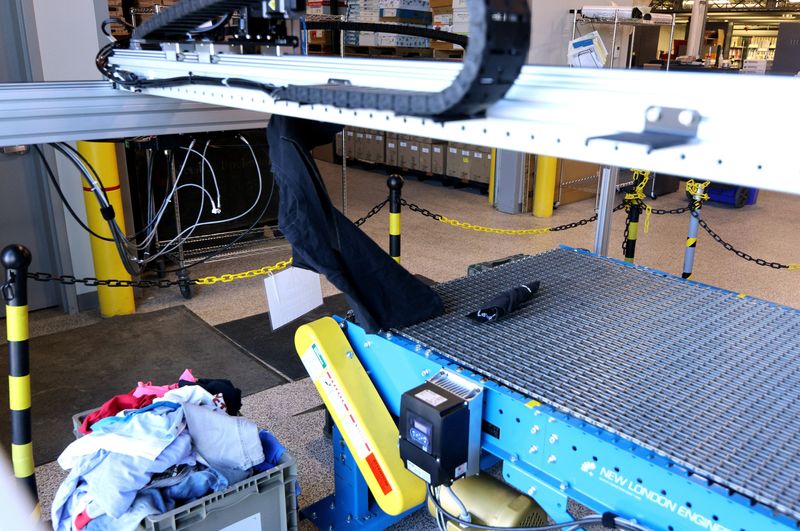
After the laser cuts out the contaminants, a conveyer belt brings the clothing to a mechanical arm, which grabs the usable part of the fabric and places it in a bin by material type. The offending remnants are shuttled down the conveyer belt to a separate bin.
The machine took a team of 10 more than two and a half years to complete — every aspect of it hand=built and -assembled except for the camera.
The whole process isn’t intricately precise, but that’s by design. For a pair of jeans, for instance, the laser might identify that the entire top — rivets, zippers, pockets — should be cut off and the legs retained. This keeps the fabric being reserved for recycling pure, which making the process quick enough to be economical.
“All those things went into the factors that allowed us to design the system the way it is today,” Walluk said. “… That’s our end goal here. Eventually move this to a company that can process clothing and then sell that bale of pure material.”
— Steve Howe reports on weather, climate and the Great Lakes for the Democrat and Chronicle. An RIT graduate, he has covered myriad topics over the years, including public safety, local government, national politics and economic development in New York and Utah.
This article originally appeared on Rochester Democrat and Chronicle: RIT’s new machine tackles one of the biggest problems in textile recycling
Reporting by Steve Howe, Rochester Democrat and Chronicle / Rochester Democrat and Chronicle
USA TODAY Network via Reuters Connect