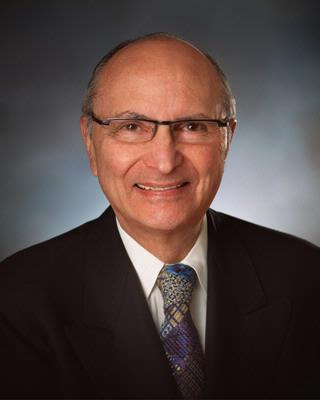
For years, people who could not see well, or people who could not see at all, came to Rochester and placed their hopes in Dr. James Vincent Aquavella’s hands.
An ophthalmologist and corneal surgeon, he was a master of what some viewed as last-ditch efforts. He tried what others didn’t, all in the hope of giving his patients, adults and children both, the joy of seeing colors or taking in a friendly smile.

Dr. Aquavella, who died on May 14 at age 94, practiced medicine until a year before his death, staying active long after most physicians would have retired.
“He lived to be an ophthalmologist, and it defined him,” said Dr. Steven Feldon, the former chair of the University of Rochester Medical Center’s Department of Ophthalmology. “He wanted to continue to make a difference.”
Dr. Aquavella could have taken on just about any medical specialty, but, in his own opinion, he may have been born to be an ophthalmologist.
“Ophthalmologists as a group of people are compulsive and tend to be nitpickers,” he told the Democrat and Chronicle in 2005.
“My theory is you were compulsive first and an ophthalmologist second. So maybe it was my personality defect that led me into the field.”
His personality and his willingness to pave new ground led Dr. Aquavella to try new and extremely delicate surgeries.
Along with a surgical team, he implanted small prosthetic devices, plastic telescopes really, into eyes, even the eyes of babies.
The device, called the Dohlman keratoprosthesis, had been developed in the early 1960s by Dr. Claes Dohlman of Harvard’s Massachusetts Eye and Ear Infirmary. Dr. Aquavella was a corneal fellow there and studied under Dohlman.
There was always a very real chance with the keratoprosthesis that sight, once restored, would be lost again as infection set in. Young children, with their especially active immune system, presented the greatest challenge.
But for Dr. Aquavella, the risk was worth it. The operations were the patients’ last, and probably only, chance to see again, or even to see for the first time.
“He was really at the forefront,” said Dr. Feldon, who was also the head of the Flaum Eye Institute. “And he was undaunted.”
During his career, Dr. Aquavella lectured throughout the world, and he trained a series of medical residents and fellows. One, Dr. Gullapalli Nageswara Rao, was with URMC for 10 years before returning to his native India and founding an eye institute in Hyderabad that is world-renowned.
Dr. Aquavella was born in Brooklyn on May 2, 1932, and received his undergraduate degree from Johns Hopkins University in 1952 and his medical degree from the University of Naples in Italy in 1957.
After that, he was a resident in ophthalmology at Brooklyn Eye and Ear Infirmary, and from 1960 to 1962 he was at Massachusetts Eye and Ear.
He then came to Rochester and had several affiliations. He was in the ophthalmology department at Park Ridge Hospital, and other hospitals before joining the University of Rochester Medical Center in 1977 as a professor of ophthalmology. He was also on the staff of URMC’s Eye Institute. That later became the Flaum Eye Institute.
In 1979, Dr. Aquavella made international news when he offered to operate on a blind Toronto man free of charge.
Martin Ramsay had lost his sight due to a reaction to penicillin and aspirin, and the Ontario Health Insurance Plan would not cover the cost of having surgery in the United States.
Ramsay did come to Rochester and the corneal implant in his right eye was a success at first. But after a year, infection set in and Ramsay lost most of the sight in the eye.
Setbacks like this were counter-balanced by advances in the surgery and by successes, as is witnessed by the tributes that have poured in after Dr. Aquavella’s death.
In addition to performing surgery, Dr. Aquavella treated patients for a wide variety of conditions.
Marjory Pearl Gurnett, a mixed-media artist in Fairport, went to him for help with dry eye syndrome. She was struck by his empathetic, courteous, and almost old-world manner.
“I don’t think they make people like him anymore,” she said. “The mold has been broken.”
Dr. Aquavella was, in Dr. Feldon’s opinion, a Renaissance man, with interests that went beyond medicine. He and his wife, Catherine, a nurse and educator and eye institute administrator, traveled widely. They collected art, some of which they donated to the University of Rochester’s Memorial Art Gallery.
“They gave major works of European painting over the decades,” said Grant Holcomb, the former director of the gallery. “They were the ideal patrons – smart, generous and kind.”
Following his wife’s death in 2013, Dr. Aquavella committed $4 million to the UR medical school, endowing two professorships in ophthalmology.
A funeral Mass for Dr. Aquavella was held Thursday at St. Louis Church in Pittsford.
Dr. Mithra Gonzalez, who had been a resident at URMC when he first met Dr. Aquavella, spoke at the service. He remembered Dr. Aquavella for his sustaining Catholic faith and “for giving sight to hundreds of visually impaired children and hope to thousands of their families.”
This article originally appeared on Rochester Democrat and Chronicle: Remembering Dr. James Aquavella, a pioneering eye surgeon
Reporting by By Jim Memmott, For the Democrat and Chronicle / Rochester Democrat and Chronicle
USA TODAY Network via Reuters Connect