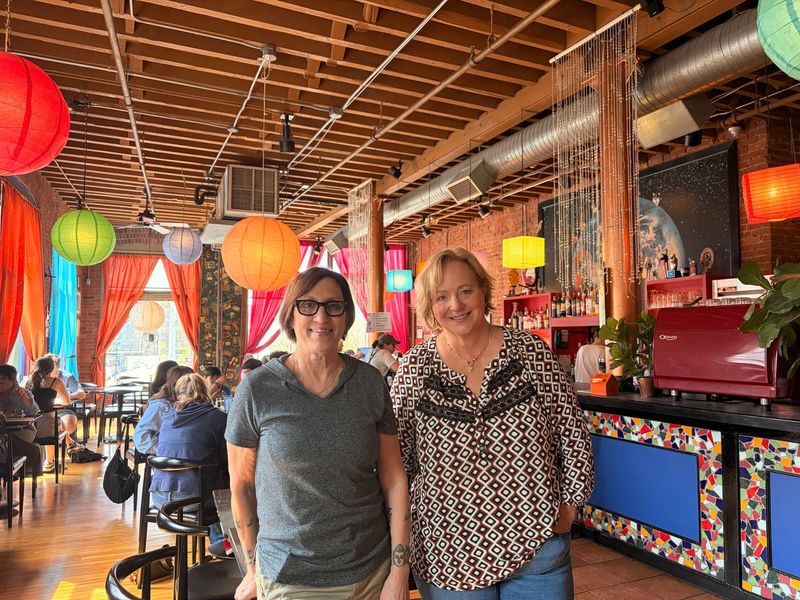
Most nights of the week, bright lights, music and mingling people outside a local restaurant bring one corner of downtown Binghamton’s Water Street to life.
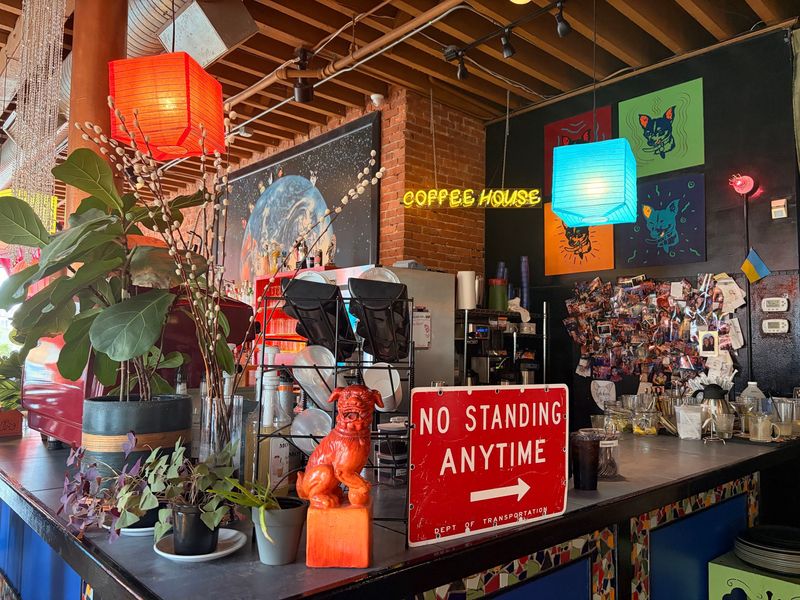
If you take a step inside, you’ll be greeted by multi-colored lanterns, a packed room of diners and the unmistakable scent of Lost Dog Café’s beloved rigatoni a la vodka.

For owners Marie McKenna and Elizabeth Hughes, Lost Dog represents a little slice of the New York City where they spent their youth. For the Binghamton area, it is a business that has defined and led the downtown restaurant scene for nearly 30 years.
For Hughes and McKenna, owning a restaurant is the culmination of years of experiences, and a return to their hometown after time away. To fully understand and appreciate the history of one of Binghamton’s favorite restaurants, it is necessary to begin at an unusual moment — when the two first left their hometown of Johnson City.
The full story behind popular Binghamton restaurant
In the early 1980s, McKenna and Hughes moved to Brooklyn alongside two friends to pursue a career in music. To support their dream and pay the bills, the two worked in restaurants, with Hughes focusing on cooking while McKenna worked as a waitress.
As time passed, the band broke up, and Hughes joined another one, while McKenna settled down, got married and had two children. In the years that followed, McKenna’s marriage ended and she moved back to the Binghamton area with her kids in 1992.
“I moved to the East Village, still playing in a band,” said Hughes. “But I mean, we were best friends. I missed her, I missed the kids. My family was up here, too, so I would come up and visit, and the more I was there I started to realize that the East Village was changing, and it just wasn’t the same anymore. I was kind of like ‘I don’t know what I want to do.'”
Hughes’ band, which was just one showcase away from being signed, was afflicted by bad luck at the eleventh hour — the band’s lead singer developed Bell’s palsy, a condition that causes short-term weakness or paralysis of the facial muscles. Then 30, Hughes decided it was time to come home, a move that would set the groundwork for the birth of Lost Dog.
Lost Dog filled a void in Binghamton
During their time in Brooklyn, the two spent countless hours at the cafés that dot the city — if you’ve spent time in New York City, you’ll know it’s hard to find a two-block stretch that doesn’t feature a coffee spot with a cozy vibe, fresh food, and of course, the fuel that keeps the city running.
“There wasn’t anything like that up here,” said Hughes. “I was like, if I’m going to live up here, I need that. I love that. No one else is gonna do it, and I need someplace to go have brunch and drink and read the New York Times.”
“I remember she called and said, ‘I think I want to move home and open a café,’” added McKenna. “I thought, ‘Oh my God, I can’t believe this.’ I was so excited.”
Lost Dog Café opens its doors for the first time
A far cry from its iconic downtown location, the business first started in an old garage at 57 Main St. with a total budget of around $9,000. Its dishware consisted of eclectic yard sale dishes McKenna had collected over the years, and its staff was made up of Binghamton University students who happened to walk by while the two renovated the space.
“It was very different back then,” said Hughes. “A lot of these guys were tattooed and pierced and they couldn’t get jobs around here.”
Everyone who worked at the restaurant was an artist in some way, so the chairs — sourced from local antique stores for little more than a dollar a piece — were painted in all different colors by the staff, giving Lost Dog a signature look and feel that evoked a neighborhood very different from Binghamton’s West Side.
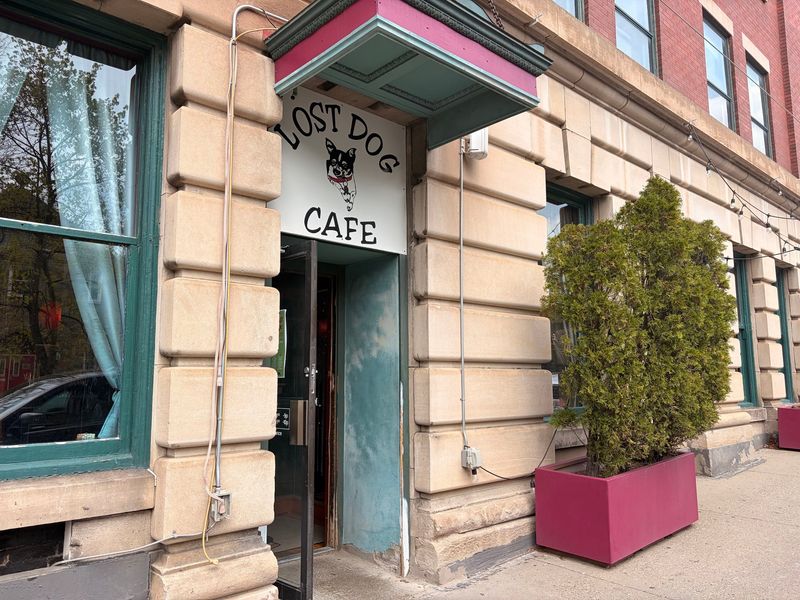
The restaurant owes its name to Hughes’ chihuahua, Clarese, who was known for getting lost in Binghamton, leading to the two and their close friends posting hand-drawn “lost dog” signs throughout the neighborhood. Clarese, who was thankfully found each time she got lost, remains the unmistakable mascot of the restaurant to this day — her image proudly sits above its front door, and her portrait adorns one of the restaurant’s walls.
On Oct. 21, 1994, the restaurant that would blaze the trail for Binghamton’s downtown food scene opened its doors for the first time.
The lack of resources may have seemed insurmountable, but Lost Dog’s first location was defined by turning an unlikely situation into a success.
Because the kitchen wasn’t ready yet and a liquor license hadn’t been procured, the business stuck to serving coffee and dessert for its first night — but the line out the door ensured Lost Dog didn’t close until around 4 a.m.
Following its initial success serving desserts and coffee, a menu was developed, with Hughes pulling inspiration from her favorite dishes she had tried during her time in New York City — the restaurant’s famous rigatoni a la vodka is based on a recipe from Stingy Lulu’s, a 1950s-style restaurant in the East Village that featured drag queens as waitresses.
Unlike in New York City, McKenna said many of the restaurant’s offerings, including veggie burgers and hummus, were unique to Lost Dog in the Binghamton area. The restaurant made sure to offer vegetarian and vegan options, including soy and rice milk for their coffee drinks.
“Back in the day, you would really just get places that had milk,” said McKenna. “Nobody would have alternative milk. So that was really interesting for the area, and I think people really liked that it’s something new. And then it just kind of took off.”
Lost Dog Café moves downtown
In 1997, the opportunity to move into a space in downtown Binghamton opened up, and with the old garage’s condition continuing to deteriorate, a move was on the horizon. At the time, the two said the area only had a couple of restaurants, including local mainstay Little Venice.
In April 1997, they reopened Lost Dog at 222 Water St., anxious to see if the restaurant’s success could continue in a neighborhood many deemed unfit.
“The first night we opened here, we had no idea what to expect because there wasn’t anything downtown, but we were packed,” said Hughes. “There were only three of us in the kitchen, and it was like a bomb went off.”
“Again, it was another huge learning curve,” said McKenna. “We didn’t have a host at the door — we didn’t even know you needed a host, because we were a little coffee shop, you know?”
As years passed, the two bore witness to more restaurants popping up, with development redefining the neighborhood’s character. In 2010, Lost Dog was one of seven restaurants to participate in Binghamton’s first Restaurant Week — in 2026, the biannual event has expanded to more than 20 restaurants and raises thousands for charity partners. McKenna also serves as the president of organizer eatBING.
‘We are all here together’
From the start, inclusivity and acceptance have been key tenets of Lost Dog’s business. Inspired by the diversity and inclusion in New York City, Hughes and McKenna have always strived to create a place that could feel like home for anyone.
“Everyone coexisting next to each other is what we tried to create here,” said McKenna. “Liz has always said that you could come in and see somebody with piercings next to a businessman next to an elderly woman. It’s a feeling like we are all here together.”
That warmth and closeness was put to the test during the COVID-19 pandemic, when the restaurant closed for about six weeks and at first reopened only for takeout orders with a skeleton crew, forcing estrangement in a business that has always championed togetherness.
“There was a bit of relief when they actually closed everything down, because at least we knew,” said Hughes. “Because we were just feeling like we can’t ask our staff to come in, they’re going to be exposed. We’ll sort it out after, but at least people are going to be safe and we don’t have to worry.”
With the help of government programs, pickup orders and a dedicated base of customers, Lost Dog made it through the pandemic, and found new ways to support the people who keep it running.
How Lost Dog puts its staff first in a competitive, fast-paced industry
According to McKenna, COVID-19 exposed the fast-paced, stressful facets of everyday life — and Lost Dog was no different. These days, the restaurant is only open five days a week to ensure all staff members get a weekend.
“A lot of people left our industry, chef after chef saying, ‘I’m working how many hours, and I have no life,'” said McKenna. “So everybody has two days off; we will close those two days and you can do something with your family, or your partner or whatever.”
For McKenna and Hughes, a massive part of Lost Dog’s continued success comes down to an incredibly talented and dedicated staff.
“I think especially now, we’re in a place where we have great managers,” said Hughes. “They’re good at everything they do. They do things the way we would want them done and even better.”
Unlike some of their employers when they worked in restaurants, the two want to see that their employees not only feel comfortable and supported, but have the freedom to live their lives the way they want.
“Marie has been a server, I worked in the kitchen, and we know it is truly hard work,” said Hughes. “And to treat your staff poorly, when they’re dealing with all that, it’s not OK. We live fairly simple lives; we don’t need anything like a beautiful car. I’d rather have this longevity and for the people that work here to not hate their jobs.”
Lost Dog’s present and future
In April, Press & Sun-Bulletin readers voted for their favorite brunch spots in the Binghamton area. Despite being open for brunch only for a few hours each Saturday, Lost Dog easily took the top spot, receiving more than 20% of the total vote — echoing Hughes’ vision for a great local brunch place that dates back more than 30 years.
At its core, Lost Dog Café & Lounge is the heart of downtown Binghamton’s restaurant scene, and it has been since the start. From supporting the local community by hosting VINES Spring Farm to Table dinner, a yearly Pride Month party and LGBTQ afterparty following LUMA, to playing a key role in the city’s Restaurant Week, it’s hard to deny that over the past 30 years, Lost Dog has become synonymous with Binghamton.
When asked if Lost Dog could go on for another 30 years, both McKenna and Hughes were quick to say that even if they aren’t around to run the restaurant, the culture and energy of Lost Dog could easily continue well into the future.
“It might not be us, but we would love it to continue,” said McKenna. “We would love the feeling and the essence of what we built to continue. We would really love that.”
This article originally appeared on Binghamton Press & Sun-Bulletin: Lost Dog Café finds its way into heart of Binghamton’s downtown food scene
Reporting by Riccardo Monico, Binghamton Press & Sun Bulletin / Binghamton Press & Sun-Bulletin
USA TODAY Network via Reuters Connect