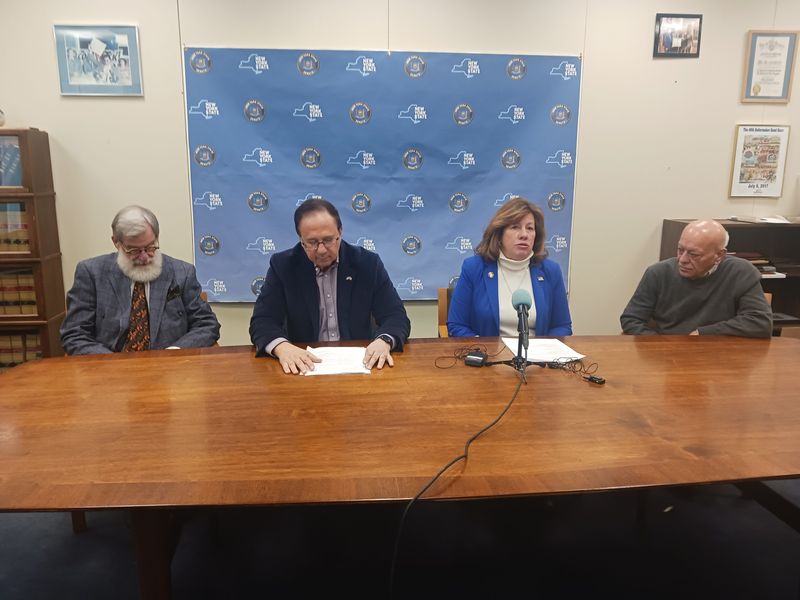
Two local state politicians are working across the aisle to address a shortage of healthcare workers in Upstate New York.
State Senator Joseph Griffo, R-Rome and Assemblywoman Marianne Buttenschon, D-Marcy, who share constituencies in the Mohawk Valley region, announced their advocacy for “a major policy initiative” that would serve to “recruit and retain doctors and improve the quality and availability of health care for all New Yorkers, especially those in more rural areas of the state,” during a press conference on Dec. 15.

The legislators poised their new push to take action as provoked by the the recent release of a New York State Comptroller’s Report that focused upon the shortage of healthcare professionals in 16 rural upstate New York counties, which included Chenango and Herkimer counties, and revealed “alarming shortfalls in primary care, pediatric, and obstetrician and gynecologist (OBGYN) doctors, dentists, and mental health practitioners, with several of the counties examined now having “no pediatricians or OBGYN doctors at all.”
Steven Kussin, MD and Sudershan Dang, MD, both physicians who have lived and practiced in the Mohawk Valley for over 30 years, joined the legislators at the State Office Building in Utica to endorse the initiative and echo the urgency around the provider shortage, warning that it is creating “healthcare deserts” across upstate New York.
Package introduced
Griffo has introduced a package of legislation to address the issue, calling for the improvement of the “Doctors Across New York” program, which incentivizes providers with student loan repayment and practice support programs (S.5071), expansion of the “START-UP NY” program to include incentives to primary care providers to practice in “otherwise underserved areas of the state (S.5075),” and the provision of partial tax exemption for the purchase of a primary residence and location of a practice in an area designated to suffer from a shortage of providers.
Buttenshon has introduced “companion legislation (A.716)” to Griffo’s bill (S.5099) that would allow students who enroll in “a state-supported medical school” to benefit from the Excelsior Scholarship program and for non-resident students “residing within a certain distance of the border of New York State to have tuition rates reduced to two-thirds of what they would otherwise pay in out-of-state tuition in exchange for agreeing to practice in New York State for a prescribed number of years.
Griffo met with several practicing and retired physicians from Upstate New York to inform the development of the bundle of bills, hoping that it will serve to solve the shortage of healthcare providers in the region.
“If we can put pieces of legislation together into a package,” said Griffo, “we can address the issue.”
Area providers emphasize quality of life as best incentive to recruit
Kussin and Dang both effused about all the Mohawk Valley region had to offer, including natural beauty, affordability, quality schools, and good neighbors.
“Whatever you need,” said Dang as if to physicians looking for a place to live and practice, “we have it here.”
Kussin advised that “recruitment of physicians is key” and that he believes the physicians themselves who already live and practice in Central New York, together with their spouses, need to be recruiting physicians from outside of the region by introducing them and their families to all the area has to offer.
“Show them the grace of living here,” said Kussin.
When asked what he believed would attract more doctors to the region, Kussin replied with a word, “lifestyle!”
He shared that when he first relocated from New York City to the Mohawk Valley, his colleagues were asking him, “Why are you going there?”
“Now,” said Kussin, “they’re saying, ‘I should have gone with you.’”
Focus on the shortage of primary care providers in Upstate
The doctors and legislators drew attention to the specific issue of a pronounced shortage of primary care providers
“They are the basis for all care,” said Kussin, “and they are the lowest paid, on-call demands are severe”
He concluded to warn that “primary care is a national problem.”
Dang noted a two prong problem where fewer physicians are seeking to practice primary care and the physicians who do are growing older. He emphasized the approach of attracting young physicians looking to start a family and a practice to the region who would be enticed by the affordability and quality of life.
A place to start
Griffo framed the bill as a blend of best practices already working in other places, and new ideas to compete with those approaches.
When queried about the timeframe, from the passing of the bill to people seeing its effect in the form of better access to care, the legislators agreed that this is the beginning of a process, with the next step being to “get our colleagues on board.”
Griffo defined the bill and the conversation they sparked on Dec. 15 as a place to begin. He believes the package of legislation advances “good ideas” but is also open to others sharing more ideas.
“We will work with the chairs of healthcare committees in both chambers,” Griffo said. “We need to start.”
What is best for the people of New York matters most
Buttenschon addressed the issue of reasonable access to care.
“Too many families across upstate New York know the frustration of searching for a doctor, only to discover there are no providers nearby or that practices are full,” Buttenschon said in a statement. “This is not just a healthcare issue, it is a quality of life issue.”
The legislators expressed a mandate to respond to the people of New York who are appealing to them to address the emerging healthcare crisis.
“Every New Yorker deserves access to affordable, reliable, and timely care,” said Buttenschon.
Griffo echoed that priority, emphasizing that what matters most “is what is best for the people.”
The legislators spoke with both optimism that the healthcare challenges could be solved and urgency that the work to do so must begin.
“I want to stop discussing it,” said Griffo, “and do something about this issue.”
This article originally appeared on Observer-Dispatch: Legislators, physicians warn of emerging ‘healthcare deserts’
Reporting by Cara Dolan Berry, Utica Observer Dispatch / Observer-Dispatch
USA TODAY Network via Reuters Connect