With grandchildren consumed by hockey, visits to the rink are a weekly occurrence for Mike Dossier.
So are reunions. Twenty-five years after last coaching a high school game, run-ins with former players are a weekend tradition. What follows are chats about the game, as most of those former players are at the rink in service of their own children, and offers to catch up over breakfast.

To this day, in a tier with his own wedding day and having kids and grandkids, thinking back to the 1995-96 Greece Lightning hockey season serves as Dossier’s ultimate pick-me-up.
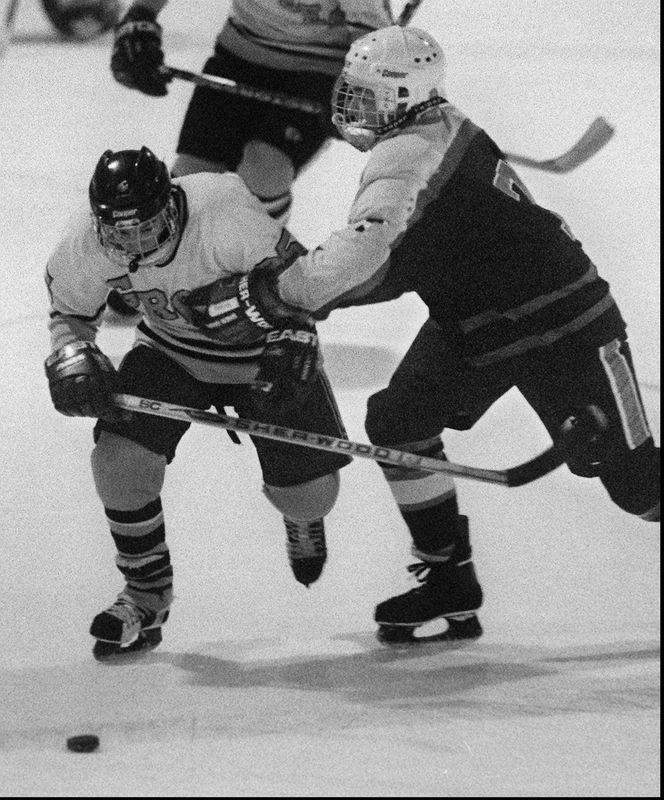
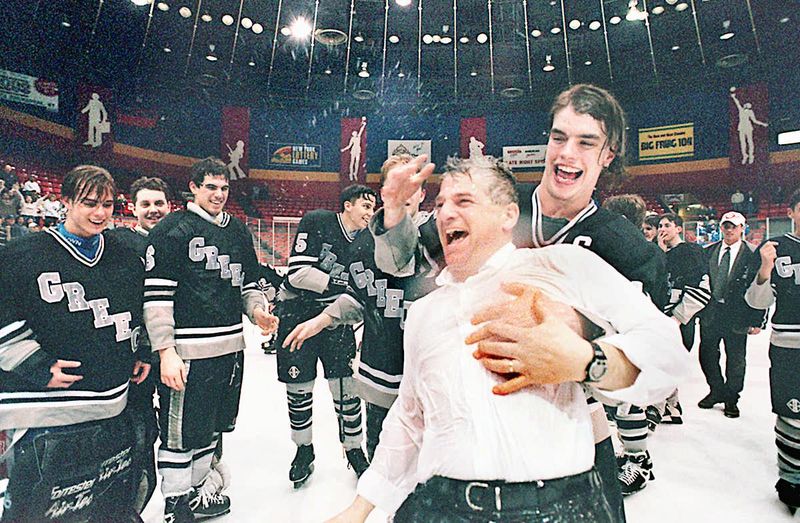
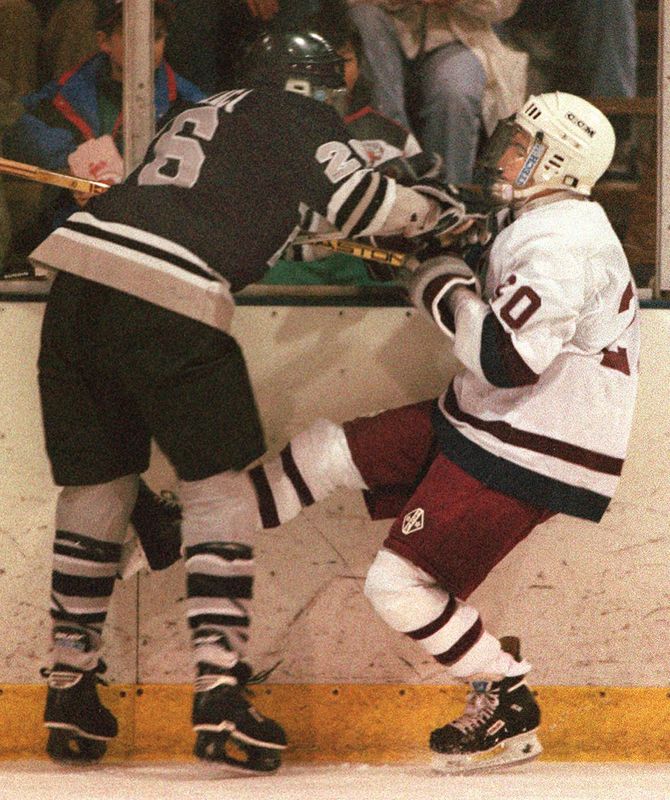
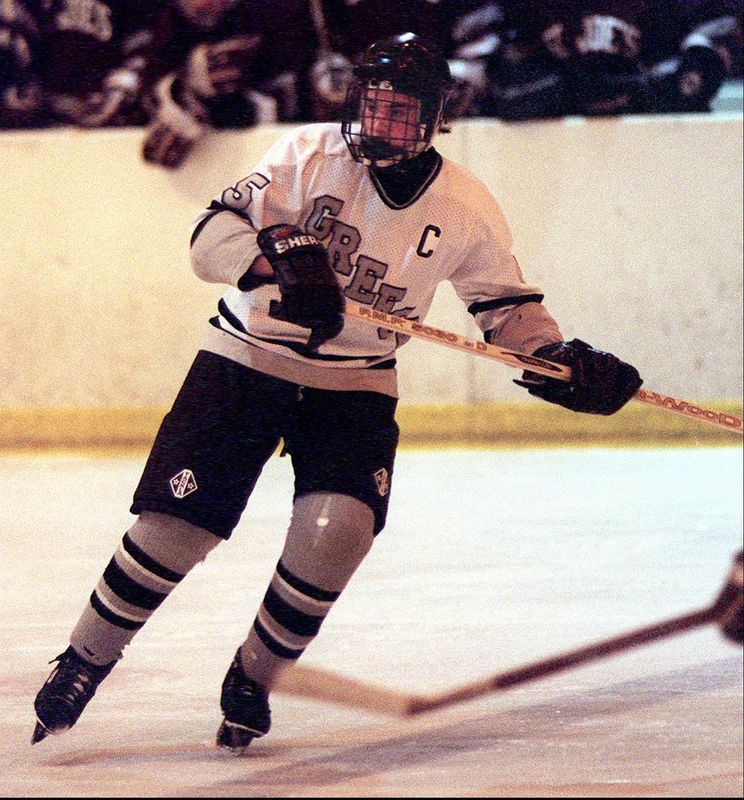
That winter, Greece became the first Rochester-area high school hockey team to win a New York state title. March marks the 30th anniversary of that milestone.
“It’s probably the highlight of my life,” Dossier said. “It’s a great, great memory.”
In the 1980s and early 1990s, Section V was an afterthought to the rest of New York state, especially in comparison to hockey hotbeds like central New York and the north country.
In a sense, Greece put this region’s high school hockey on the map. But the program’s success, lifted not only by a wealth of talent but the combined enrollments of each of Greece’s high schools, stirred mixed emotions from the competition.
“A lot of it was based on jealousy,” said Dave Insalaco, a senior on the Lightning’s 1995-96 team. “We were really good.”
Section V’s new powerhouse
Ask a hundred citizens of the Greater Rochester area their thoughts on the town of Greece, and a hundred different opinions may follow. Once upon a time, it wasn’t up for debate.
Situated close to the once-prosperous Eastman Kodak Company, Greece was considered among the fastest-growing towns around in the mid-20th century, while the area itself, once thought to be “worthless swamp land,” was ripe for suburban development. In 1967, Greece overtook Irondequoit as Monroe County’s most populated town and was referred by the Democrat and Chronicle as a “mini city.”
One branch of that tree was growing interest in ice hockey. Lakeshore Hockey Arena, which opened in the early 1970s, was located in Greece and headquartered Rochester Youth Hockey, the top organization for young players. Any skater with hopes of playing Triple-A, the most competitive level of travel hockey, did so through Greece’s twin rinks.
“Everything was based out of Lakeshore,” Insalaco said. “I think that’s why you had such a large volume of talented players on the west side at the time.”
As far as high schools were concerned, if Aquinas, McQuaid and Irondequoit were the old guard of Section V hockey, Greece was the boisterous new kid on the block. Combining student-athletes from high schools Arcadia, Athena and Olympia, the black-and-silver-clad Lightning reached the state semifinals in 1989 in only its third year as a varsity program.
Coached by former Rochester Americans defenseman Ray Maluta, tryouts for Greece’s hockey team included upwards of 60 participants. Many, following their varsity careers, went on to play collegiately. Above all was Jason Bonsignore, the fourth overall pick by the Edmonton Oilers in 1994, who starred for Greece as a freshman and sophomore from 1990 to 1992.
Making the team was no small feat, so players wore their varsity jackets as a badge of honor … and were treated like de-facto celebrities around town.
“It was a big deal to be on the Greece Lightning hockey team. Wherever you went, if you wore that jacket, people would come up to you. It really brought a lot of people together to root for Greece.” said Jason MacBride, a former goaltender. “It was a really prosperous and upcoming community, and you could feel the energy and love for the hockey team. When we played home games at Lakeshore, it was standing room only.”
“We were proud as peacocks of that program,” said Tony Robinson. “We were a public school, we were from the west side. I thought living in Greece was the coolest thing since sliced bread growing up. We had everything right at our fingertips.”
Goodbye, Monroe County
Odd as it is for someone whose adult life was preoccupied with hockey, Mike Dossier didn’t have much of a background with the sport growing up. While attending Aquinas in the 1960s, his hot spot was the gridiron.
Dossier never played organized hockey. His playing experience was limited to the pond.
Still, he had keen interest in the sport. Dossier remembers observing a local youth hockey practice, where the drills were unorganized and the players inattentive. Despite lacking a personal track record, he offered to help out. Within a few years, he led Rochester Youth Hockey’s squirt team to a New York state title.
By the late 1980s, after a brief stint as Aquinas’ assistant, he joined Ray Maluta’s staff at Greece. And by 1993, he was the Lightning’s head coach.
“A guy who probably never should’ve been a coach at all, ends up being around for awhile and having a phenomenal time,” Dossier said.
Dossier’s expertise wasn’t necessarily Xs and Os, but he had an innate ability to build culture and connect with players. It was a stark contrast to the previous coach, Maluta, a former professional who was “very knowledgable, very strict, very regimented.”
“He knew when to coach and when not to coach, when to be that father figure or coaching figure, and when to let us loose and do our thing,” said Robinson. “We knew how to play the game. (Dossier) was there to implement the conditioning and team building and other things we needed as young kids.”
“If you did your job, he was a great guy to play for. He was very friendly and gave us a lot of room to be creative,” said top scorer Bobby Garrison. “We’d make a suggestion and he was more than willing to hear us out and do his best to accommodate. Not having that hockey background probably helped, because he didn’t have an ego.”
Culture-building was imperative for a program that had team members at three different high schools, at a time that pre-dates cell phones and social media.
Spaghetti dinners at the Dossier household, with matriarch Kathy and daughter Lucy supplying the pasta, are among the fondest memories.
Sometimes, a coach’s job is to foster motivation. And there was plenty of it after Greece was ousted from the Monroe County league and forced to operate as an independent program prior to the 1993-94 season.
Administrators cited Greece’s tryout process as a primary reason. Former Section V hockey chairman Peter Cardamone told the Democrat and Chronicle in 1993 that the town of Greece had 70 high school-quality players, but 40 were annually left off the roster. “Our business is to provide kids with an opportunity to play,” Cardamone said.
It was often suggested that Greece de-merge its hockey program into two teams, which the school district scoffed at due to projected costs of about $25,000.
Some thought Greece’s removal from the Monroe County league reeked of envy. Greece, a public school district, wasn’t allowed, but private schools like Aquinas and McQuaid were.
The decision also rendered Greece’s players ineligible for all-county awards.
“I remember sitting in the Ritter locker room at RIT (prior to a sectional final), and everyone is getting recognized for being player of the year and this and that. It’s like, I had f—– 60 points, I should be out there,” Insalaco said. “It just drove us and motivated us to be successful.”
The independent status was a blessing in disguise. Greece’s booster club, led by parents Peter and Mary Ellen Oppelt (son Shaune played defense), raised over $20,000 for the 1995-96 season to help fund bus trips and games against New York state’s top competition.
“My thing always was, maybe we had a little edge because we had more kids to pick from,” Dossier said. “But when push came to shove, if it wasn’t for (being independent), we would’ve never won a state championship.”
“All we cared about was winning sectionals,” Garrison said.
In 1995-96, Greece did that … and then some.
Lightning strike state tournament
Greece, after making state tournament appearances in 1989 and 1991, was not immune to down years.
The 1992-93 season was a changing of the guard. Bonsignore, the team’s top player, left after his sophomore season in 1992 to pursue a junior hockey career. Remaining was a core heavily dependent on freshmen, and the team struggled to a 9-11-1 record (though the Lightning still managed a section semifinal appearance) in Ray Maluta’s final season.
With a strong nucleus in 1993-94 and 1994-95, under Dossier’s leadership, Greece’s expectations were a championship.
Instead, the Lightning’s scoring machine was shut out by Batavia in the 1994 semifinals (despite doubling their opponent’s shot total). And in the 1995 playoffs, Greece fell to Pittsford, a 20-win team that the Lightning defeated twice in the regular season, in another semifinal exit.
“We underachieved,” recalled Insalaco. “I remember going to K.C. Burritt’s house and we’re sitting in the basement not knowing what would happen with the team, and how maybe guys would go play juniors. I didn’t want to feel like this again, We said, we are not losing our last game, it’s not f—— happening. From that point on, that’s what it was all about.”
While the 1995-96 team couldn’t match the previous groups’ talent, perhaps the playoff disappointments were a necessary stepping stone. Greece, now in its third season as an independent, shrugged off all competition.
En route to a 20-win regular season, Garrison, a senior, set team single-season and career records in scoring (passing Bonsignore), while the goaltender MacBride set Section V records for consecutive games (four) and periods (15) without allowing a goal.
“That Greece team was outstanding, and I knew they had a chance to win states,” said Aquinas’ Montgomery, whose team was one of the Lightning’s victims. “They scored goals, but defensively they were outstanding. One of the best defensive teams I ever coached against.”
The Lightning averaged over five goals a game, discarding New York state blue bloods like Massena, Rome Free Academy and Canton in the process. Greece’s lone blemish during the 1995-96 regular season was a 5-3 loss to St. Joe’s out of Buffalo, a result rectified in the teams’ second matchup.
One team Greece did not play in the regular season was Section III’s Oswego, who defeated Greece 10-1 the previous winter. When the eager Lightning requested a rematch in 1995-96, Oswego couldn’t fit the game into its schedule.
No matter. Greece breezed through its three Section V tournament games and opened the state tournament with wins over Canton and Suffern. Waiting in the final was Oswego, and Dossier had some buttons to press following the perceived snub.
“Oswego really beat us up the year before. We needed another game against them, we had an off day,” Dossier said. “I think it was scheduling, we just couldn’t make it work. But we said, ‘They don’t want to play us! They’re afraid of us!’ We made it dramatic.”
Following puck drop at the Utica Auditorium, Greece controlled play in the first period, taking a two-goal lead on scores from Insalaco and defenseman Brian Cooper.
However, Oswego featured future NHLer Erik Cole and SUNY Oswego scorer Matt Vashaw, and proved a worthy adversary. The Lightning coughed up the lead only five minutes into the second period with consecutive goals against.
The rest of the game was a rollercoaster, but with 59 seconds left in regulation, junior Justin Booth — a role player in any estimation — put home a rebound attempt to seal a 4-3 win and the first New York state title for both Greece and Section V.
Said Oswego coach Pete Sears after the game, “We’re not quite as deep as Greece and it caught up with us. That’s as good a team as we’ve seen, no doubt.”
A town divided
Good things can’t last forever. For so long, the Greece Central School District pushed back on the notion of two hockey teams.
After another state tournament appearance in 1998, groans about Greece’s large talent pool were echoed around New York state, not just Monroe County. NYSPHSAA, the governing body for New York state’s high school athletics, threatened to remove Greece’s merged teams from its association.
Prior to the 1999-2000 season, the Greece school district announced the upcoming hockey season would be the last for that iteration of the Greece Lightning, and the team would be split in two.
“I don’t know, I was disappointed,” Garrison said. “Obviously it’s an expensive sport and schools gotta do what they gotta do. Back when they did it originally, I think it was mostly complaining from people that didn’t want to compete with us. I couldn’t imagine being halfway through my career and having to play against my best friend in the same school district.”
“I think it was unfair, what happened,” said Hilton coach Chris Monfiletto. “We had other teams that merged. Pittsford pulled from two schools. Greece was a team that really represented Section V well.”
Greece’s final season as a completely merged hockey team ended in gut-wrenching fashion. Facing Massena in the state quarterfinals, the Lightning took a 3-2 lead with under two minutes remaining, only for Massena to counter with two goals in 37 seconds — including the winner with 15 seconds to go.
An unceremonious end for a program that helped put Section V in the spotlight. And also the end of Dossier’s coaching career, as he exited the program after the season.
“With the split, I didn’t want to coach against kids that I had when it was both teams,” Dossier said. “It was a good time, but it was getting to the point I was ready (to step down).”
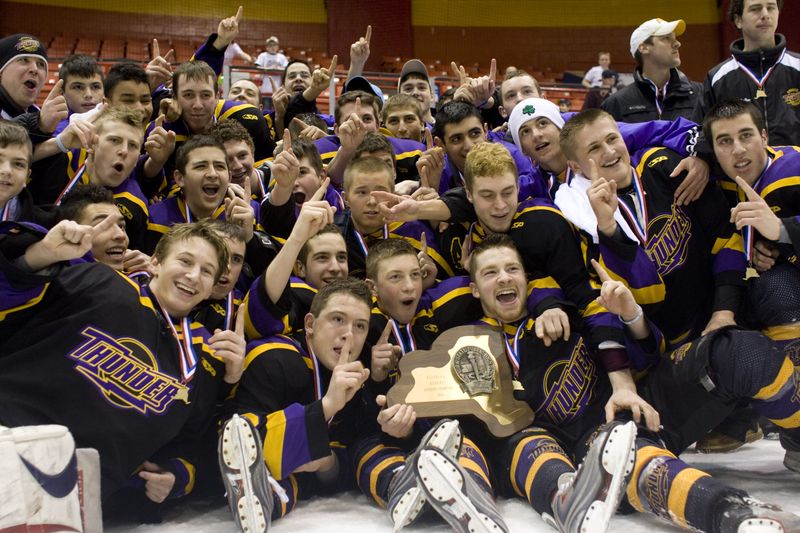
Keeping the weather theme, Greece divided its hockey teams as such: Arcadia and Olympia combined and maintained the Lightning nickname, while Athena and Odyssey became the “Thunder.” The teams played each other twice, sometimes three times a year, in a matchup called the “Storm Game.”
Elsewhere, opposing teams finally had their wish.
“It was the political reason … Greece central was giving more people the opportunity to play,” said Rob Howell, a former Lightning player and later Arcadia/Olympia coach following the split. “The bigger cloud around it was always other teams and Section V saying, ‘They win every year, how can we make it more fair for the rest of Section V?'”
Team success largely favored Athena/Odyssey. Under coach Dan Webb (Dossier’s assistant in the final merged season), the Thunder won three Section V titles in the next decade.
In 2009, the Thunder became only the second team in New York state history to finish undefeated, capping a 27-win season with a 3-2 win over Mamaroneck in the large school final.
That team featured four players who’d later play at Division I colleges.
Looking back, members of the 1990s Greece teams accepted the school district’s direction. Clearly Greece had enough manpower to support two teams, and there were financial considerations to justify the decision.
“I understand why they split. It was short-lived, being independent. There was the volume of players and the talent for it,” Insalaco said. “It just wasn’t practical to have one team anymore.”
The break up, however, didn’t last forever.
Imperfect Storm
Jason MacBride never envisioned a long career in hockey after high school. He didn’t become a starter until his senior year in 1995-96, and even then shared the net with freshman Keith Hahn.
While he played club hockey at the University of Rochester, his future was beyond a pair of pads. Nowadays, he’s the district attorney of Ontario County, elected to the position last November.
While he still maintains connections to Greece, MacBride — along with many of his former teammates — chose to live elsewhere in his adult life.
“I never thought I’d leave Greece. We were born there, raised there, my wife works there. It really was a wonderful community … and still is,” MacBride said. “But socioeconomically, the town has changed significantly.”
When MacBride graduated in 1996, enrollments for Greece’s four high schools, including Odyssey which rarely contributed players to the Lightning, amounted to 4,603 students.
Student enrollment for the current 2025-26 academic year has dipped to 2,367.
While the vanishing of students affects all sports, niche ice hockey has languished the most. The days of 60-plus kids at tryouts are a distant memory, and for much of the 2010s Greece’s hockey teams didn’t even make cuts.
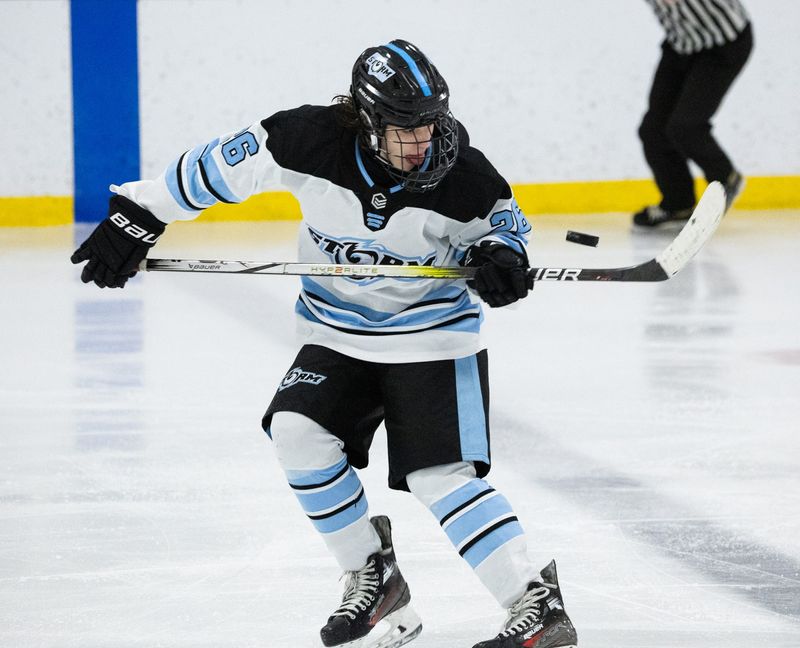
That spurred a re-merging of the hockey teams, forming the Greece “Storm” prior to the 2017-18 season.
“When the schools re-unified, I remember being pretty pissed they didn’t go back to the Greece Lightning, with the colors and everything,” MacBride said. “It would’ve been a wonderful opportunity to bring the program back where it started. It was a missed opportunity, and something that was regrettable as a former Greece hockey player.”
There were growing pains too. Howell, who carried over from Arcadia/Olympia as the Storm’s coach, remembers having a locker room cut in half at first. Former Thunder players would sit on one side of the dressing room, Lightning players on the other.
It wasn’t until well into the season that student-athletes set aside their old rivalry.
“They all knew each other, but still looked at each other as Thunder and Lightning kids,” Howell said. “It was like that for the first eight or nine games, and I think we won only one game (in the first half of the season).”
Since re-merging its hockey teams Greece has finished with a winning record only twice in nine seasons and has failed to advance past the section quarterfinals in that period. A far cry, for a program which expectations were once championship or bust.
With over two-thousand high school students, Greece still laps the rest of Monroe County, so declining enrollment alone cannot explain the hockey team’s downturn.
Former players offered several theories. Lakeshore Hockey Arena, where Greece still plays its home games, is no longer the hub for top-notch youth hockey. And onlookers argue that Section V’s talent pool in general has diminished, as many of the area’s top players forego high school hockey in favor of junior programs or prep schools.
Asked whether Greece can return to its former glory on the ice, there are doubts.
“I wish I could say so, but I’m not naive to how things have changed,” Insalaco said. “I don’t know if it’s possible. I don’t think it will. That’s not bias toward my era, it’s just knowing what’s going on in the world of hockey and the cost, and how the dynamics have changed in general.”
If that’s the case, as they say, Lightning won’t strike twice.
— Justin Ritzel works as a sports reporter for the Democrat and Chronicle, with a focus on Section V athletics and high school trends.
This article originally appeared on Rochester Democrat and Chronicle: Greece hockey made history 30 years ago. Why that glory may never return
Reporting by Justin Ritzel, Rochester Democrat and Chronicle / Rochester Democrat and Chronicle
USA TODAY Network via Reuters Connect