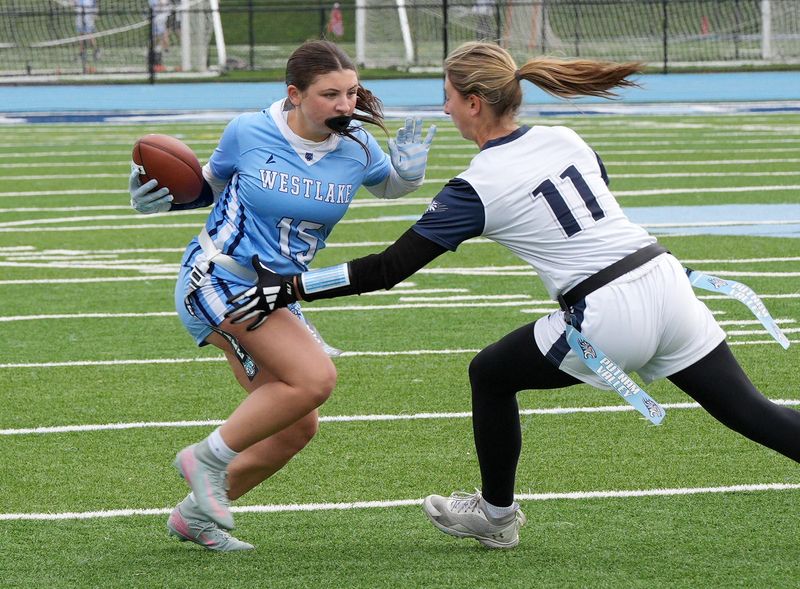
Flag football is one of the fastest growing sports in the United States, building in popularity through the last decade with the establishment of organized youth leagues and its adoption as a varsity high school sport.
That surge is likely to accelerate in the coming years with men’s and women’s flag football being added to the 2028 Olympic Games and the NCAA in January announcing its commitment to having it become a sanctioned collegiate sport.

New York is among 19 states that offer girls high school flag football as a varsity sport, officially approving it in 2023, and the Lower Hudson Valley already has produced some elite teams, despite most of the athletes being novices.
The sport has existed since at least the 1940s, considered a recreational alternative to traditional football whose non-contact format eliminates the need for helmets and elaborate padding.
So, what are the major differences between this sport and tackle football? And how do the football fledglings quickly adapt?
Tackle football vs. flag football
Smaller field dimensions: The standard high school flag football field is 80 yards long and 40 yards wide with 60 yards of playing field and two 10-yard end zones. A traditional football field has a 100-yard-long playing area with two end zones.
Fewer players: While standard tackle football calls for 11 players on each team on the field at once, flag football is a 7-on-7 game. The offense typically includes a quarterback, center and some combination of five receivers and running backs, while defenses utilize linebackers, defensive backs and a rusher.
Non-contact: The rules allow only minimal and incidental contact, and any intentional shoving, hitting or holding is penalized. The players typically wear belts with two flags attached and, instead of tackling, a play ends when the ball-carrier has a flag pulled from their waist. Once the flag is pulled, a whistle blows and the ball is marked at that spot.
Scoring: Like traditional football, the offense has four downs with which to operate and can advance the ball via the run or pass, and the objective is to reach the end zone. A touchdown is worth six points but, instead of a kick, the point-after tries are plays run from the line of scrimmage. Teams can opt to go for an extra point, which requires them to reach the end zone from the 3-yard line, or a two-point attempt from the 10-yard line.
Defense: The assignments are similar to that of tackle football, just without tackling. A rusher is tasked with pressuring the quarterback to get a sack or force an errant pass. The linebackers, cornerbacks and safeties cover the offensive skill-position players down field. A fumble is marked a dead ball at the spot and doesn’t result in a turnover, unless the defensive player recovers the ball before it hits the ground. Interceptions are turnovers and can be returned.
Length of the season: Flag football teams compete in the spring in New York, with its season running from late March to June, as opposed to tackle football which is played in the fall. The New York State Public High School Athletic Association rules allow for 16 regular season flag football games, about twice that of tackle football, so teams will often compete 2-3 times per week.
A crash course in football
Scarsdale High School coach Thomas Newkirk played tackle football at the University of New Haven and has since organized and competed in adult flag football leagues and coached at the youth level. He guided Scarsdale to an undefeated season and a state championship last year.
In building his team, he said, he often recruits athletes with a background in basketball and/or soccer, as their “footwork and coordination” tend to translate well.
In teaching an athlete with little to no football experience, the most basic fundamentals are the starting point.
“I teach them where and how to line up, how to position their feet to run a route, and proper technique in catching a football,” he said. “For the quarterbacks, you start with how to grip the ball to throw it. They’ll usually pick that up within a few days, then we get into defense: How to stay in front of the person you’re covering, how to properly grab a flag.”
Somers High School assistant coach Katie DiChiaro founded the first all-girls flag football youth league in New York in 2018, and it’s since grown and kickstarted a wave of similar organizations. With that, some of the underclassmen in local high schools now have played the sport since grade school, so the learning curve is shortened for them.
Most teams in the area have about two dozen offensive plays, each having some optional variations like pre-snap motion and route adjustments, DiChiaro said. The players must learn those schemes and, in addition to practice, teams study film of themselves and upcoming opponents.
“We sometimes take for granted that these girls are incredible athletes who want to learn and improve,” DiChiaro said. “They’re smart and willing to put in the effort to develop their skills, so once they’ve learned the basics, you’ll see them processing the information and getting better with every rep.”
Stephen Haynes covers sports for The Journal News/lohud.
This article originally appeared on Rockland/Westchester Journal News: Flag football is surging in popularity. How different is it from tackle football?
Reporting by Stephen Haynes, Rockland/Westchester Journal News / Rockland/Westchester Journal News
USA TODAY Network via Reuters Connect