Julia Schmidberger has several roles, each of which carry a great deal of responsibility and some pressure to perform.
She is a freshman at the College of Staten Island, maintaining a 4.0 GPA while majoring in Biochemistry and Spanish, and is part of an exclusive honors program. And those obligations are juggled alongside playing two sports and being involved in multiple campus clubs.

The former Somers High School standout was recruited there as a soccer goalkeeper, then soon joined the flag football club team, playing in college a sport she had picked up only four years earlier.
What might seem overwhelming to most is what Schmidberger considers the most enjoyable aspect of her college experience. “I’ve loved it here,” she insisted.
But a conversation last winter made her wonder what she might find even more fulfilling.
The NCAA ruled on Jan. 16 that flag football would be added to its Emerging Sports for Women program, with a promise of funding and promotion from the governing body of collegiate athletics.
Frank Jennaco, Schmidberger’s former club coach, was then hired by Manhattan University, one of several schools with a Division I athletic department that announced it would sponsor a varsity flag football program. Jennaco then contacted his former pupil with an offer.
“It was a difficult decision, mostly because of the academic opportunities at (College of Staten Island),” Schmidberger said, “but the chance to play Division I flag football is amazing. I love soccer, but I’ve always been more drawn to football. All the adrenaline and excitement I feel playing it just at the club level, I can only imagine what it’ll be like at ‘D1.’ I’m so hyped!”
At the conclusion of this semester, Schmidberger will transfer to Manhattan to join the flag football team for its inaugural season as a varsity collegiate sport.
With more than 60 colleges now featuring the sport and offering scholarships, and that January ruling further establishing its standing, Schmidberger is likely among a wave of women whose collegiate route is being recalculated.
This is the latest step — and a significant one — in the expansion of flag football, which is one of the fastest-growing sports in the world. Its addition to the 2028 Olympic Games is reflective of that.
Participation has surged in recent years in the United States with an estimated 2.4 million children playing in organized leagues in 2024, which was a 71% jump from the previous year, according to the International Federation of American Football.
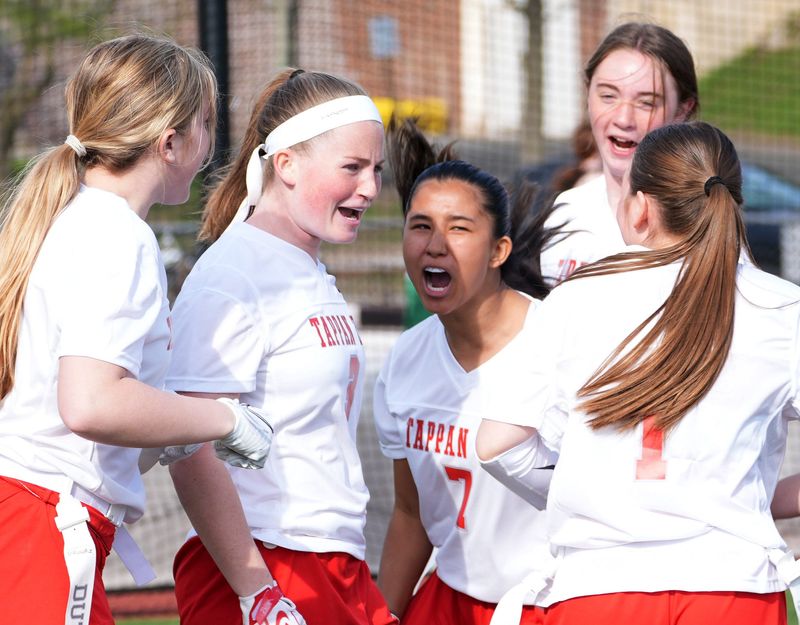
Girls high school flag football has grown exponentially in New York in quick time, and a few of the local teams have already distinguished themselves. Scarsdale went undefeated last spring, dominating the large-school competition and becoming the first area team to win a state championship in the sport. Tappan Zee almost matched that feat, reaching the state final in its classification.
The New York State Public High School Athletic Association groups schools into geographic sections. Section 1 covers Westchester, Rockland, Putnam and a portion of Dutchess County. This area has 36 varsity teams, the most of any region in the state, and more than four times as many as it started with in 2022.
Of course, New York isn’t alone as 19 states and Washington, D.C. now sanction flag football as a varsity sport, including New Jersey, which joined earlier this month. Another 21 states are having pilot seasons, essentially giving the sport a trial run before approval.
The added visibility of the Olympics, the support of the NFL, and the involvement of major corporate sponsors like Under Armour, suggest the sport could soon soar beyond its fledgling level.
“It means there’ll be resources and promotion behind it, and it’ll be seen, and that’s really exciting,” said Scarsdale High School coach Thomas Newkirk, who has competed in and operated adult leagues since 2000 and helps run Northeast Flag Football, a prominent Connecticut-based youth league. “It means flag has come a long way from just being a hobby. This sport is legitimate.”
Raising the flag locally
As its name suggests, flag football is a modified version of traditional American football.
The rudimentary concepts are similar, but it’s a non-contact sport with a 7-on-7 format played on a shortened 80-yard field. The players wear belts to which flags are attached and, in lieu of tackling, a play is stopped once a flag is yanked out.
It’s viewed as a safer and more convenient alternative to football, one not requiring helmets and padding, and presenting far less risk of injury.
The sport has existed in the United States since the 1940s, commonly played recreationally in parks and backyards. It eventually was adopted by several colleges as a club or intramural sport, essentially a recreational offering to students.
But in recent years, with the proliferation of youth leagues helping to spur early interest and player development, flag football has been pushed to the forefront at the high school level and now, perhaps, collegiately.
It’s projected that upwards of 100 colleges will add the sport within the next two years, lending itself to the possibility of there eventually being an NCAA flag football tournament.
One of the captivating elements, for players and viewers, is the template allowing for a showcase of athleticism. With more spacing than traditional 11-player football, speed and agility are accentuated.
“It’s entertaining to watch, and that definitely helps with the popularity,” said Newkirk, a White Plains native who played cornerback in tackle football at the University of New Haven. “A lot of these girls, you already know they’re good athletes, but they’ll still surprise you with some moves in the open field.”
Another benefit, Somers assistant coach Katie DiChiaro said, is the sport being accessible and affordable for most.
Local high school teams draw heavily from athletes in other sports, some of whom have no prior experience playing football. Soccer and basketball players translate well, Newkirk said, as those players usually have the coordination and athleticism to adapt, even if they’re just learning the nuances of football.
Tappan Zee sophomore Addy Zayac joined their flag football team after being cajoled by quarterback Eve Girardi, days after they helped the girls basketball team win a state championship in March.
“Eve convinced me to try it,” the rookie defensive back said. “She and coach (Darrell) Flynn were right, I’m picking it up as we go and it’s a lot of fun.”
Girardi is a soccer star committed to Central Connecticut State University, but her dad is a longtime football coach and, almost through osmosis, she and her siblings became passionate about it.
“To see it become what it is now is awesome,” said Girardi, who began playing flag football in the first grade, initially on boys teams. “Football has always been a male-dominated sport, but it’s incredible to see so many girls getting into it and loving it. We’re still in the early (stages) right now, and it’s only going to get bigger.”
Running it up the flagpole
DiChiaro fell in love with football as a kid, influenced by her older brother, and grew up in Hastings-on-Hudson playing it at recess and in neighborhood pickup games.
But she really became immersed after joining the intramural flag football team at the University of Tennessee and competing with other athletic women from around the country who took the sport seriously.
“That’s one of my core memories,” said DiChiaro, who now has three daughters. “That inspired me to want to give that feeling to my kids and other women.”
She is credited as the de facto progenitor of the flag football boom in the Lower Hudson Valley.
DiChiaro founded in 2018 the first all-girls youth flag football league in New York, introducing the sport to kids as early as kindergarten and helping develop their skills. She and her friend Jenn Kisslinger also established a local women’s league, which the 45-year-old competes in.
“We’re grateful,” Newkirk said, “because flag wouldn’t be what it is here without Katie.”
The success of her league helped birth others and drove interest, later helping to fuel a statewide groundswell for the establishment of girls flag football as a high school sport. The New York State Public High School Athletic Association was convinced and 48 teams across six sections were organized for a pilot season in 2022. Section 1 had eight teams that year, quickly put together within a month before the inaugural spring.
Schmidberger was among the newcomers, the lifelong Chicago Bears fan getting a chance to play a version of organized football. She made Somers’ varsity team as a freshman and eventually developed into a standout at several positions including linebacker, wide receiver and punter.
“Interest is what they’re looking for,” DiChiaro said of the pilot concept, which is somewhat like the first episode of a TV show. “During that season, you’re operating as an independent program, kind of detached from the other teams at the school, and you’re not eligible for the playoffs. But you’re competing against other schools. If enough kids participate, then the next year it’s adopted as a varsity sport.”
NYSPHSAA sanctioned flag football in 2023 and established a state championship tournament in 2024.
It helped, of course, that the NFL got on board as an early supporter. The Jets, Giants and Bills help sponsor the New York teams, hosting clinics and offering some funding for equipment.
DiChiaro has been a liaison, working with the Giants community relations staff and fostering a connection with Section 1. She was named High School Girls Flag Football Coach of the Year by the Giants last summer.
Somers High School each year hosts a flag football preseason jamboree that draws most of the local teams for instructional practice and scrimmages, and the Giants send players to help coach. Some NFL organizations have hosted flag football exhibitions during halftime of games, and the Giants have had local teams participate in field day events at their practice facility in New Jersey.
“Sometimes with girls sports, we feel like there isn’t as much recognition,” said DiChiaro, who stepped down as head coach and became an assistant at Somers this year when her daughter, Kelly, made the team. “Having the NFL involved makes the girls feel special; it lets them know that the sport is for real.”
Safety is still a concern
The Centers for Disease Control and Prevention conducted a study on sports-related head injuries last year and found that youth tackle football players sustained 23 times more high-impact head injuries than in flag football. On average, flag football players endured about eight incidental head collisions per season and concussions account for 5-8% of the injuries.
That obviously doesn’t mean the sport is without risk. Its structure and officiating attempt to ensure there is minimal contact, but that’s difficult in a fast-paced game with athletes often lunging, leaping and diving at full speed.
“The rules are meant to protect them, and we coach them to avoid penalties, but there will always be incidental contact,” DiChiaro said. “I’ve mandated my players wear headbands as a protective measure (against) concussions.”
The U.S. women’s national team wears soft-shelled headbands with material that provides some cushioning for a potential head collision. Several companies produce specialized headbands, including Guardian Sports, best known for its Guardian Cap, a protective football helmet cover meant to reduce the rate of concussions.
“It’s important for the girls to protect themselves,” DiChiaro said, “and trying to promote safety should be paramount.”
What’s next?
Iona University and SUNY Binghamton, New York colleges with large athletic departments, are joining Manhattan University in transitioning their women’s flag football teams from club to varsity sports. Dominican University in Rockland County expects to debut a team in 2027.
“It’s creating opportunities for these girls to continue playing a game they love in college and getting some of their education paid for in the process,” Newkirk said. “I don’t think there’s any boundary it can’t cross.”
The Olympics also represents a potential boon in growing the sport, especially with Los Angeles hosting the event in 2028. The United States, Mexico, Canada and Panama are among the premier national teams, but more than 70 countries compete internationally under the International Federation of American Football.
Given the growing interest, the current spotlight and large platform soon to come, DiChiaro said she anticipates flag football becoming “one of the larger college sports” within the next decade.
“What we’ve seen over the last few years, and especially now, is that football isn’t just for the guys,” Schmidberger said. “There’s space for us, too.”
Stephen Haynes covers sports for The Journal News/lohud.
This article originally appeared on Rockland/Westchester Journal News: Flag football is growing here, probably faster than you think
Reporting by Stephen Haynes, Rockland/Westchester Journal News / Rockland/Westchester Journal News
USA TODAY Network via Reuters Connect