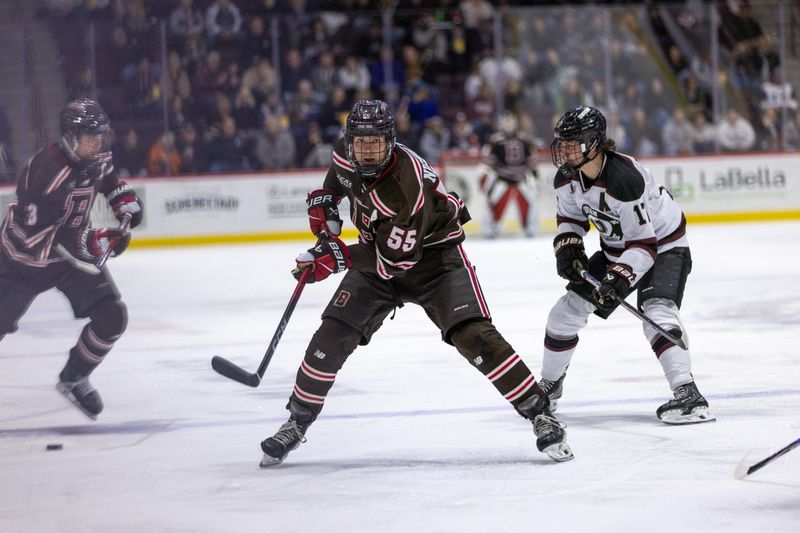
Among college ice hockey commitments, it’s rare for seniors who plan to play at the next level, especially Div. I, to go from high school straight to college ice.
Only two former Section 1 ice hockey players are playing for Div. I teams. They’re doing so in what has become a traditional manner for D-I hockey programs, having first played at the junior level.

After graduating from Suffern in 2022, Ryan Schelling, 21, son of Suffern coach Rob Schelling, spent three seasons in juniors, playing for the NAHL’s Northeast Generals in Massachusetts, the Surrey Eagles and Langley Rivermen, both of British Columbia and the BCHL. Schelling’s a freshman at Dartmouth and through Feb. 16, had played in 24 of the Big Green’s 26 games.
Section 1’s other Div. I player is Scarsdale’s Brian Nicholas, 20. He played for Scarsdale before spending most of his senior season (2022-23) attending Scarsdale classes remotely while playing for the USHL’s Sioux City Musketeers In Iowa. He also played there the following year, as well, before joining Brown University’s team. Last year, as a freshman, he made the ECAC all-rookie team and this year he has played in all 26 Bears games. He participated in New York Rangers prospect camp last summer.
We caught up with the pair to discuss their rise in hockey and their goals.
Q: What’s your first ice hockey memory?
BN: My first ice hockey memory is skating in my backyard with my older siblings (James, Stephen, Erin and Michaela). My parents, as well as my siblings, taught me how to play hockey and I would not be here without them. Growing up, I would always skate in my backyard with James, Stephen and Erin’s high school hockey teammates such as Devon Shell, Matt Blakely and Rob Burns. Even when I was young, there were never any rules and hitting was allowed. Playing with my older siblings and their friends is why I was able to get ahead of the other people my age.
RS: My first hockey memory was skating the flag out before a New York Rangers game.
Q: How old were you when you decided you wanted to play high school ice hockey and then how old were you when you decided you wanted to play beyond high school?
BN: I think ever since I was around 5 and I was watching my siblings play modified hockey in preparation to play varsity hockey, I wanted to be just like them. When they were on the varsity ice hockey team, I was the team waterboy with one of my best friends and future high school teammate Charlie Stemerman. Some of my best memories watching hockey is watching James, Stephen and Erin win back-to-back section championships against Suffern while I was the team waterboy. I always wanted to be just like my siblings.
RS: I always knew I wanted to play for Suffern since the day I learned how to skate. Watching them and hanging around all the guys my entire childhood made it my dream to be a Mountie one day. I always dreamed of being a college hockey player and eventually, hopefully, an NHL player. Once I got to middle school I realized that I could try and make these dreams a reality.
Q: Was there a close-second sport, which you’d play if you somehow couldn’t play hockey and why does it rank so high?
BN: Football was always my second-favorite sport growing up. Being able to play varsity quarterback my junior year before leaving for Sioux City was some of the most fun I ever had playing any sport. I always still play competitive golf in the summers and play in some of the MGA events James used to play in and Stephen still does, so I think I kind of enjoy golf a little bit more now as a way to relax and get away from the rink.
RS: I played lacrosse in high school and I love to golf but nothing compares to hockey.
Q: What’s your favorite memory from youth hockey?
BN: My favorite memory from youth hockey is having my dad be my coach for my Scarsdale youth team. Being able to drive to the rink every day with my dad and play the sport I love most with him there, supporting, coaching, and cheering me on, was special.
RS: Skating between periods at Suffern hockey games in front of the crowds!
Q: If there’s a moment you could go back to and relive from high school hockey what would it be?
BN: I wish I could relieve all the bus rides, team dinners, and moments making jokes in the locker room with all of my brothers and best friends.
RS: The feeling of winning a state championship with my dad and all my best friends.
Q: What are you most personally proud of from you high school career?
BN: I’m most proud of the lifelong friendships I was able to make with my teammates and coaches. Some of my best friends to this day are my former high school hockey teammates, like Freddy Kushnick, Kyle Kahan and Ian Silberstein, as well as my coaches, Syno and Felix. Both my coaches, Syno and Felix, have meant so much to me and my career. To see them continue to support me and attend my college games and show their support to me shows the character those two have. Even as Scarsdale High School lacrosse coaches, they got to coach my best friend, Colby Baldwin, and they will go to his Penn State lacrosse games, as well. The way I’m able to keep in touch with those two coaches and even see them in the summers and even get dinners with them is so special.
RS: Definitely winning a state championship.
Q: What was the most difficult part of adjusting to juniors – being away, the level of play or something else?
BN: I think the biggest adjustment for me, being so close with my siblings and family, was just moving away at such a young age. Leaving my high school friends and teammates before my senior year was the hardest decision I ever had to make but felt it was necessary in order to give myself the best chance to play in the NHL.
RS: Living away from home is definitely hard. I was very fortunate to have such great billet families and teammates that made that transition easier.
Q: Back home, during high school hockey, what club team did you play on?
BN: I played for the Midfield Jr. Rangers, who were coached by Martin St. Louis and then the North Jersey Avalanche.
RS: New Jersey Rockets and North Jersey Avalanche
Q: Compare and contrast high school hockey, club hockey, juniors and Div, I hockey in terms of atmosphere, level of play, fun and expectations/pressure.
BN: I think every level you move up, the game starts to feel more like a job and your dreams seem closer and closer. The pressure increases, personal expectations increase and the atmosphere is more competitive and better at each level. I think one thing I am very good at is living in the moment and trying to see hockey the same way as I did as a 5- year-old and on the varsity ice hockey team. I will never see hockey as a job, and to me, no matter what level I play at it will always be the game I love.
RS: I don’t think anything compares to playing high school, just the opportunity to play in front of people you grew up with your entire life and, for me personally, my dad. It was the most fun I had playing hockey.
Q: In juniors, how long did the season run and what was your average day and week like? Did you live with host families?
BN: I lived with a host family both years in Sioux City. Kim Coy was my billet mom and is still to this day a second mom to me. I was fortunate to live with two teammates, as well, Max Strand and Hagen Burrows, both who won the Mr. Hockey award in Minnesota high school hockey and play Div. I hockey with aspirations of playing in the NHL. My season in Sioux City was 62 games long and we were there from the end of August to April. My typical day would be a lift, two skates, and two separate video sessions, along with mental game meetings and recovery activities, such as cold tubs and saunas. We would be at the rink from 9-4 every day.
RS: The season is definitely long. You play over 50 games and it’s nine months long, you practice all week and play games on Friday and Saturdays. Yes I lived with host families for three years.
Q: Were there any funny moments from juniors that you can share?
BN: In Sioux City, Iowa, there wasn’t always a lot to do. … Although we were at the rink for most of the day, our team and front office decided to join the local bowling league that occurred every Monday night. Being in such a small town, most of the town attended our games and were fans, so it was really fun to be out in the community, signing autographs and engaging with the community.
RS: The rookie dinners were always fun. The rookies basically dress in funny outfits and treat the rest of the team to a nice dinner.
Q: Was it before high school, during high school, during juniors or only actually playing this year that you became confident you could play at the Div. I level?
BN: I believe the first moment I truly realized I could play Div. I hockey was June 1 after my freshman year of high school and when I ultimately committed to Michigan. This was the first day colleges could offer me and when I received a good amount of calls on this day, It made me realize that my dreams are feasible.
RS: I originally committed my freshman year, so after that I knew I would always strive to live up to that.
Q: No other sport has basically a built-in delay before going to college. Is the delay a good or bad thing or both and in what way or ways?
BN: I was only delayed one year, so I am currently a 20-year-old sophomore. The coaches here thought I was ready to come in last year at 19, even though I was still young. I was able to have a great year and be named to the ECAC All-Rookie team, as well as attend New York Rangers development camp. I believe that the timeline does not matter because my favorite quote is, “You can’t put a clock on your dreams. You can only get 1% better each day to achieve them.”
RS: I think it’s good and bad. I’m 21 now but I feel a lot more matured and prepared for college and college hockey.
Q: Why was Div. I your goal?
BN: I thought it was a better path for me to play in the NHL as opposed to playing major juniors.
RS: The opportunity to play at such a high level and challenge myself and give myself the opportunity to continue playing hockey after college is extremely exciting.
Q: How did you land at your college as opposed to other schools and was this your choice when you started juniors?
BN: I was originally committed to Michigan for three years and then decommitted at the beginning of my second year in Sioux City due to a coaching change at Michigan. I then fell in love with Brown.
RS: I was fortunate enough to commit to Dartmouth, which balances a top hockey program along with top tier academics.
Q: Do you have a declared major and, if so, what? If not, what are you possibly leaning toward?
BN: I have a major in business economics and a minor in astronomy, as well as a certificate in entrepreneurship.
RS: I plan on being an economics major.
Q: What’s the best thing about being a Div. I athlete and the worst thing about it?
BN: The best thing is the friendships I have made along the way both with the men’s and women’s hockey teams, such as my roommate, Charlie Gollob, and are dorm neighbors, Avery Saba and Emma Yates, who we have a tradition of getting Ben and Jerry’s with on Thursday nights before both of our teams’ weekend games.
RS: The ability to compete in a sport you love at a really high level is something that’s really nice about being a Div. I athlete. Obviously, the long hours and after-practices and lifts, having to balance that with school is tough, but it’s something you adjust to.
Q: What is your typical week like now?
BN: We practice Monday-Thursday and play games Friday-Saturday. If the games are away we will travel on Thursday. We also lift Monday-Wednesday and have a team stretch and recovery lift on Thursdays.
RS: A typical week would be, practice Monday-Thursday, workouts twice a week, games on Friday and Saturdays, as well as class every day.
Q: To date, what has been your favorite moment playing college hockey?
BN: Scoring my first college goal in overtime to beat St. Lawrence and having a hat trick and scoring the overtime winner vs RPI.
RS: My first game at Dartmouth’s Thompson Arena, the environment was a lot of fun and it was really exciting.
Q: What’s your favorite pre-game and post-game meal and what’s your favorite snack for bus travel to and from games?
BN: Pre game meal – grilled chicken with rice and broccoli. Post game meal – Chicken parm and pasta. Bus snack: Dried mangos
RS: I love the steak dinners the night before games, chicken parm after games and my favorite snack is probably just the Uncrustables.
Q: What was the biggest misconception you had about college hockey and what is exactly like you expected it to be?
BN: I think college hockey was what I expected it to be. Playing juniors showed me what high-level hockey is like and being able to play in such a special place as Sioux City, I was able to play in front of 4,000-5,000 people every day. I think my experience in Sioux City helped make the transition to Brown extremely easy. Ultimately, college hockey is very similar to juniors. You just have to find a way to manage the school and classes on top of hockey.
RS: I think it’s how I expected it — extremely hard days and long hours. But I love it. We have an amazing group, so it makes coming to the rink every day easier.
Q: Looking back, what about your personality, work ethic or approach most helped you reach this level?
BN: I believe my reluctance to take no for an answer and (reluctance to) let other people beat be in drills, sprints, and battles in practice. As coach Syno would attest to, I always have had to be the first on the ice and last off and I have always had to make sure I win every sprint we do.
RS: I’m always open to learning new things and trying to always improve my game.
Q: You come from a sports-rich family. How much has that played a role in your own athletic story? And did someone inside your family or outside it inspire you in some way?
BN: All of my siblings and both of my parents have always inspired me. Growing up in such a competitive household, where there was only one winner every single day, I was taught and shown what it takes to achieve my goals.
RS: With both my parents playing sports — my mom lacrosse and my dad playing hockey — it has always pushed me to be a really competitive person, and seeing all my dad’s records growing up definitely inspired me a lot.
Q: Is Div. I ice hockey the end goal or do you see yourself possibly making this a career?
BN: I want to play in the National Hockey League.
RS: I would love to play hockey for as long as I can.
Q: If a career, what do you need to do between now and then?
BN: In order to make it to the NHL, I think I just have to keep enjoying the process. I don’t want to get ahead of myself. So, I think the most important thing for me is to just live in the moment and focus on the process as opposed to the outcome. In terms of hockey, I just have to keep working on my skating with my skating coach, Eric Nates, in the summer.
RS: Keep improving my game, being a student of the game and always being competitive!
Q: If there’s one thing or a couple of things you’d like current youth-level and high school players back home to know, what would you tell people thinking about playing college hockey?
BN: My coach growing up for the Westchester Express, Luigi Olinto, who to this day is one of the best role models and influences of my career, always told me that, “Hard work beats talent when talent doesn’t work hard,” so I would want to tell them that no matter how much or how little talent they have, hard work does not take talent and you can always be the hardest worker. Good things happen to those who enjoy the process of getting 1% better each day.
RS: Always be learning and working on improving. Always try to be the most competitive player on the ice. Winning is a choice. If you want it bad enough, you will be successful!
Nancy Haggerty covers sports for The Journal News/lohud.
This article originally appeared on Rockland/Westchester Journal News: College hockey players Ryan Schelling & Brian Nicholas on their paths
Reporting by Nancy Haggerty, Rockland/Westchester Journal News / Rockland/Westchester Journal News
USA TODAY Network via Reuters Connect