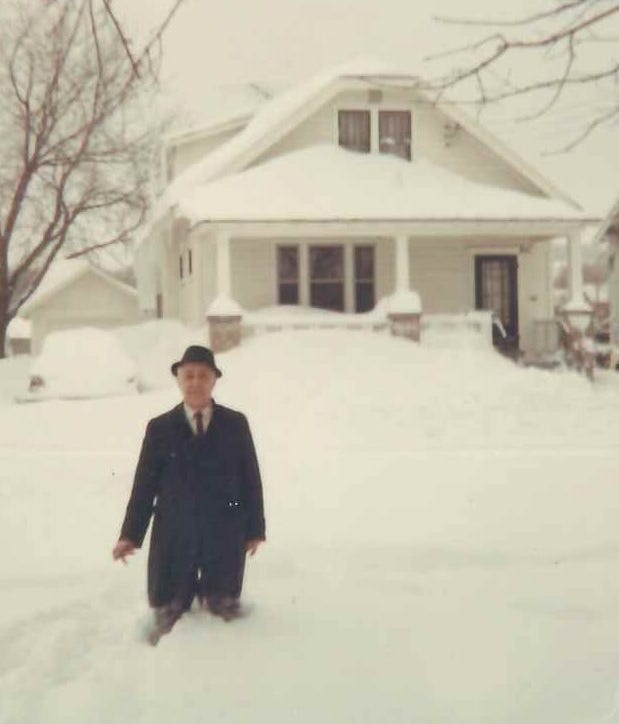
Do you remember a winter snowstorm, well, really a blizzard, so intense that schools, stores, banks, public transportation, courts and most businesses shut down for a few days because roads are impassable?
Do you remember the New York State Thruway closing all the way from Albany past Buffalo to the Pennsylvania state line, stranding more than 1,000 drivers and their passengers in the Indian Castle service area where space was so tight that they have to stand up all night?

Do you remember plows being taken off impassable roads so that one could wait at a Utica fire station in case the fire engines needed to get to a fire and others were dispatched to bring doctors to hospitals to treat emergency cases?
Do you remember 32.9 inches of snow falling in three days in Utica, which reached about 50 inches when added to snow already on the ground and lake effect snow that fell the day before and the day after the blizzard?
If so, you must be older than 60.
All of that happened during the Blizzard of ’66, which hit New York on Jan. 30 and 31, and Feb. 1 in 1966 and put Oneida County in the National Oceanic and Atmospheric Administration’s record books for the biggest, single-day snowfall in state history and, in fact, in East Coast history.
The blizzard dumped an astonishing 50 inches of snow on Camden in one day, listed in the records as Feb. 1, 1966, and 68.2 inches over the course of three days, according to NOAA data on the biggest one, two and three-day snowfall records for every county in the country.
About the Blizzard of ’66
The blizzard started in the south, a nor’easter, although no one called it that back then, and gained strength as it moved north along the East Coast before it hit an Arctic front from Greenland, said Jim Farfaglia, of Fulton, author of “Voices in the Storm: Stories from the Blizzard of ’66,” published in 2015, and “Historic Snowstorm of Central New York,” published in 2022.
“Warm air meets cold air. And it collided and created this big, monstrous storm,” he said. “The reason why I think in our area it was so significant was (that) then lake effect kicked in sort of after the nor’easter moved through.”
The storm hit 20,000 square miles, including the whole Northeast as well as parts of the South and Midwest, Farfaglia said. During the same time period, snowfall records that still persist were set in several counties in Virginia, Mississippi, Tennessee, West Virginia and Indiana, according to NOAA.
The storm started in New York on Saturday, Jan. 30; the “epicenter” hit on Monday, Jan. 31; and it started to move on by Feb. 1, Farfaglia said. There can be some confusion, though, about just when it started and ended because parts of the region experienced lake effect snow right before and after the blizzard, he said.
But the impact of all that snow was clear — people were trapped for days.
“I think one of the reasons it remains so monumental is because we didn’t have the technology we have today,” Farfaglia said. “Today we get warned about nor’easters 10 days ahead … but back then, it really hit a lot of people who were unprepared.”
Blizzard of ’66 stories
Farfaglia, 70, remembers going to a surprise birthday party for his grandmother the Saturday before the blizzard.
“And by the time the party was over and we were going home,” he said, “there was quite a bit of snow and fog.”
The Syracuse Post-Standard failed to publish during the blizzard, Farfaglia said, as did the Oswego Palladium-Times, the latter for the first time in 100 years, according to the O-D archives.
But another newspaper, the Advance Journal in Camden, published throughout the blizzard because employee Jim van Winkle made a hair-raising drive from Williamstown to Camden in horrible conditions to get the paper out, said Faraglio, who interviewed van Winkle, later the editor of a successor newspaper the Queen Central News.
While many area newspapers published lists to let readers know which businesses had decided to close, the Camden paper found it easier to simply print the much shorter list of what was still open, Farfaglia said.
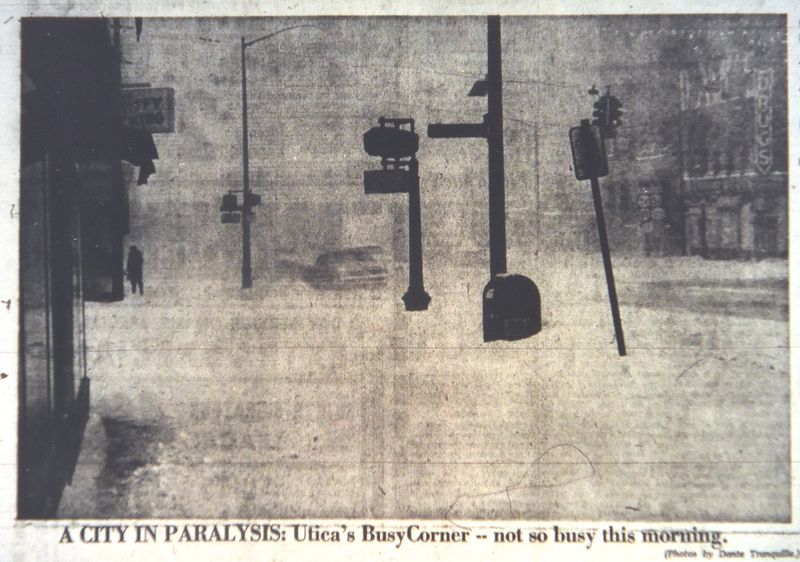
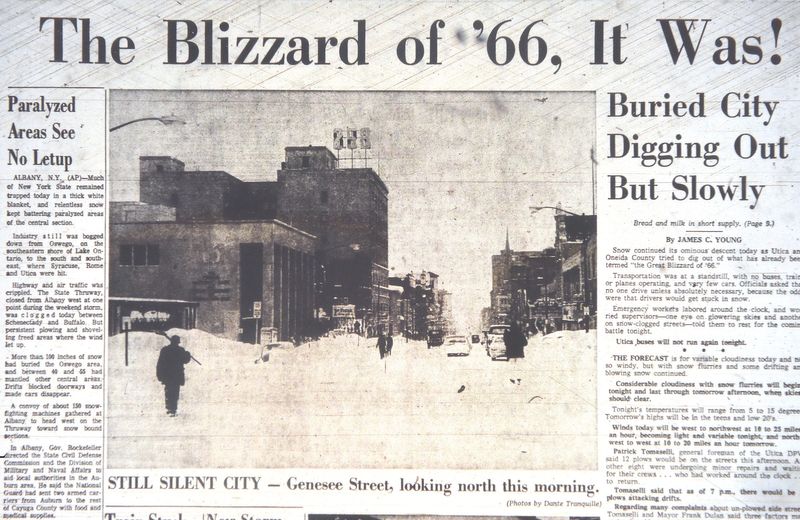
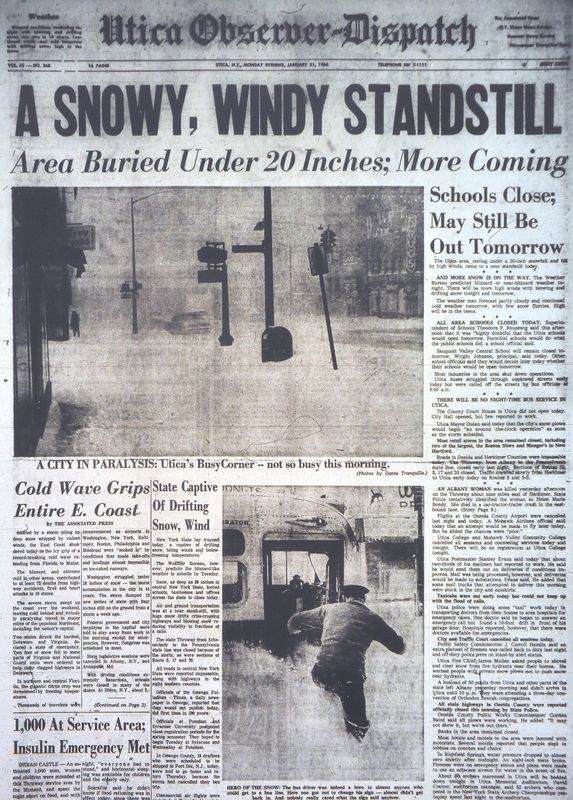
Coverage and photos in the O-D archives shows that Oneida County and Utica shut down as the heavy snowfall and high winds moved in. The top headline in the paper, which was an evening paper in those days, on Jan. 31 read “A SNOWY, WINDY STANDSTILL.” A photo of an intersection in Utica on Jan. 31, 1966 shows streets without traffic and just one person standing on a sidewalk through a blur of falling and blowing snow.
Plows had to raise their blades several inches to get through the snow on the roads. Eight-foot drifts hid parked cars on Culver Avenue in Utica and abandoned cars blocked side streets throughout the city.
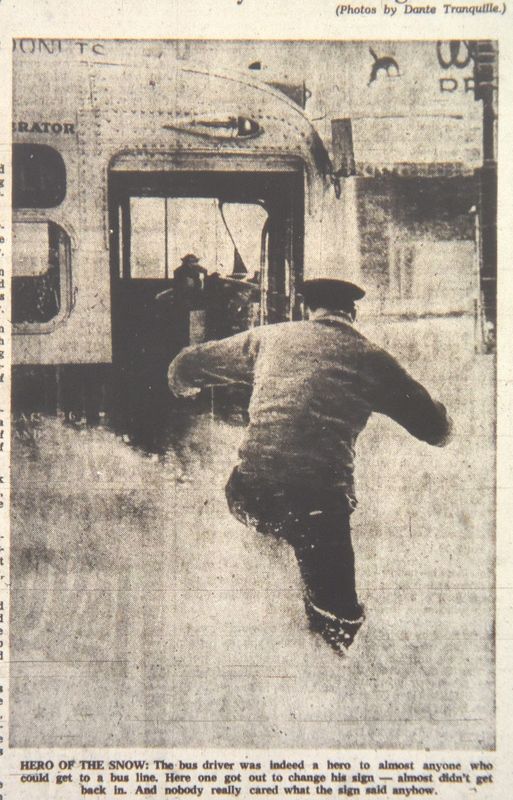
Hotels and motels throughout the area were packed with stranded motorists, and some had people sleeping in their lobbies after they ran out of rooms.
After the New York State Archery Championships on Jan. 31, 52 archers were stranded at the Utica Memorial Auditorium for at least two nights.
A train traveling to Buffalo from New York City took 25.5 hours to arrive.
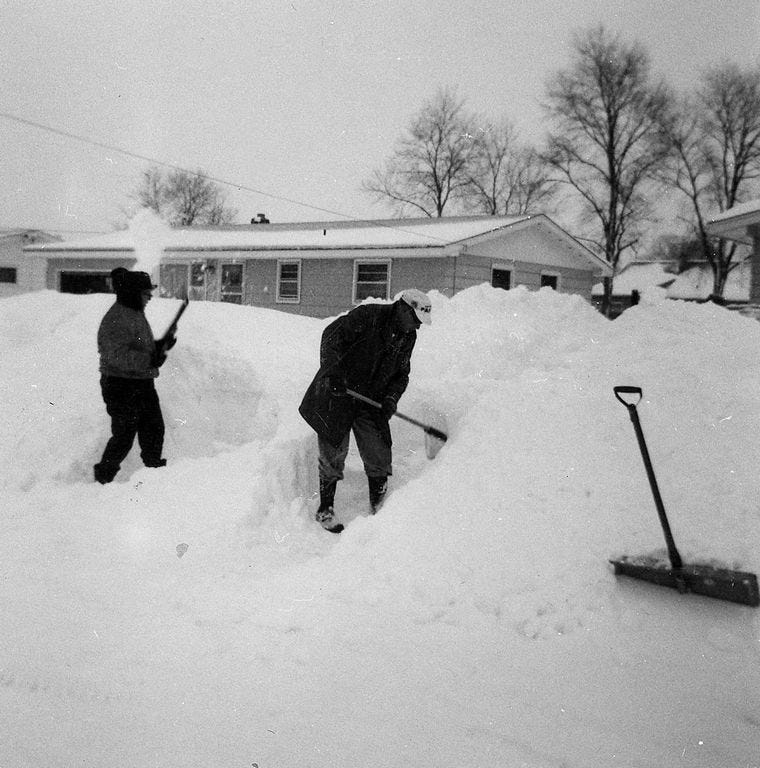
Ernest Portner, 92, from the Town of Lee, remembers trying to log after the Blizzard of ’66. They had to shovel each tree out from about six feet of snow until they could get low enough to cut it with a chainsaw, he said.
That blizzard was definitely a bad one and so was another in the mid-70s, worse than anything in recent years, he said.
They worked three days and nights without a break, Portner recalled. It took them about a day and a half to make it 14 miles to Thompson’s Corner, he said.
“It took 24 hours to get seven miles to Rome,” he added.
He still has three of six plows his dad used to have that are fitted with skis on the front and treads on the back, the oldest from 1924, he said.
Portner said he saw a county plow trying to clear a 10-foot snow drift off the road near his home. It kept hitting the snowbank, backing up and banging into it again, he said. Hitting the drift sent the back of the truck into the air, but the plow eventually made it through after about half an hour, Portner said.
“It was bad. This main road was plugged for, I think, four or five days,” he said. “And nobody could get through.”
But eventually, plowing and shoveling stopped helping.
“There was finally no place to put it anymore,” Portner said. “It was so deep. You couldn’t put it out of the way.”
Record snowfall in other states
But the distinguishing feature of the 1966 storm was how quickly it dropped so much snow. NOAA’s National Center for Environmental Information has records on the largest single-day snowfall recorded in every county in the United States with the records going back as far as 1872.
The 50 inches that fell in Camden in 1966 remains, 60 years later, the largest single-day snowfall in the East, one spot ahead of New Hampshire where the biggest, one-day snowfall was 49.3 inches in Coos County at the Mt. Washington weather station, a place famous for its terrible weather, on Feb. 25, 1969.
The states with counties that beat Oneida County’s record with more than 50 inches of snow within one day include California (five counties), Colorado (four counties), Washington (two counties), Alaska (two counties), Idaho (two counties), Oregon (one county) and South Dakota (one county).
The record goes to Pierce County, Washington where the Ranier Paradise weather station recorded 70 inches on Jan. 26, 1955.
The center records of the highest recorded snowfall in each county does not yet include data from this winter.
More snow in Jefferson County?
Oneida County did almost lose its top-snowfall-in-a-day title, Farfaglia said.
An accumulation of 68 inches of snow, fallen within 24 hours, was measured in Adams in Jefferson County in 1976, he said. But questions arose about the statistic and further research revealed that the snow had been measured improperly, Farfaglia said.
So the measurement was thrown out and Jefferson County did not take Oneida County’s record.
It doesn’t matter how much snow a place gets or how quickly if there isn’t someone there to measure it and make a record in keeping with NOAA standards.
Record snowfall in other counties
Here are the top single-day snowfalls for the snowiest counties in New York and some more local counties, listed by ranking within the state, county, location of weather station where the snow was measured, date and snow measurement, according to the national center:
The lowest record was the Bronx, which got 19 inches of snow on Feb. 12, 2006.
No other counties in New York have one-day snowfall records from the Blizzard of ’66. But several storms over the years have set records in multiple counties, including on March 15, 2017 when records were set in Madison, Otsego, Hamilton and Essex counties.
A storm on Dec. 17, 2020 set records in seven counties, including Chenango, Broome and Schenectady. And a March 14, 1993 storm brought record, one-day snow totals to seven counties, including Onondaga and Cortland.
Records for two- and three-day snowfall
But if Camden got a lot of snow in a short time in 1966, its overall snowfall during the blizzard wasn’t as record breaking. During the blizzard, Camden got 65 inches of snow in two days and 68.2 inches over three days, according to the national center.
Both of those totals are still records for Oneida County, but neither is a statewide record. Lewis County got 69.3 inches at a weather station at Highmarket over two days ending Jan. 6, 1988, according to national data. Oneida County and Camden’s two-day total came in second statewide.
And Camden’s snowfall in 1966 drops to fourth place among the list of each county’s highest snow accumulation over three days. Erie County tops the list with a measurement of 86.5 inches at a weather station in East Aurora on Nov. 20, 2014, followed by a measurement of 84.2 inches at Highmarket in Lewis County on Jan. 1, 2002.
Oswego County came in third place, also based on the 1966 blizzard. Although Camden got more snow in one day, over the course of three days, Mallory in Oswego County got 70.2 inches, ending Feb. 1, 1966.
And when it comes to snow accumulation over the course of two days or over the course of three days, New Hampshire and Mt. Washington took the highest spot in the East with 77.1” in two days on Feb. 26,1969 and 91.1 inches in three days during the same storm.
The same records show that 33 counties in Florida, 11 in Georgia and three in Hawaii have never had measurable, one-day snowfalls since record keeping began.
This article originally appeared on Observer-Dispatch: Blizzard sent record snow to Oneida County 60 years ago. How it unfolded
Reporting by Amy Neff Roth, Utica Observer Dispatch / Observer-Dispatch
USA TODAY Network via Reuters Connect