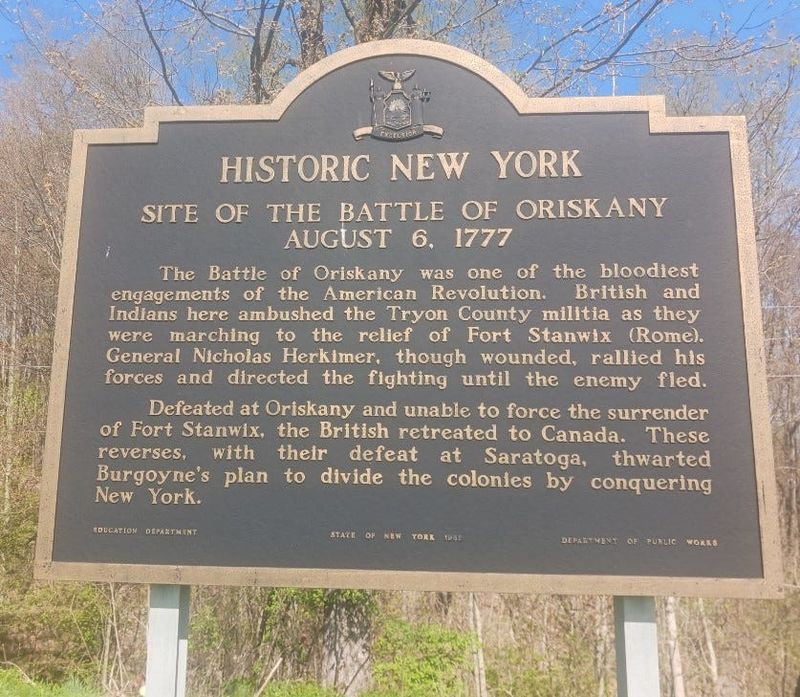
August 6, 1777. The date of the revolutionary Battle of Oriskany.
August 6, marks the 249th anniversary of what is remembered as one of the bloodiest battles of the American Revolutionary War.

Commander of the Tyron County Militia, Brigadier General Nicholas Herkimer had advised Commander of the Continental Army’s 3rd New York Regiment, then Colonel Peter Ganesvoort at Fort Stanwix that he would be leading a contingency to fortify the fort’s stand against a British siege.
The British had ceded the southern colonies. The Northern colonies though, boasted the web of waterways that allowed for the transport of labor and goods between the Canadian border and harbor cities along the Northeast seaboard.
Even before the Erie Canal would burst open those trade routes, their value to the nation that controlled them could barely be quantified. And – as it had been during the French and Indian War – the Mohawk Valley and its crucial “carrying place, the Oneida Carry, were critical to control.
To the victor would go the spoils of centuries.
Past is prologue
The epilogue to the telling of the story of the Raids at German Flatts (modern-day Herkimer, NY) serves at once as prologue to the Battle of Oriskany.
Many of the same characters – such as Nicholas Herkimer and George Washington – play roles in both stories. In the French and Indian War, they led on behalf of the British; in the Revolutionary War, they would lead the battles against them.
The entanglements engaged in by these foreign imperialists and their North American colonists fractures the Six Nations of Iroquois, the people indigenous to the land. Efforts on the part of Nations occupying those places hosting the bloodiest of raids at one time fought primarily to remain neutral, but during the Revolution, took sides.
The Mohawk and Seneca Nations aligned with the British. Only the Oneida Nation served with the revolting settlers, earning the enduring designation of “Our First Allies.”
Nicholas Herkimer
Then Captain Nicholas Herkimer, presiding over Fort Herkimer – named for his father – on behalf of the Crown, led militia in beating back the 2nd French raid on German Flatts in 1758.
In 1777, Herkimer, now brigadier general, commanding the county’s militia, would become a profile in courage and an American hero in his valiant campaign in the unexpected yet now infamous Battle of Oriskany.
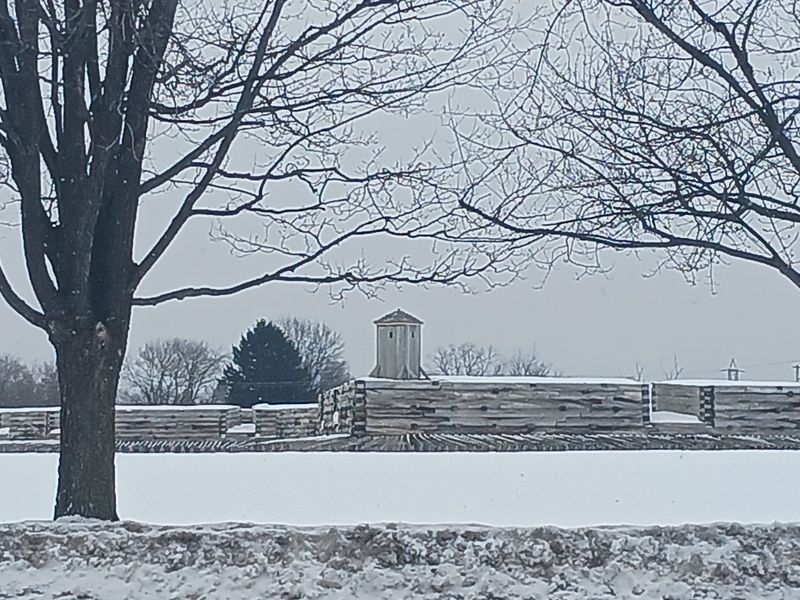
Fort Stanwix
After presiding over the French and winning control of the northeastern states, particularly the Oneida Carry in New York, the British – feeling no further threat to justify its maintenance – abandoned Fort Stanwix, built to fortify their control of the Carry against the French, leaving it to blight and fade, “a ghostly monument to the British victory in the French and Indian War.”
In July of 1776, after signing the Declaration of Independence, the Americans reoccupied Fort Stanwix. Gansevoort tasked one Lieutenant Colonel Marinus Willett with dusting off and shining up Fort Stanwix, bringing it back in service, only now to serve the Americans.
Willett will go on to play a pivotal role in an ancillary battle that will own the legacy of the British failure to reclaim Stanwix.
British Brigadier General Barry St. Leger was tasked with leading the Kings Royal Regiment of New York, 1777 to march on Albany. En route from the North – again through the critical Oneida Carry in the Mohawk Valley – the British forces planned to reclaim Fort Stanwix.
“He was supposed to brush Stanwix away,” said President of the Oneida Carry Research Group John Carmody. “They thought it would be easy.”
It would prove far from it.
An ‘Act of War’
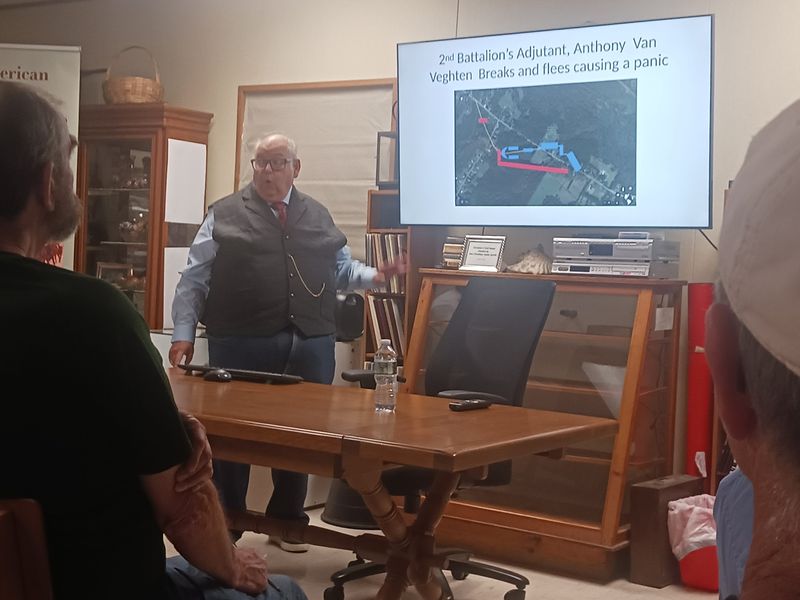
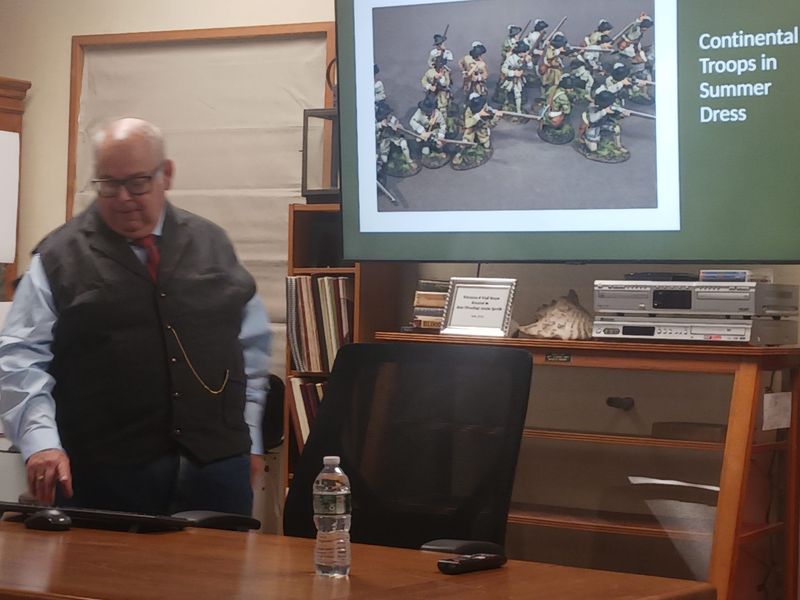
In a presentation titled “Oriskany Battlefield Reconstructed,” hosted by the Oriskany Museum on August 2, local historian and expert on the Oriskany Battle and Battlefield Joseph Robertaccio shared hard won insights into the leaders and lead-up to “the bloodiest battles of the American Revolution.”
“There was an agreement between Joseph Brant and Nicholas Herkimer. The agreement was, so long as Nicholas Herkimer and his troops remained on their side of the Oriskany Creek, there’d be no war,” shared Robertaccio.
“Once Herkimer crossed “the Rubicon,” the Oriskany Creek,” he continued, “it was an act of war.”
“These men were trying to to keep the war from eating up the Mohawk Valley,” Robertaccio conferred.
“They failed.”
The approach and its ‘misfires’
Herkimer, with approximately 800 men, was encamped near the Village of Oriska (now known as Oriskany), six miles east of Fort Stanwix, on August 5.
He sent three scouts to Stanwix with a letter to Ganesvoort hidden in one of their hats, confirming their position and readiness to combine forces to defend Stanwix from the British attack. He requested Ganesvoort fire three cannon balls to confirm his receipt of the message, which would also serve to confirm an expected dispatch of a diversionary sortie to shield Herkimer’s approach.
But the plot grew very thick, as the scouts struggled to move around and past British and Indian positions already established en route to the fort, severely delaying their anticipated arrival at Stanwix.
Meanwhile, at Oriska, tensions grew among leaders, escalated by that delay. As no cannonballs had sounded, Herkimer’s instincts were to wait, but his officers feared waiting and pressed to “march.” Herkimer succumbed to the pressure, against his better judgment, and ordered the advance absent the confirmation.
By the time the scouts arrived at Stanwix, when Ganesvort allegedly fired the three cannon balls, the Battle at Oriskany had already begun. Robertaccio shared that Herkimer never did hear the cannonballs.
Only one of the three scouts survives to return to Herkimer’s force and ultimately confirm that Ganesvoort had received his message.
Ganesvoort orders the anticipated diversionary sortie. To lead it, he appoints Willett. Neither man could know that sortie would serve as a turning point in a battle neither knew already raged in the pastoral little village – a turning point that may well have saved Stanwix – and with it the Northern colonies – from ultimate British rule.
The British learn of Herkimer’s encampment
Molly Brant, wife of Joseph Brant – a Mohawk military leader and British captain who played a prominent part in the American Revolution – is advised by a Scout for the Crown that Herkimer is encamped near Stanwix with over 700 men. She sends two Indians to warn the British, holding on the Lower Landing of the Oneida Carry.
“This causes absolute panic in British camp,” said Robertaccio. “They had no idea anyone was anywhere near them.”
Sir John Johnson, son of William Johnson – key to British victory in the French and Indian War – goes out with “Old Smoke,” the most senior of the war chiefs at 80 years old to pick a strategic spot for a contingent to lay in wait for Herkimer and his troops. They would borrow a page from French tactics in the warfare just two decades ago, “la petite guerre” – also known as “irregular warfare.” Translate in a word – ambush.
The Ambush
Robertaccio shared images graphing what Herkimer’s advance would have looked like, regiments lined up in three separate columns, marching behind what was called the “Fore Guard” – a lead of 30 to 40 men – with a wagon train carrying supplies to the rear.
Indian War Chiefs were strategically positioned to stun the Fore Guard and almost at once attack each column.
The attack on the Fore Guard was bloody and brutal. War chiefs wielded “slaughter weapons: spears, tomahawks, some muskets. They were scalped, speared, some shot.”
“All of this is happening within a matter of seconds,” Robertaccio clarifies.
Robertaccio shares that Herkimer and Brigade Surgeon Moses Younglove, who were traveling in the 1st Battalion column, hear shots and screams and suspect only a skirmish among the Fore Guard. Herkimer dispatches Younglove to investigate on foot while he follows on horseback. From Herkimer’s vantage point, upon seeing the Indian Siege, turns and heads “hell bent for leather,” shouting back to his Surgeon, “Run, Younglove, RUN!”
The 1st Battalion seeks “a little higher ground,” as the Indians attack the wagon trains, Herkimer is reported to have been shot in the leg. This injury would prove to be the mortal wound responsible for his death shortly after the battle.
Only one member of the Fore Guard survived the ambush.
In response to the ambush, Robertaccio describes Herkimer’s troops as “a panicked mob.”
“The Indians liked quick victory, they liked scalps, they liked prisoners” said Robertaccio of the fear that would then cause two thirds of Herkimer’s force to flee.
“Thirty minutes into the battle,” summed Robertaccio, “Herkimer had lost two thirds of his men.”
Herkimer, his wound rendering him barely able to stand, was beseeched to “turn over command” and be removed to receive medical care.
He is reported to have responded, “I shall meet the enemy.”
About 160 American militia and Oneida did not flee that day when, en route to fortify the battle to hold Fort Stanwix. Those 160 men stood with Nicholas Herkimer and fought back, fought what will forever be remembered as the Battle of Oriskany.
The Thunderstorm
Still shellshocked from the ambush and abandonment of the majority of their force, woefully outnumbered by the British on this day reported as one of the hottest of that summer, destiny looks dark for Herkimer and his men … till a lightning storm struck.
“It came straight out of the west,” recounted Robertaccio of the now legendary thunderstorm that then rolled in that day amid the Battle of Oriskany – the likes of which no resident of the Mohawk Valley who has lived through a summer there is not familiar, shocking squalls that unleash deafening thunderclaps and torrents of rain before disappearing as quick as they came.
“It came in the direction of the attack,” said Robertaccio. “That is literally how it is remembered.”
The Seneca Indians, who were fighting with the British that day, held fast to their belief that the Oneida used the sacred Turtle Rattle to summon that storm, knowing it would force a pause in the battle and give Herkimer time to regroup.
While the British changed out their troops, Herkimer did just that, rallying his remaining troops in the adjacent ravine.
In those moments, as noted by a survivor of the Battle of Oriskany many years later who was searching for his brother there, referring to a hill to the West of what is considered the footprint of the Oriskany battlefield.
“The top of the hill was covered with our dead.”
‘Tricks of War’
As fighting resumed, both sides switched up strategies.
Lt. Col. John Butler, British Superintendent of the Indian Department, responsible for engagement with the “Six Nations,” directed a “trick of war;” he had his men switch their “Army of Canada” hats for the hats worn by the fallen men of the militia strewn across the field.
Captain Jacob Gardiner, who commanded Herkimer’s 3rd Battalion, is credited with recognizing the ruse.
“Forget the hats! Look at their coats!” He shouted to his me, “Shoot on, boys. Shoot on!”
Herkimer’s tree
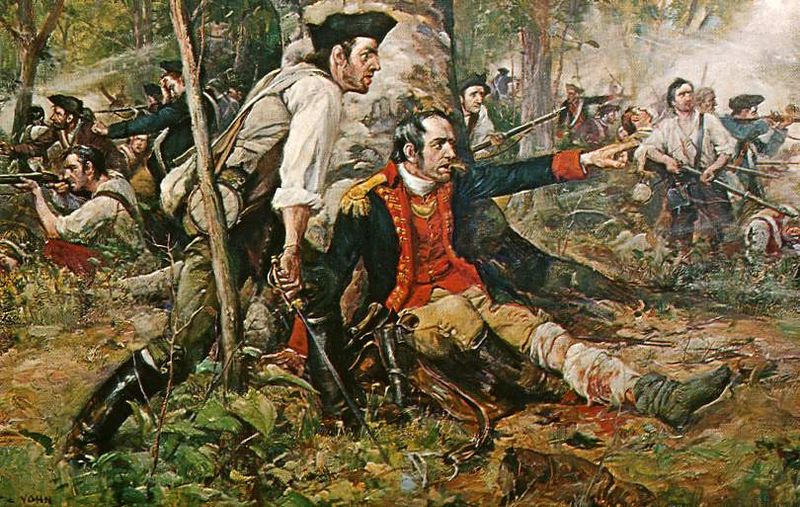
Herkimer, now famously slumped against a tree on the edge of what was now and will forever be a battlefield, still refuses to be removed from the fray, commanding his troops … meeting his enemy.
The iconic image has been memorialized many times, in many ways, but most immediately, by a man whose name is not known but almost certainly fought with him at Oriskany, who carved the face of a man into a tree believed to be the once against which Herkimer leaned slumped that day.
Today, at the Oriskany Battlefield State Historic Site, a marker stands where what is believed to be where that tree once did, so the General could be imagined on that ground in his final act of courage for his new country.
WIllett’s Sortie
The almost poetic misdirect in the Revolutionary tale of Oriskany now pays off.
Ganesvoort, unaware of the brutal battle already in progress at Oriska, indeed does dispatch a diversionary sortie of 206 men led by Willett, including 50 men from the Massachusetts militia of the Continental Army of New England. If the thunderstorm did not twist the fates at Oriskany that day, historians argue that Willett did, dubbed by the website “All Things Liberty,” as an “unheralded war hero” for his exploits that day.
Willett’s targets were encampments of War Chiefs on the outskirts of Oriskany.
Further to driving away remaining “stragglers” at the camps, the sortie seized a booty, including wagonloads of supplies, Britsh flags, and most critically, some baggage belonging to Johnson containing his personal papers, revealing intelligence – including the locations or critical supply lines – pivotal in fighting the balance of – and winning – the Revolutionary War.
The Seneca recounted that, when Willett, who they called ‘The Blue Devil’ referring to the color of his eyes, took their camp, among the items confiscated were their “medicine bags.”
“The Seneca believed their magic – their “mojo” — was contained in those pouches,” shared Robertaccio.
When Willett took them, “he took their will to fight.”
At approximately 3 p.m., 350 men fortifying Willett’s contingent arrived from Deerfield.
Without their medicine pouches and now fatefully outnumbered, those Indians who survived the sortie fled, abandoning the battle and further diminishing the British forces.
At approximately 4 p.m., the British retreat to the Lower Landing, leaving just one ceremonial soldier at the Oriskany Battlefield.
The sortie returned victorious to Stanwix, boasting no casualties and only two men slightly wounded.
Battle of Oriskany – the outcome and aftermath
The Oneida returned that night of Aug. 6, looking for wounded survivors. They are reported to have carried any out on their backs.
Reports of the battle held that the King’s Royal Regiment boasted 380 men, 20 rangers, and 610 Six Nations warriors.
Herkimer marched with 760 men, according to “Herkimer’s Ballad,” a song memorializing the battle composed by Willett.
Robertaccio confirms 40 Oneida.
“Herkimer was outgunned,” summed Robertaccio.
The official reports to General George Washington confirmed 32 British casualties and 60 Six Nations casualties, though Robertaccio suspects some of them to be “Blue-Eyed Iroquois,” British who posed as natives.
Robertaccio agreed that numbers of casualties at Oriskany have historically conflicted.
Early reports out of Fort Dayton held that 340 men were “missing,” presumed killed or taken by the British. But it was later confirmed that most of those represented in that conflicting count were later found to have “run home” from the battle.
Robertaccio he finds the accounting of Christopher Yates, who noted that “in peril” that day, 144 men were lost, Including the 16 prisoners, to be most reliable.
“These references confirm that the accounting of 160 men is pretty close to accurate,” said Robertaccio.
While one POW taken by the British at Oriskany was discovered alive 30 years later, Robertaccio described the likely violent deaths the others would have been subjected to.
Brigadier General Nicholas Herkimer died on August 16, 1777, 10 days after the Battle of Oriskany. He had lay wounded at his home near Little Falls, his leg shattered by the shot that struck him during the initial ambush.
A physician asked to examine the wound decided to amputate the leg. The arteries were not sealed properly and, as a result, Herkimer bled to death that day.
In response to a question posed at the Oriskany Museum regarding how many Oneida fighting with Herkimer lost their lives that day, Robertaccio admits there is no certainty around it.
He confirmed that the Oneida would have buried their dead at the Oneida Burial Ground, located off Marble Hill Road, but that their tradition allowed for no grave markers. He also confirmed that the 144 men reported lost did not account for Oneida casualties.
“I don’t know how many Oneidas were killed,” said Robertaccio. After a reverent pause – he repeated, “I don’t know.”
The Oriskany Battlefield State Historic Site
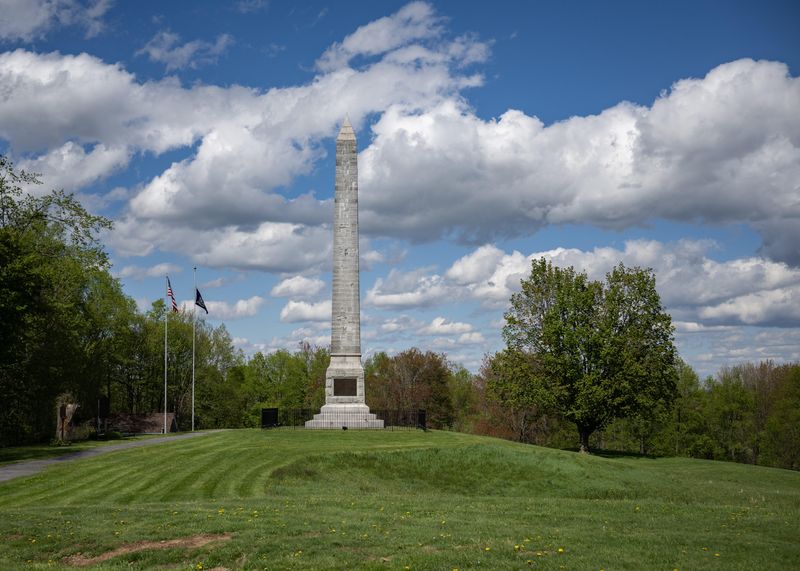
In 1884, The Oriskany Battle Monument was erected in what is now a pastoral, ironically peaceful field along New York State Route 69. The soaring Obelisk, a shape and symbol meaning “from the earth to the heavens,” was designed by a monument committee, with its construction supervised by master mason William Jones and bas-reliefs designed by J.R. O’Donovan. The shaft is fashioned from limestone sourced from the Mohawk Valley, with much of it mined from the dismantled Erie Canal Weigh Lock in Utica.
Two bronze plaques bear the names of those known to have engaged in the battle, with a somber reference to the unknown soldiers whose names will likely never be known.
It was not until 1927 that the Oriskany Battlefield was declared a New York State Historic Site, so designated as part of the 150th anniversary remembrance of the battle.
While a visitors center is only open seasonally, the grounds are open to visitors every day, from dawn to dusk, where the “Battlefield Trail” – a self-guided loop that begins behind the Visitors Center – leads guests down to the ravine where the ambush took place.
Visitors are then led over uneven terrain, including slopes and turns, with interpretive markers left like breadcrumbs to find the way, detailing tactics, warriors, and shifts in the historic battle, including the key role of Oneida warriors, the “tricks of war,” and Herkimer’s tree.
It is a strangely peaceful place to drive past, with the monument set off the road, it appears as a passive field bordered by a babbling brook across the street from a vintage white farmhouse.
But to stop and set foot on this field, this battlefield, leaves a human heart with no doubt they now tread on a solemn place. Solemn. While no word is sufficient to describe it … there is no better word than that.
Oriskany History and Artisans Day
On Wed., Aug 5, the eve of the anniversary of the Battle of Oriskany, the Oriskany Museum together with the Oneida County History Center is hosting “Oriskany History and Artisans Day” to complement the weekly Oriskany Farmers Market held at Trinkaus Park, 420 Utica Street, Oriskany.
The event will span from 2 – 7 p.m. Admission is free of charge.
Visitors can look forward to shopping with local vendors for food and hand-crafted/homemade goods. Booths will be manned by local historical authors and members of the county’s historical organizations.
Live entertainment will include crafting demonstrations, performances by Chris Thomas and the Onkwe’hon:wehkah Smoke Dancers at 2:30 and 4 p.m., and live music from Monk Rowe and the Five Families Ensemble at 5:30 p.m.
All are welcome!
This article originally appeared on Observer-Dispatch: Battle of Oriskany reconstructed by local historian at Oriskany Musuem
Reporting by Cara Dolan Berry, Utica Observer Dispatch / Observer-Dispatch
USA TODAY Network via Reuters Connect
By Cara Dolan Berry, Utica Observer Dispatch | USA TODAY Network