Summer is flying by as we hit mid-August.
Supposedly we are past the traditional hottest days of the summer. July was a pretty comfortable month, and the first half of August looks the same, though late summer can certainly produce some pretty hot and humid days.

On some of these summer mornings, do you lay awake in bed with the window open? Have you been noticing that the songbird action has been changing? Things are starting to quiet down. Not many robins singing out there as their nesting season is winding down – some robins having had three broods of young starting in early April.
I’m still hearing a variety of birds, but their sounds are different – many being those of young birds. I still hear the rattling noise of the Baltimore Orioles as they wait for me to put the grape jelly dishes back out on the deck railing. (We take them and other feeders in at night to keep them away from the racoons.) We still consistently hear the Cardinals singing and Catbirds making their presence known as well. As I’m doing my daily early morning outside chores, I still hear a variety of birds in the distance, but it’s nothing like it was in late spring and early summer.
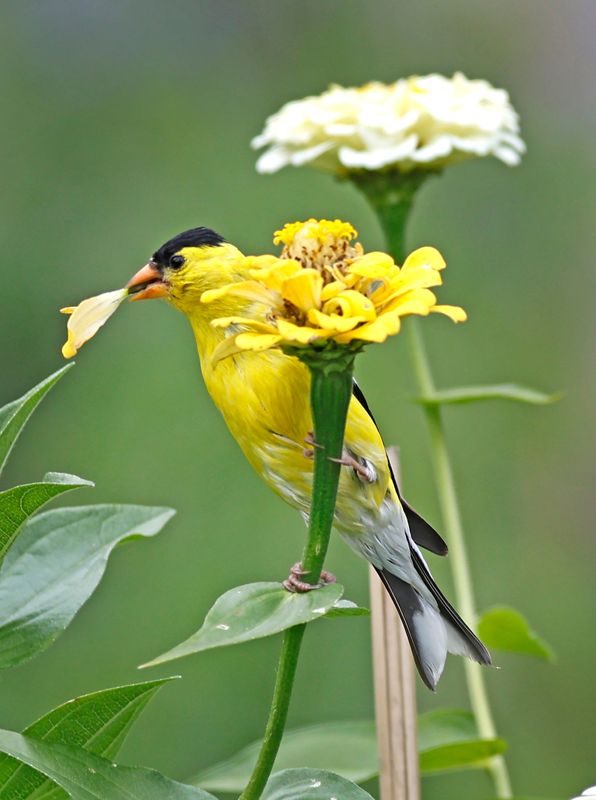
As I have mentioned recently, the Goldfinches are in the stages of their one and only nesting. They have been waiting for late summer’s bounteous weed seed production which will make it much easier to find food and to feed their young when they fledge later in August and early September. They also enjoy plenty of insects like many other seed-eating birds do. If you are feeding Goldfinches, you may notice more males at your feeders than females as the females will be busy incubating eggs. It’s not too late to plant a bunch of sunflower seeds right now so that in fall you will have plenty of bird action in the sunflower patch from a variety of birds. You can use the sunflower seeds from your bird feed.
Later in August much bird migration begins. Given that most bird species are done nesting, you can imagine how much the bird population has increased! Yes, right now, the local bird population is probably at its peak for the year due to the many young that have fledged – maybe even doubled. Soon several species will leave for the south, but most will likely leave in September.
Our Purple Martin colony using the gourd rack at the lake is busy feeding a combined 60 young Purple Martins right now. Last year the whole colony left the lake in mid-August. Hoping they stay longer this year! They will be congregating with thousands of other Martins in the marshes along the Great Lakes – Grand Island being one such place until early September when they depart for the south. This summer we have our first-ever pair of Purple Martins nesting here at the farm!
August always reminds me that it’s the time of year when I will start hearing owls calling at night. Some of these could be young owls trying out their voices. You could be hearing the Eastern Screech Owl making a shrill call, a Great Horned Owl hooting, or a Barred Owl making some neat barking calls or even relaying its trademark call saying what sounds like “Who… Who …. Who cooks for you?”
It’s the time of year when we see many swallows congregating on the utility wires. Many of them are young swallows still getting some feeding help from their parents. If you carefully inspect these larger flocks with binoculars, deeper into August and September you may notice a few of the less common Swallow species like Rough-winged, Bank, and Cliff Swallows mixed in with the much larger numbers of Barn and Tree Swallows. When driving country roads and approaching a large flock of swallows, please slow down as soon as possible, as many of these young swallows don’t yet know the danger of a speeding automobile.
If you are feeding grape jelly to the Orioles, you may still get some good action. If you have bluebird nest boxes, there are still some bluebird pairs that will nest in August. You may have noticed that the blackbird population at your feeding station has decreased.
Away from the feeder, if you see massive flocks of birds that look grayish black or brown, those are very likely flocks of Starlings which are an extremely pesty invasive species causing a major imbalance in our bird ecosystem. Furthermore, these Starlings stay here year-round and spread the seeds of many invasive plants including Tartarian honeysuckle and wild grapes. Adult breeding Starlings are generally black, but young and off-season Starlings are that dark grayish color – basically pretty ugly and a major problem. Starlings are not members of the Blackbird family and were brought to America by boats from Europe over the last couple of centuries. I hate wasting precious print space on Starlings!
So, though summer is flying by, there is still so much to enjoy ahead of us! Just recently, I co-led a birding field trip around Conesus Lake. We saw and heard so many neat birds and it reminded me that August affords us so much beauty, as does September. Take advantage of opportunities to go places to do some birding and hiking! Until next time, if you have any questions, comments, or observations to share you can reach me, Hans Kunze, via text/call at 585-813-2676. Happy birding!
This article originally appeared on The Evening Tribune: August nature observations as summer bird population peaks | Column
Reporting by Hans Kunze, Columnist / The Evening Tribune
USA TODAY Network via Reuters Connect
By Hans Kunze, Columnist | USA TODAY Network