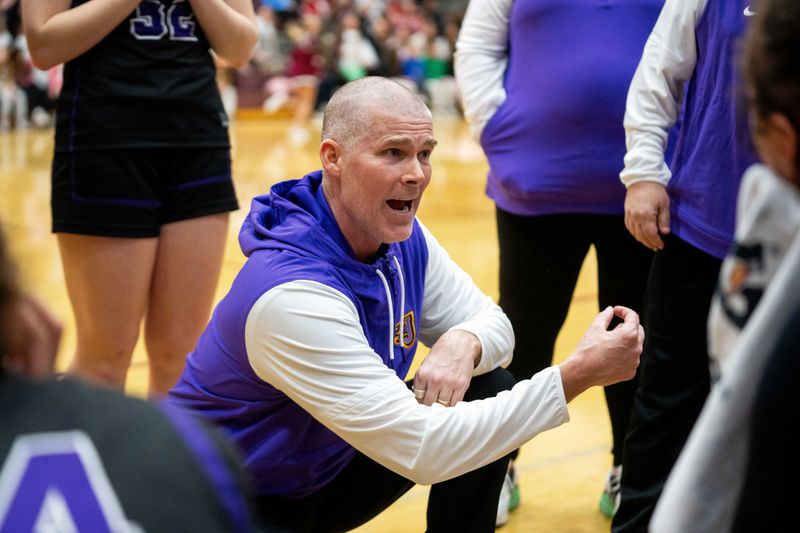
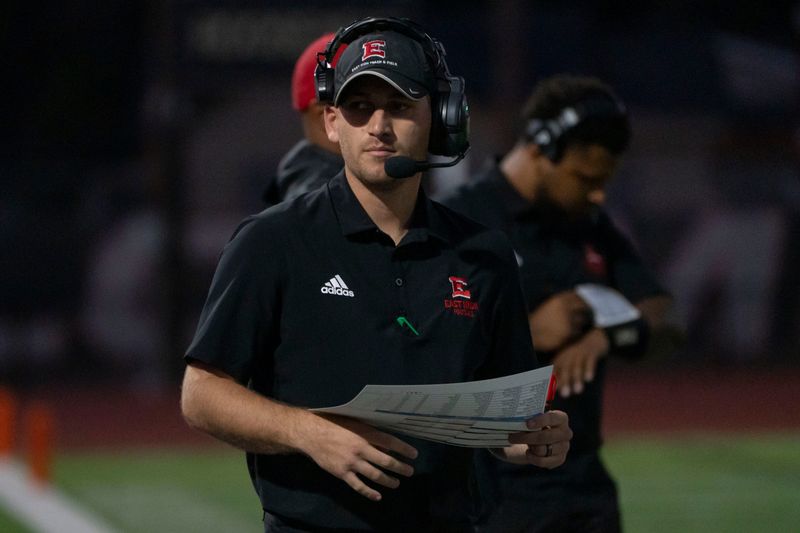
Joshua DeWaard and Chad Jilek sit on opposite ends of the high school coaching spectrum: different sports, different lengths of careers, different levels of success at their respective schools.
DeWaard started his coaching career in 2017, picking up a position at Des Moines East right out of college. He is currently the head coach of the Scarlets football program.

Jilek’s coaching career started nearly three decades ago, but he’s best known for leading the Johnston girls basketball program that’s won three-straight, undefeated state championships. He also coaches girls tennis at Waukee Northwest and led the Wolves to a state title this past October.
One coach has watched players exit his program because of open enrollment; the other has gained athletes — albeit only a couple — through the statewide policy that provides families with the freedom to choose public schools without the boundary-based restrictions of their residential school districts.
“When I started seeing kids switching schools,” said DeWaard, “I was just like, whoa, I did not realize this was such a big thing that went on here.”
So, high school athletes can switch schools to, say, play for a more competitive — or winning — program?
Yes, and no.
The answer isn’t black and white, and digging deeper into open enrollment raises more questions about competitive balance and equity within high school sports.
What is open enrollment, and how does it work in Iowa high school athletics?
Open enrollment – Iowa Code 282.18 – began with the 1989-90 school year.
The law has evolved in the close to 40 years since its adoption, and it’s been the job of Iowa’s two governing bodies of high school athletics — the Iowa High School Athletic Association, IHSAA, and the Iowa Girls High School Athletic Union, IGHSAU — to handle the sports side of open enrollment.
Both organizations’ rules are straightforward: Student-athletes are ineligible for varsity participation for 90 consecutive school days after transferring, unless they qualify for one of several exemptions. The most common exemption is a change of residence.
But there are several other exemptions as well.
Open enrollment only applies between districts, only between public schools, and — for athletics — only concerns varsity competition. So, if a freshman who never played varsity decided to open enroll elsewhere before their sophomore year, that student would be immediately eligible. A student-athlete would also be eligible, regardless of previous varsity experience, if the district of residence verified a report that the student was subject to harassment or bullying.
And then, there is also the option of waiving the ineligibility period. For this to happen, both school boards, the one the student-athlete is leaving and the one they are entering, must approve.
For districts with more than one high school, like Des Moines Public Schools, Ankeny and Waukee, the district is responsible for setting its policies regarding intra-district transfers.
How do Iowa’s transfer rules compare to the rest of the United States?
Tom Keating — the executive director of the IHSAA — attends a meeting with the directors of other state associations each year, and each year, he sees that Iowa isn’t the only state that adapts to laws and policies handling high school athletes’ eligibility.
“We always have a round table, and eligibility is always number one in that discussion,” Keating shared.
In a meeting like that, it’s clear there is no one correct way of handling high school athletes’ eligibility.
Keating said 51 associations are represented at those meetings — the District of Columbia, in addition to all 50 states — and there are probably about 40 different ways of handling eligibility. Several states’ rules revolve around the same core principles, but there are variations across the country — especially among states that do and don’t have open enrollment.
Based on the bylaws outlined in each of the 52 governing bodies’ handbooks — Iowa represents two of those since Iowa is the only state that maintains separate governing bodies for boys and girls — every state allows transfers in some capacity.
But for the transfers that don’t involve a bona fide move, the ineligibility period varies.
Iowa’s 90-school-day ineligibility period for athletes without exemptions lands right in the middle of the pack. It is in line with the Hawkeye State’s neighbor to the left, Nebraska, which also requires a 90-day ineligibility period.
South Dakota boasts some of the shortest requirements in the country, with a 15-day waiting period — which only applies if the student is not enrolled before the beginning of the semester.
Delaware, Maryland, New Jersey and Rhode Island all sit around 30 days, and New Jersey even allows one penalty-free transfer during the first six semesters after a student’s initial high school enrollment.
Some states — the majority of the country, actually — make athletes sit out for an entire year.
But there is nuance with most states’ rules. In Florida, transfer eligibility depends on whether a student has already participated in a sport at their previous school. If a student transfers before participating in a sport, they may join a team at the new school right away. If the student transfers after participating in a sport, the student must meet one of the approved transfer criteria. If that criterion is met, the student becomes eligible to participate starting on the sixth day of attendance at the new school.
Nearly 140,000 students compete in high school sports in Iowa, according to a National Federation of State High School Associations’ participation survey from the 2024-25 season.
The number of those who deal with open enrollment is a smaller group of student-athletes.
The IHSAA and the IGHSAU don’t track the total number of open enrollments statewide.
The organizations are only involved in open enrollment cases involving varsity athletes. Keating and IGHSAU associate director Gary Ross could only provide the Register with an average number of appeals cases their organizations see.
That number fluctuates, but they said it’s only between five and 10 appeals each year.
“Let’s zoom out because…Iowa has moved the needle toward school choice,” Keating said. “This philosophy that you should be able to have your student educated where you want them educated. And there’s another part of that that says, ‘Well, if they can have school choice, but they can’t participate in activities, that’s not really full choice.’”
So, open enrollment might not be the top issue facing Iowa high school sports, but is a landscape that is ever evolving.
In April, Iowa lawmakers passed legislation, House File 2591/HF513, that, pending Gov. Kim Reynolds’ signature, will allow eighth-grade students to play varsity sports. Eighth graders have been allowed to play baseball in the summer since 1973 and softball since it became a summer sport in the 1960s. But if the measure becomes law, it would extend that privilege to all sanctioned sports.
Within that same piece of legislation is language that would change the period of ineligibility for open enrollees.
If signed into law, students who transfer through open enrollment would need to sit out 140 calendar days — as opposed to the current 90 consecutive school days.
What is the role of the IHSAA and the IGHSAU in the world of open enrollment?
Keating has watched the use of open enrollment change during his nearly 50-year tenure in high school sports across the state.
He recalled some cases from his time as an athletic director and principal, but it wasn’t until his early years at the helm of the IHSAA that he saw how the policy directly impacted and was used by high school athletes.
“It really ramped up, like so many things did, during COVID-19,” Keating said. “When the Des Moines schools decided that they weren’t going to be in person, students were looking to go somewhere else to play.”
During that time, the state’s Department of Education required schools that were operating 100% online in fall 2020 to suspend in-person extracurricular activities.
Ross — who oversees eligibility and legislative topics at the IGHSAU and spent 22 years as activities director at Johnston — saw a similar shift in open enrollment during the 2020-21 school year.
So, as open enrollment and its use evolved, the two governing bodies were tasked with balancing this statewide policy with upholding competitive equity and fair play in high school sports.
That is no simple task.
Both the IHSAA and IGHSAU handbooks — as well as those of other states — contain language stating that open-enrollment transfers motivated by athletic participation are not permitted. The problem with that, though, is that it’s a subjective process to determine whether a student-athlete transferred for athletic reasons.
“Just because they’re an athlete, that shouldn’t prevent them from being able to open enroll,” Ross said. “And yet, there are some situations that come up where it’s very clearly the only reason. So, having that piece that’s solely for athletic purposes, it changes the dynamics.”
The two associations act first as an educational resource — for athletic directors, parents and students — providing guidance on the steps for open enrollment and how to go through the process to keep eligibility intact.
The IHSAA and IGHSAU are also responsible for upholding the 90-day ineligibility period, a number that has been in place for as long as Ross can remember. He believes the 90-day number was decided because it roughly equates to a semester.
Finally, the IHSAA and IGHSAU handle appeals related to open enrollment when a student athlete is determined not to have any exceptions and falls into the 90-day ineligibility period.
“If someone open-enrolls from one district to another, and one of the districts does not agree to waive the ineligibility, then they’ll ask for a ruling from us,” Keating explained. “So, we will look at whether any of the exceptions would apply, and then we issue an administrative ruling. If the family or the school disagrees with the administrative ruling, then they can appeal to our Board of Control.”
There will almost always be rumors surrounding the transfer process when an athlete decides to open enroll. But the governing bodies’ boards cannot speculate; they must make decisions based solely on the facts available to them.
“I think (there is) the idea that everybody gets to go where they want,” said Keating, when asked if there’s something that is misunderstood by the general public. “I think people need to understand, the actual open enrollment has to be approved. Not just the eligibility part, but the open enrollment has to be approved.
Does one of the top girls basketball programs in the country benefit from open enrollment?
Over the past 26 years, Jilek has coached — in some capacity — almost every high school sport.
His Johnston Dragons ended their most recent season by claiming another title and keeping their winning streak — currently sitting at 79 games — intact. The girls basketball team has won five state championships — including the last three — under Jilek’s tutelage.
All that is to say: If high school girls basketball players were to open enroll, the premier program to go to is Johnston. But in 14 years with the Dragons, Jilek has only added two players to his roster through open enrollment.
“I worked in some other places, like Clinton and Mason City, where there’s not a lot of other options,” Jilek said. “But in the Des Moines area, there’s a lot of options within a 20-mile radius that students could choose from if they wanted to open enroll. So, it’s maybe more prevalent in places like this…but in the grand scheme of things, I don’t see it as something that happens that often or is a major problem.”
With only two players in over a dozen seasons, Jilek has a small sample size of how open enrollment impacts high school sports. But he does have an idea of how it has impacted his program, specifically.
He recalled the first time a player came into his team because of open enrollment, about six or seven years ago. He remembered explaining what was happening during a team meeting.
And his players weren’t excited.
Between bringing a relative stranger onto the roster and the prospect of losing playing time, Johnston’s players weren’t sure what it would be like.
Everything worked out in the end; that player became one of the best teammates to come through Johnston’s program, according to Jilek. But even in an uber-successful program, he saw the potential impact of open enrollment.
Since he doesn’t see many players looking to leave the Dragons, much of Jilek’s experience with the policy is directing athletes and parents interested in his program to the correct resources.
“I get contacted by probably three or four families each year, just inquiring about open enrollment and coming to play at Johnston,” Jilek said. “We send those parties to the administration to talk about the process, and we just make sure they’re following all the rules and regulations.
“Like I’ve said, I’ve only had two in 14 years. So, you might have a number of families reach out, but 99% of them end up staying where they’re at.”
Jilek still sees some inequities regarding the current policies for enforcing eligibility.
For example, he pointed to the 90-day ineligibility period, which begins on the first day of the school year — or upon transfer, if it occurs in the middle of the year. Based on the timing laid out in the regulations, fall and winter sport athletes are at a greater disadvantage and would miss out on more of their season if they are not granted a waiver.
“If I’m a soccer player (who) wants to open enroll, I could play the soccer season at my current school, and I could play the whole soccer season at the next school,” Jilek explained. “Whereas, if you’re a fall sport, you’re going to miss the entire season, or basketball, you’re going to miss half the season.”
The deadline to open enroll is March 1, but that is not binding; while the open enrollment process is ongoing, athletes may still compete for their current teams. So, as a basketball coach, the ineligibility period following open enrollment would impact his team more than a softball or track and field coach.
Despite all its success, Johnston girls basketball is not building rosters around athletes who transfer through open enrollment. He gets plenty of talent at Johnston High School — and through its middle school feeder programs.
And even if he didn’t, students could still come to Johnston through open enrollment because of the Dragons’ reputation. Open enrollment only involves varsity athletes in high school sports.
So, students are free to open enroll before their freshman years or before playing at the varsity level without facing the ineligibility penalty. There is no telling how many of Johnston’s players — if any — have come to the program through that avenue.
Do some of the state’s largest schools struggle because of open enrollment?
DeWaard grew up in Pella.
There, students either went to the public high school or the private high school. Those were the two options, and those students-athletes played for the community they grew up in.
“As an athlete in Pella, it never would have crossed my mind that I would even consider another school,” DeWaard shared. “Whereas here, it’s on the minds of the families in our community that it’s an option.”
It didn’t take long for him to see how open enrollment impacts high school sports, especially at the Des Moines Public Schools.
He recalled losing a two-way starter and all-district player through open enrollment in his first year as head coach. The Scarlets faced their former player and teammate early in the next season, which confused DeWaard, who thought that varsity-level student-athletes who transferred through open enrollment were required to sit out for 90 consecutive school days.
That student likely benefited from the exemption that allows the district’s school board to agree to waive the ineligibility period.
“For open enrollment (from one school district to another), we typically approve the transfer eligibility form from the athletic associations, so a student does not have to miss three months of participation,” said Phil Roeder, spokesperson for Des Moines Public Schools.
The district does not want to punish students for leaving the Des Moines public high schools.
DeWaard sees it differently. Automatically waiving the 90-day ineligibility period doesn’t give student-athletes a reason to remain within DMPS. It gives them an easier path to leave.
And the availability of open enrollment — combined with waiving the ineligibility period — adds another layer to DeWaard’s job. He and his staff spend a significant amount of time recruiting players from their school to stay, and they aren’t always successful.
“Recruiting our own kids is part of the job, and that can be frustrating when you’re in a position like East, which has been a struggling program, trying to get things turned around,” DeWaard explained.
“For example, this one kid we felt like we really invested in his development; we helped him find himself in the weight room. And then a bigger suburb comes in and snatches him up. How are we supposed to build this thing if, as soon as we get a kid who shows some promise, they move on to a different school?”
There is also the issue of team building. It isn’t easy to piece together a roster and develop team chemistry when there is a chance the best players — the ones that end up in leadership positions on and off the field – could be gone the next season.
He understands the motivation, though.
“If there’s something that he’s actually getting that we aren’t providing, well, then that’s not on the kid,” DeWaard said. “That’s on me. And if the kid’s right, then we’ve gotta make our program better. …We can blame the rules and blame open enrollment all we want, but at the end of the day, we need to build something that’s worth staying for.”
He understands that every program — regardless of location and reputation — encounters challenges.
When it comes to open enrollment, there is a greater spotlight on the Des Moines Public Schools programs and how they lose athletes to the high schools in the surrounding suburbs.
Some of the highest-level football recruits from the last few years began their careers with DMPS programs but finished outside of the five metro-area high schools. It’s difficult to know whether those student-athletes changed schools through general transfer or open enrollment.
DeWaard said he doesn’t have all the answers because he understands the issue from both sides.
“We need to be asking the question: What do we want Iowa high school football to be?” DeWaard asked. “The best form of football I’ve ever been around is high school football…and I don’t want it to become all about the transfer portal and the win-at-all-costs of it all.
“That’s not just me coming from the East coach and ‘I’m losing all my kids’ perspective. That’s a purity of the high school game perspective.”
This article originally appeared on Des Moines Register: What is the impact of transfers on Iowa high school sports?
Reporting by Alyssa Hertel, Des Moines Register / Des Moines Register
USA TODAY Network via Reuters Connect