One of Iowa State University’s most significant artworks isn’t in a museum or sculpture garden. It is on the stage at Stephens Auditorium.
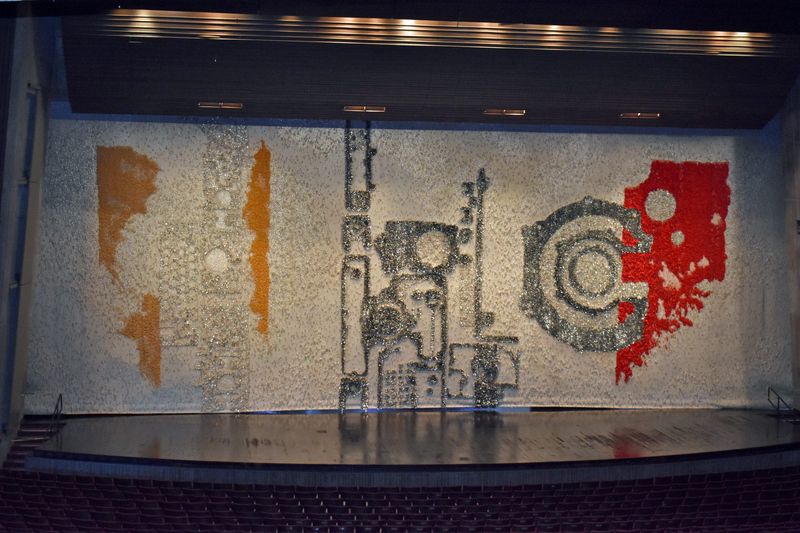
“Giniro-no-kigou,” which translates roughly as “Silver Code,” is the auditorium’s stage curtain, which has been on display at select performances since 1969, the year Stephens Auditorium opened.

On a recent weekday, a small group gathered at Stephens for what felt less like a tour and more like a pilgrimage. Led by University Museums educator Caitlin Patton, the walk began with a modest stainless-steel sculpture in the upper lobby, but everyone knew the real destination. The legendary, rarely seen textile waited below.
“Silver Code” was fully unfurled across the stage, a rare sight that drew audible gasps.
Designed by Japanese textile artist Ryokichi Mukai and woven at the Kyoto Textile Conservatory on what was then the largest loom in the world, the 80‑by‑35‑foot tapestry gleamed under stage lights. Its surface shimmered with spun rayon, nylon and polyester film, creating a metallic sheen that nodded to the technological ambitions of a land‑grant university in the late 1960s.
The curtain itself cost $20,500 to commission, a sum that was donated by Bill and Dorothy Fisher, who were the namesakes for Fisher Theater. Shipping the tapestry to Iowa cost more than twice the price of the artwork itself – $50,000. The curtain weighs about 2,800 pounds and is one of the heaviest pieces in ISU’s vast art collection.
A long journey from Japan to Chicago
To get to Ames, the curtain was rolled up and loaded into a 40-foot wooden crate that weighed 5,600 pounds. The shipment left Kyoto, traveling east, going through the Panama Canal and up the eastern seaboard of the U.S. to the St. Lawrence Seaway. It was unloaded in Chicago and placed on a truck trailer bound for Ames.
“Silver Code” may be the only stage curtain in the U.S. that is designated as artwork and owned by an art museum. Some are still left in Japan, according to Kawashima Stage Curtains.
When University Museums formally took ownership in 2013, “Silver Code” underwent a painstaking conservation effort.
“It had never had a deep clean,” Patton said. “But the synthetic fibers held up remarkably well.”
Dust had settled into every knot and crevice. Gold fringe had turned brown. Conservators cleaned it entirely by hand – sometimes only three square feet a day – using water, microfiber cloths and Q‑tips.
What do the images on ‘Silver Code’ mean?
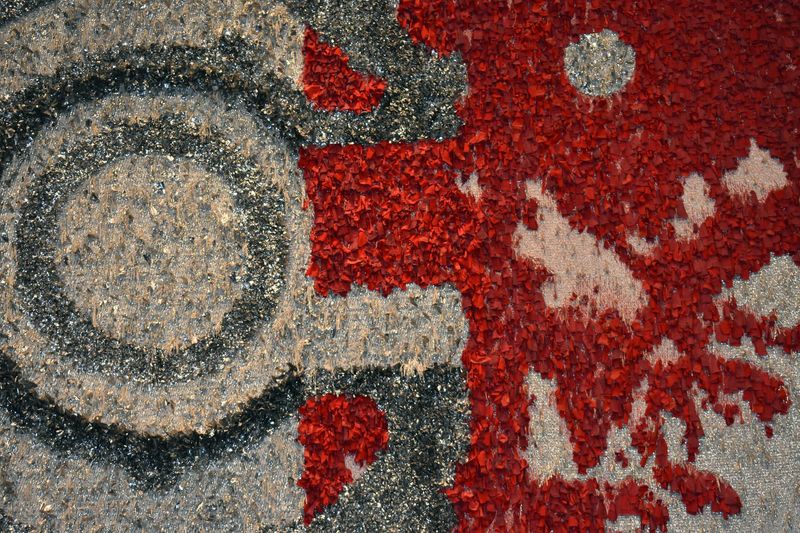
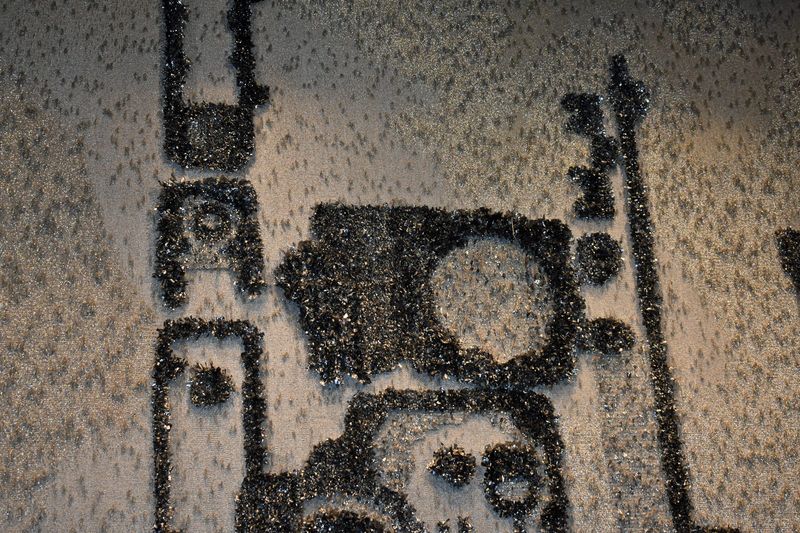
Up close, the curtain’s surface reveals a dense landscape of spun rayon, nylon and polyester film.
“It wasn’t designed to represent any one field,” Patton said. “It was meant to suggest innovation itself.”
Visitors lingered in front of the curtain, pointing out shapes that seemed to emerge from the abstract composition: a reversed outline of Iowa, a red form resembling Indiana, circular elements that looked like gaskets or circuitry, gold and red elements that may have been inspired by ISU’s cardinal and gold.
Patton welcomed the interpretations but pointed out that Ryokichi Mukai left no legend or key. It’s abstraction on a monumental scale.
The work invites viewers to find their own meaning, Patton said.
Most attendees admitted they had rarely seen the curtain down during performances. It is typically stored rolled high above the stage and brought out only on request. That rarity made the moment feel almost ceremonial.
For a few minutes, the group stood quietly before the vast silver surface, an artwork that has watched over the auditorium for more than half a century, still gleaming, mysterious and capable of captivating a room.
Ronna Faaborg covers business and the arts for the Ames Tribune. Reach her at rfaaborg@usatodayco.com.
This article originally appeared on Ames Tribune: Stephens Auditorium features rarely-seen artwork. Meet ‘Silver Code’
Reporting by Ronna Faaborg, Ames Tribune / Ames Tribune
USA TODAY Network via Reuters Connect