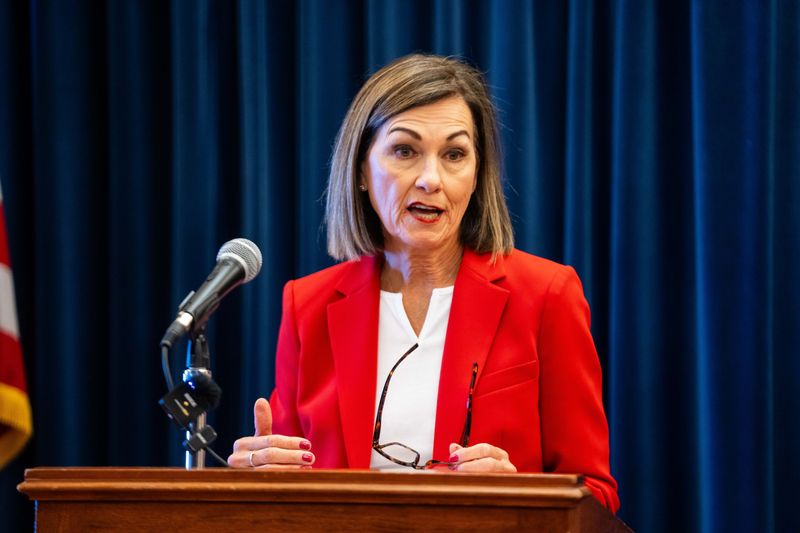
All public employers — including state agencies, counties, cities and school districts — will be required to check the citizenship status of their new employees using the federal E-Verify system under a bill awaiting Gov. Kim Reynolds’ signature.
The legislation, Senate File 2218, would put new citizenship checks in place for public employees in the wake of the immigration-related arrest of former Des Moines Public Schools Superintendent Ian Roberts last fall.

It also creates stricter rules for when undocumented immigrants may be granted bail after being charged with certain crimes and adds penalties for providing an employer, or employee, with a false Social Security number.
The Iowa Senate passed the bill 37-10 on April 28, and the House followed with a 71-20 vote on April 29, sending the bill to Reynolds for her signature.
“It verifies employment eligibility, protects legal workers and honest employees and it ensures integrity in our voting process and protects our voice as lawful voters,” said Rep. Brooke Boden, R-Indianola.
State agencies, cities, counties must use E-Verify, SAVE to check citizenship
Public employers in Iowa, including state agencies, cities, counties, school districts and the Iowa Legislature, would be required to use two federal programs to check the citizenship status and employment eligibility of new hires.
The two systems are E-Verify and Systematic Alien Verification for Entitlements, known as SAVE, which allows users to check someone’s immigration status against other federal databases.
The bill sets up a challenge process for someone who believes they have been wrongly flagged as ineligible to be hired.
The legislation goes further than an executive order Reynolds signed last year that required the use of E-Verify and SAVE for for state agencies and anyone receiving a state license.
Private schools would also be required to use E-Verify to check new hires’ eligibility, under the bill.
The Iowa Board of Educational Examiners must ensure anyone being granted or renewing an Iowa education license has proven they are authorized to work in the United States. Public and private schools would also to verify any prospective employees’ work authorization.
Providing false Social Security numbers to employers, employees would be a crime
Providing a false Social Security number to an employer for the purpose of obtaining a job would become a crime under Iowa’s fraudulent practice law.
It would also be a fraudulent practice for an employer to knowingly provide a potential employee with a false Social Security number so they could hire that person.
Businesses that knowingly hire or continue to employ someone who has provided a false Social Security number would face fines of $10,000, under the bill.
If the company is found to have violated the law four times, the employer would be required to halt all operations at the location where the violation was found until the company’s owners and managers complete training on how to comply with the law.
Iowans must swear they are citizens when they register to vote
Anyone registering to vote in Iowa would be required to swear that they are a U.S. citizens, under penalty of perjury. Under current law, Iowans must attest that they are U.S. citizens when they cast their ballots.
The bill also requires the Iowa Secretary of State’s office to use SAVE to check the citizenship status of registered voters.
Any voter flagged by the system would be designated as unconfirmed and their registration would be canceled unless they could provide proof of citizenship within 90 days.
The office already uses the database, but the legislation would codify the practice.
The legislation sets a statute of limitations of five years for the crime of election misconduct, longer than the three-year limit in current law.
Rep. Heather Matson, D-Ankeny, said the SAVE database has falsely flagged citizens as ineligible to vote and could prevent people’s ability “to fully participate in their government.”
“I believe that our fundamental right to vote is paramount,” she said. “And whether it is an intended or unintended consequence, utilizing a system known to have falsely claimed citizens weren’t eligible to vote will very likely make it harder for Iowans to vote.”
Boden disagreed.
“This legislation does not create new barriers for those who are following the law,” she said. “It reinforces the guardrails and ensures fairness for everyone.”
Undocumented immigrants will face tighter bail requirements
Undocumented immigrants arrested in Iowa for any charges other than a simple misdemeanor would automatically face the presumption that they are a flight risk and should not be granted bail, under the bill.
The defendant would be able to challenge their denial of bail if they can show, under a preponderance of the evidence standard, that they will appear for trial.
The legislation also creates a presumption that anyone arrested for a forcible felony is not eligible for bail. The defendant could challenge their denial of bail under the same standard.
(This story was updated because an earlier version included an inaccuracy.)
Stephen Gruber-Miller covers the Iowa Statehouse and politics for the Register. He can be reached by email at sgrubermil@registermedia.com or by phone at 515-284-8169. Follow him on X at @sgrubermiller.
This article originally appeared on Des Moines Register: New hires to undergo E-Verify check under passed Iowa immigration bill
Reporting by Stephen Gruber-Miller, Des Moines Register / Des Moines Register
USA TODAY Network via Reuters Connect