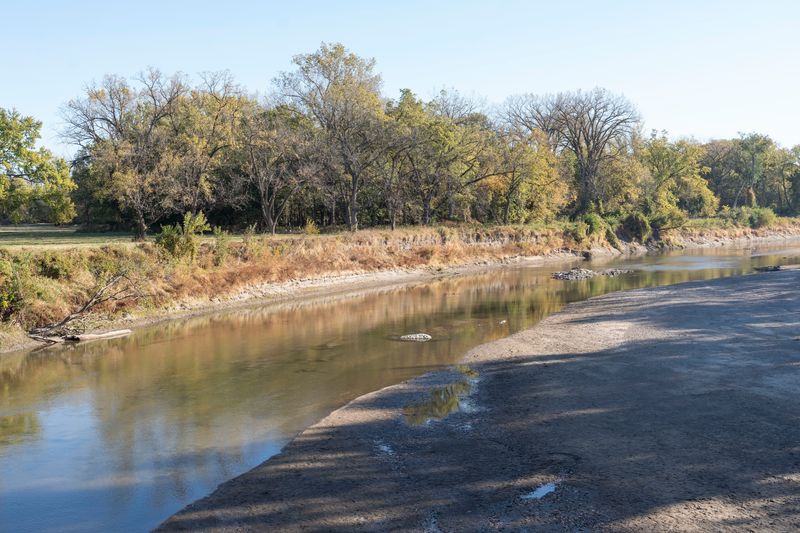
Nitrate levels in the Raccoon River are the highest they have been since 2013, forcing local officials in central Iowa to enact a lawn watering ban for the first time.
The stage three water shortage plan went into effect on June 12 after Central Iowa Water Works customers were asked to cut lawn watering by 50% on June 11. Nitrate levels in central Iowa’s key drinking water source, the Raccoon River, hit twice the federal limit for safe drinking water.

While treated drinking water continues to meet state and federal regulations, the lawn watering ban is meant to ensure treatment facilities can produce enough water for lifeline essentials, according to Central Iowa Water Works.
“What’s going to happen if we continue at this rate, is we will violate the nitrate standards set by the EPA,” said Tami Madsen, Central Iowa Water Works’ executive director. “When we violate that nitrate standard, we will have to issue a notice to all of you to let you know that pregnant women and children are unable to drink the water that we are producing.”
What is nitrate?
Nitrate is a form of nitrogen that naturally occurs and has many human-made sources, according to the Minnesota Department of Public Health. Nitrates serve as plant nutrients, commonly used for farming, but excess amounts can create water quality issues, according to the EPA.
How does nitrate enter drinking water?
Nitrate can enter bodies of water through multiple sources, including lawn runoff, leaking septic tanks and wastewater treatment systems.
In Iowa, the main sources of nitrate pollution are from fertilizer runoff and animal waste, according to the Iowa Environmental Council.
Why are nitrate levels so high in the Raccoon River?
Increasing commercial fertilizer and manure application from farming has been a source of increased nitrate levels in Iowa’s water sources. In 2013, Iowa saw an extreme drought followed by record rainfall, triggering high runoff. This is not the case for 2025.
“Over the long haul, we overapply nitrogen to our crops, and that surplus has got to go somewhere,” said Chris Jones, a former hydroscience engineer and researcher for the University of Iowa. “It doesn’t go off into the Milky Way. It goes into our aquifers, the rivers and our atmosphere.”
June is usually a high season for nitrate levels in rivers, Madsen said. The fall season is another time for high fertilization application.
“Fertilizer use has increased by a factor of 10 since World War II,” she said. “And some consider the amount used to be more than what can be taken in by” crops.
However, she didn’t say why this year is different, as the Raccoon River is nearing record-level nitrate rates. Jones found it concerning that Central Iowa Water Works didn’t identify where the increased pollution is coming from this year.
“It really implies that some our leaders are sort of complacent with this pollution,” Jones said. “That’s very concerning for central Iowa in my estimation.”
With central Iowa’s water system being vulnerable in a standard weather season, Jones said there needs to be more regulation around farm input to prevent further exacerbation.
“This vulnerability is going to increase, there’s no doubt about it,” Jones said. “Until the state’s leaders come to grips with that, we are going to continue to see these problems at a greater frequency.”
What health risks can nitrate in drinking water cause?
When consumed, the body breaks nitrate down into nitrite and eventually to N-nitroso compounds. Even though the Environmental Protection Agency’s nitrate limit for water is 10 milligrams per liter, Jones said even as much as 3 milligrams of nitrate per liter of water can result in cancer.
“If you live in Des Moines, you could go years without drinking water below 3 milligrams per liter,” Jones said. “So the fact that we are just meeting the standard at 10 and to do that we have to sacrifice lawn watering, well, that’s just a small part of the story.”
While the Environmental Protection Agency and the U.S. Department of Health and Human Services haven’t declared nitrate or nitrite as a cause of cancer, the International Agency for Research on Cancer determined nitrate and nitrite are “probably carcinogenic to humans.”
The Iowa Environmental Council reported on research findings that postmenopausal women in Iowa had an increased risk of bladder cancer as nitrate concentration in water supplies increased. Studies done in Spain, Germany and Taiwan reported similar findings, according to the IEC.
Can nitrate in Iowa’s water cause birth defects?
Yes, the federal nitrate drinking standard was established in 1962 to prevent blue baby syndrome. This can be a life-threatening condition for infants that prevents blood from carrying vital oxygen through a baby’s body.
Since federal laws have limited nitrate levels to 10 milligrams per liter of drinking water, blue baby syndrome is rare, according to the Iowa Environmental Council.
Studies done in Iowa, Texas, Canada and Australia also found statistically significant links between nitrate-contaminated drinking water and birth defects in the brain and spinal cord of infants, as well as limb deficiencies, according to the Environmental Education Council.
What does nitrate do to aquatic life?
Excess nutrients in water causes algae blooms, which can consume oxygen and block out sunlight. This prevents underwater plants from surviving. The algae eventually die after consuming all the oxygen, which kills all aquatic life with it.
The second largest dead zone in the world is in the Gulf of Mexico, renamed by the U.S. government as Gulf of America, where the Mississippi and Atchafalaya Rivers meet the Gulf.
Kate Kealey is a general assignment reporter for the Register. Reach her at kkealey@registermedia.com or follow her on Twitter at @Kkealey17.
This article originally appeared on Des Moines Register: Nitrates in Iowa’s water near record levels. What are the dangers if they don’t drop?
Reporting by Kate Kealey, Des Moines Register / Des Moines Register
USA TODAY Network via Reuters Connect