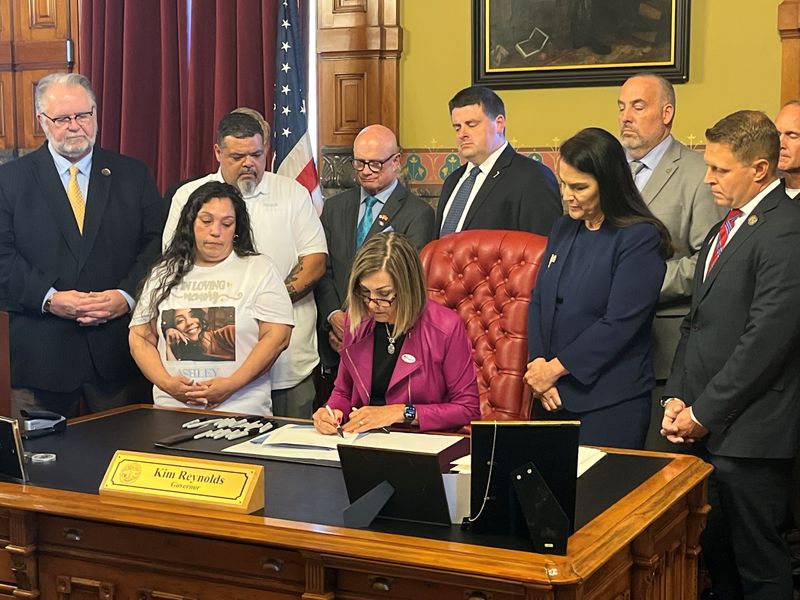
Anyone convicted of a third felony in Iowa will spend a minimum of seven years behind bars under a law signed by Gov. Kim Reynolds.
Reynolds signed House File 2542 on Tuesday, June 2, in a ceremony in the governor’s formal office at the Iowa Capitol, where she was joined by Republican lawmakers and law enforcement.

“If someone repeatedly commits serious crimes and refuses to change their behavior, there will be real consequences,” she said. “This law focuses on protecting law-abiding citizens, supporting victims and ensuring that those who repeatedly threaten public safety are removed from our streets.”
The law requires anyone convicted of a third felony to be sentenced as a habitual offender — meaning they will face a mandatory seven-year prison sentence that cannot be reduced. After serving at least seven years, they will become eligible for parole.
The measure more than doubles the current minimum of three years in prison for habitual offenders under current law. And it makes the habitual offender designation mandatory for a third felony conviction.
The law takes effect July 1.
Reynolds said the law shows Iowa will stand with victims, support law enforcement and prioritize public safety.
“We believe in second chances, but we also recognize that continued criminal behavior demands accountability,” she said. “When offenders repeatedly choose to break the law, the state has a responsibility to protect families, businesses and communities.”
House Republicans originally proposed a far more expansive bill that would have created a mandatory 20-year sentence, with no parole, for people convicted of multiple felonies or certain misdemeanors.
The final version of the legislation represents a compromise with Senate Republicans, who had hesitations about the original version.
The final bill passed the Iowa Legislature with bipartisan support, clearing the House 66-20 and the Senate 39-6.
House Speaker Pat Grassley, R-New Hartford, said House Republicans’ goal was to make sure Iowa is “a safe place for families to live.”
“Iowa is not going to be a place where career criminals are welcome,” he said. “And hopefully today that message is sent loud and clear that we are going to enforce our laws, we’re going to protect victims.”
The nonpartisan Legislative Services Agency anticipates the law will increase Iowa’s total prison population by 49% by fiscal year 2030, adding another 4,363 inmates.
It could cost the state nearly $2 billion to construct enough new prison space to house those inmates over the next five to seven years, the agency estimates.
Additionally, the agency estimates that the Department of Corrections would need to hire 962 new employees to manage the larger prison population. The state could see ongoing costs to run Iowa’s prison system, including staffing costs, increase by $115.6 million per year, according to the estimate.
Reynolds said the law’s cost will depend in part on how it’s enforced by prosecutors. She said Iowa is also finishing paying off an existing prison bond and the state can shift that funding stream to cover future costs.
“I talked to both leaders in both chambers and legislators that were really passionate about this bill — it’s the right thing to do — but that they need to be aware of this and they need to be thinking about how we continue to fund the population that we have,” she said. “So we’re looking at it, we’re addressing it and they’ll be ready to address it moving forward.”
Iowa’s stricter sentencing law comes as some states, and the federal government, have rolled back their own harsher sentencing for repeat offenders.
The Iowa Department of Corrections consistently reports operating above its capacity for inmates. As of June 1, Iowa’s prisons were 28% overcrowded, with 8,958 inmates compared with a capacity of 6,990.
At the same time, the department says Iowa’s recidivism rate at its lowest point in a decade: 32.8%.
FBI data show property crime and violent crime have also fallen in Iowa over the last five years.
Reynolds also signed Senate File 2399, which raises Iowa’s bond amounts for the first time since 2017 and requires judges and magistrates to justify in writing if they set a lower bail than what is recommended.
Warrant resolution clinics banned in Iowa under new law
Reynolds signed another law, House File 2787, banning warrant resolution clinics, after someone whose warrant was withdrawn at a Polk County clinic was arrested and charged with murder one week later.
The clinics allow people with outstanding warrants to meet with a judge, schedule a new court date and have their warrant lifted.
The Polk County Attorney’s Office and other agencies hosted an April 3 warrant resolution clinic, which was attended by Sharneeka Evans, who had her warrant withdrawn and was subsequently accused of first-degree murder in the April 10 slaying of Ashley Marie Hall of Des Moines.
Hall’s mother, Tawnya Swanson, joined Reynolds at the Capitol for the bill signing. Reynolds offered Swanson “our heartfelt condolences” and commended her “for being such a strong voice on behalf of your daughter.”
“No law can make up for this unimaginable, preventable loss but it serves as a powerful reminder that decisions made within our justice system have real consequences for real people,” she said.
Hall’s father has said he doesn’t blame the clinic for his daughter’s death.
Rep. Steven Holt, R-Denison, who led the passage of the bill, also recognized Swanson, saying “this got personal for me very quickly.”
“Our hearts go out to her and her family,” he said. “No parent, no children should have to endure such a tragedy, and no law can undo the loss, but we do have a responsibility to learn from it and do everything we can to prevent similar tragedies from happening in the future.”
Stephen Gruber-Miller is the Capitol bureau chief for the Des Moines Register. He can be reached by email at sgrubermil@registermedia.com, by phone at 515-284-8169 or on X at @sgrubermiller.
This article originally appeared on Des Moines Register: Kim Reynolds signs 3-strikes law as Iowa prisons near capacity
Reporting by Stephen Gruber-Miller, Des Moines Register / Des Moines Register
USA TODAY Network via Reuters Connect