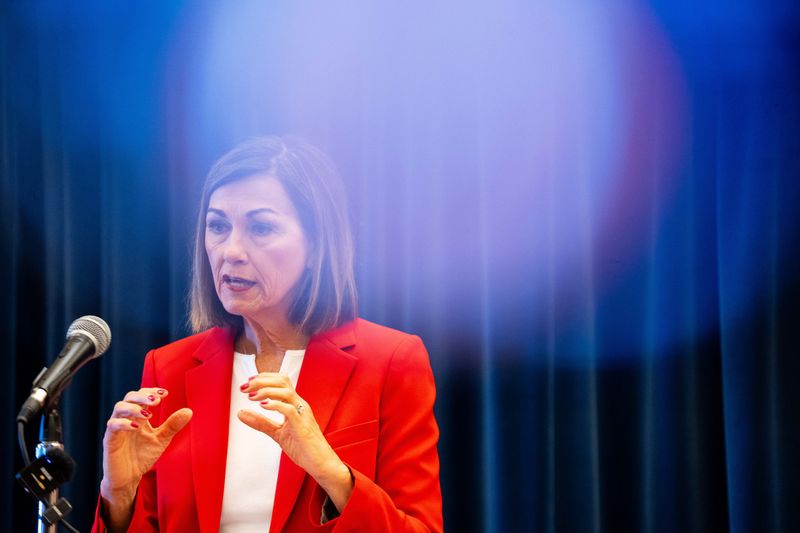
Gov. Kim Reynolds signed a law restricting the governor’s emergency powers ahead of a competitive open-seat race to elect her successor.
House File 2694 curtails powers used to regulate churches, vaccine requirements and whether private businesses can stay open under a state disaster emergency declaration.

The outgoing governor, who decided last April not to seek reelection in the 2026 midterms, signed the law on Tuesday, June 2. It takes effect July 1.
Republicans championed the measure to address concerns stemming from the COVID-19 pandemic when Reynolds temporarily ordered churches closed to limit the virus’ spread.
The House blocked a controversial Senate-backed provision that would have allowed government funding to continue into the next fiscal year if a governor failed to sign a budget into law and passed it 67-23.
The Senate voted to “recede” from its continuing budget amendment and voted 31-14 to pass the bill with the House’s original language. Sen. Cherielynn Westrich, R-Ottumwa, missed that vote but was the chamber’s lone Republican to oppose it on a previous vote.
The continuing funding language split some Republicans. It would have thwarted lawmakers’ attempts to use the state budget as a bargaining chip to push for certain policies, as some Republican senators — including Westrich — did in 2025 to force a vote on eminent domain legislation.
Democrats consider measure a ‘power grab’
Democratic lawmakers have pushed back on the measure as a “blatant power grab” by the Republican-led Legislature ahead of a tough governor’s race.
Nonpartisan elections analysts with the Cook Political Report labeled Iowa’s governor race a “toss-up,” its most competitive category.
Democratic state Auditor Rob Sand, who holds a formidable fundraising lead, is the lone Democrat in the race. He will face the winner of a five-way Republican primary contest.
Sen. Molly Donahue, D-Cedar Rapids, said during Senate debate the policy would tie the hands of Iowa’s new governor before voters have their say.
“This is a power grab,” Donahue said. “By curbing the power of the possible — possible — Democrat governor, you’re short-changing Iowa voters. Instead of preparing to work with whoever the people of Iowa choose next year, this proposal assumes the outcome and then moves to limit that office’s ability to govern effectively.”
House Speaker Pat Grassley, R-New Hartford, said in February that Govs. Reynolds and Terry Branstad have provided a consistent approach to handling state government.
“I don’t want Iowans to read into any more than the fact that we will have a different governor that does not come from the standpoint of the Branstad-Reynolds legacy, and so those decisions that we’re making isn’t just partisan focus,” Grassley said.
“As we’ve been looking back over the last few years, now that we’re away from the COVID and away from some of the emergency declarations, I think our caucus has said, ‘OK, it is time for us to really look at what are those important things.'”
Marissa Payne covers the Iowa Statehouse and politics for the Register. Reach her by email at mjpayne@registermedia.com. Follow her on X at @marissajpayne.
This article originally appeared on Des Moines Register: Iowa is limiting the governor’s powers ahead of a ‘toss-up’ 2026 race
Reporting by Marissa Payne, Des Moines Register / Des Moines Register
USA TODAY Network via Reuters Connect