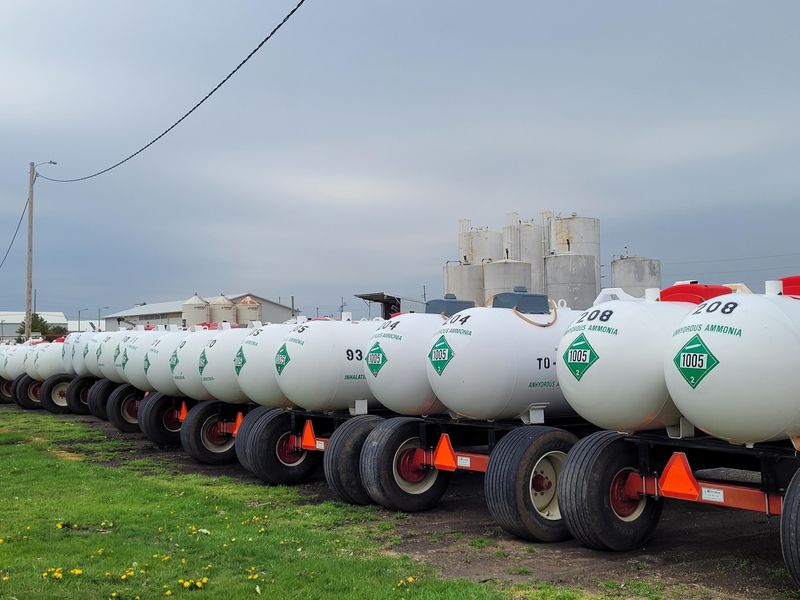
The war with Iran is driving fertilizer and fuel costs higher for Iowa and other U.S. farmers, who already are struggling with a fourth year of expected losses.
The price spike also is raising concerns about higher grocery bills for consumers.

About a month away from planting this year’s crops, some farmers say local suppliers have declined to provide them prices for nitrogen and other fertilizers. Those who’ve gotten estimates say prices are as much as 40% higher than they were last fall.
Iran’s threat to shipping in the Strait of Hormuz in the oil-rich Persian Gulf region has cut off about half of the global supply of urea, a widely used nitrogen fertilizer, according to an American Farm Bureau market analysis and data from the Fertilizer Institute, an industry group. It has also blocked about 20% of the world’s natural gas supply, this the group says is “a foundational input for most nitrogen fertilizers.”
Mark Mueller, a northeast Iowa farmer, said his price for anhydrous ammonia ― another form of nitrogen fertilizer produced with natural gas ― climbed $100 to $950 a ton, or about 12%, over four days in early March. Mueller, the Iowa Corn Growers Association board president, said another supplier “quit taking orders for nitrogen fertilizer,” sending an email to customers that said, “We’re not sure we can get it.”
When farmers face supply shortages or major price spikes, “those impacts ripple through the entire food chain” resulting in “higher prices for our families across America,” said Zippy Duvall, president of the Farm Bureau, who raises chickens and beef cattle in Georgia.
The national farm group is asking President Donald Trump to take action to improve fuel and fertilizer supplies, including reopening shipping lanes in the Strait of Hormuz so tankers can safely move through.
Trump got little positive response to a request for allies’ help in policing the waterway. But U.S. Agriculture Secretary Brooke Rollins said in an email to the Des Moines Register on Tuesday, March 17, that the administration is “looking at every potential option to lower fertilizer costs.”
Administration officials are also talking with members of Congress about a second bailout for farmers, Rollins said. The U.S. Department of Agriculture is now distributing $11 billion to row crop producers, in part to help offset markets lost due to Trump’s ongoing trade wars.
“Everything is on the table,” Rollins said March 13 at a White House event, adding that all but about 25% of U.S. farmers have purchased this year’s fertilizers. Many farmers in Iowa and elsewhere in the Midwest applied fertilizer in the fall, when discounts often are available, while other farmers wait until spring, closer to when plants will use it.
Some Iowa and U.S. farmers accuse the limited number of fertilizer suppliers of taking advantage of the war and the critical spring planting period to gouge them.
Farmers who hadn’t bought fertilizers now must pay “$200, $300 a ton more” over last fall’s prices, said Lance Lillibridge, who also farms in northeast Iowa.
“That’s the definition of price gouging,” said Lillibridge, the former president of the Iowa Corn Growers Association board.
Farmers who may not get the fertilizers they need, “I don’t know what they’re going to do,” he said.
Extreme bottleneck, war’s timing add to rising fertilizer prices
Chad Hart, an Iowa State University agriculture economist, said fertilizer prices typically follow energy markets since natural gas is a critical component in the production of anhydrous ammonia.
Energy prices have swung widely since the U.S. and Israel began the war in Iran on Feb. 28. Overall, crude oil prices have risen about 40%, market data shows.
“You always have to keep an eye open” for price gouging, “especially when you have relatively few traders in the market,” Hart said. But he pointed primarily to the “extreme bottleneck in the supply chain” caused by the closure of the strait along with the war’s start as spring planting is set to begin. He also cited a rush of farmers trying to lock in prices and ensure supplies are available.
The Fertilizer Institute said in a statement online that global supply disruptions can “ripple across the trade routes and affect availability and price in other regions.”
How long fertilizer prices remain high — and the impact on farmers — depends on the length of the war, said Seth Meyer, director of the University of Missouri’s Food and Agricultural Policy Research Institute.
A similar spike that occurred when Russia invaded Ukraine in 2022. “There was a lot of angst about availability,” said Meyer, USDA’s former chief economist. He added, however, that it was “more about price.”
The fertilizer price spike could push farmers seeking to hold down costs to switch some acres from corn to soybeans or other crops that require less nitrogen fertilizer, Meyer said.
“Margins are already bad. All this does is make those margins” worse, he said.
Iowa farmer: ‘There’s virtually no competition’ in fertilizer market
Mueller, Lillibridge and other farmers say the rising prices resulting from war add to price pressure farmers already have experienced because of consolidation within the fertilizer industry — dominated by giant suppliers like Nutrien Ltd, Mosaic Co., Koch Inc. and CF Industries Holdings Inc.
Mosaic has about 80% of the U.S. phosphorus market; Nutrien and Mosaic have about 90% of the potash market; and CF Industries, Nutrien and Koch have about 70% of the U.S. nitrogen market between them, Mueller wrote in testimony submitted to the U.S. Senate Judiciary Committee in October.
“There’s virtually no competition, except at the retail level… and they have little room to compete,” Lillibridge said. “We’ve had a boot on our neck for several years.”
On March 10, Iowa Corn Growers and 13 other sister organizations wrote to Rollins and U.S. Attorney General Pam Bondi asking for an update on Trump’s executive order in December calling for an antitrust investigation into companies in the U.S. food supply chain, including fertilizer manufacturers.
Corn groups made a similar request in February but received no response, they said in the letter. Since then, farmers’ financial outlook has worsened.
“Corn prices remain depressed, while the cost of essential nutrients continue to reflect a market distorted by excessive concentration,” the groups wrote.
“The consequences of inaction are not abstract,” they wrote, saying, “Across every corn-producing region in the country, farm families are operating on razor-thin margins at best — and at a net loss in many cases.”
Bloomberg News, citing unnamed sources, reported March 4 that the Justice Department was investigating the pricing practices of Nutrien, Mosaic, Koch, CF Industries and Yara International ASA for possible civil and criminal antitrust violations.
A Justice Department spokesman said Tuesday in an email that the agency can’t “comment on the status of a pending criminal investigation” but “stands ready to investigate and prosecute any company that exploits opportunities by engaging in collusive schemes that artificially increase prices and harm American consumers, farmers and businesses.”
Rising fuel prices will add about $2,000 to farmers’ fuel bill
While farmers face higher fertilizer and fuel prices, pushing production costs to new highs, prices for corn, soybeans, wheat and other crops have improved since the war’s start.
“It’s helping in one way and hurting in another,” Hart said.
U.S. corn prices climbed about 4% and soybeans nearly 5% since the war started. Though they have since given up most of their gains, the price spike was welcome news in Iowa, the nation’s leading producer of corn and second-largest soybean grower. Iowa also is the nation’s largest ethanol producer, using about half its annual corn supply to make the renewable fuel.
Iowa Agriculture Secretary Mike Naig, along with state and national groups, want Congress to boost demand for the fuel by passing legislation allowing year-round access to gasoline with 15% ethanol, called E15, which is typically cheaper at the pump. Most U.S. gasoline sold now contains 10% ethanol.
It’s been a contentious issue, tied up with oil companies’ requests that some small refineries be exempted from federal requirements to blend ethanol and biodiesel into their supplies. Higher ethanol blends are banned in some U.S. regions during summer months due to air quality restrictions ― a measure farm groups contend is based on outdated data.
Farm groups say allowing year-round access would boost corn demand by about 2.5 billion bushels annually. That would “support markets that farmers rely on and keep fuel costs affordable for both farmers and consumers,” Naig said in a March 11 email.
Already, unleaded gas prices have climbed nearly 30% since Feb. 25, the week the war started, reaching an average of $3.35 a gallon this week. And diesel prices are 31% higher, averaging $4.63 a gallon.
Hart said rising fuel prices push costs higher across the U.S. economy. “Those costs tend to get passed along to the consumer,” he said.
The Soy Transportation Coalition estimates that a farmer with 1,000 acres can expect to pay about $2,000 more this year to bring the harvest to the local elevator.
South Carolina farmer Harry Ott said during the American Farm Bureau call earlier this month that higher fertilizer and fuel costs “ could not come … at a worse time. ”
“When you add these price increases on top of a really bad farm economy, I’m afraid… a lot of farmers are not going to be able to finance putting a crop in,” said Ott, South Carolina Farm Bureau Federation board president.
Nationally, farm bankruptcies climbed nearly 46% to 315 last year over 2024, U.S. court data shows. Iowa had the third-largest number of filing nationally, following Arkansas and Georgia. Iowa’s 18 ag bankruptcies last year represented a 157% increase from 2024.
Hart said the uncertainty that comes with the war “leans toward extending the ag recession.”
Mueller said he’s hearing from farmers whose bankers have declined to lend them money for this year’s crop, and they’re hoping to find another lender.
“I’ve never gotten those phone calls before,” he said. “I’m seeing distress out there. … Farmers are barely scraping by.”
Donnelle Eller covers agriculture, the environment and energy for the Register. Reach her at deller@registermedia.com.
This article originally appeared on Des Moines Register: Iowa farmers say fertilizer prices spiking as spring planting nears
Reporting by Donnelle Eller, Des Moines Register / Des Moines Register
USA TODAY Network via Reuters Connect