Editor’s Note: This story was originally published on July 8, 2025. The story has been edited to reflect the 250th anniversary of the United States.
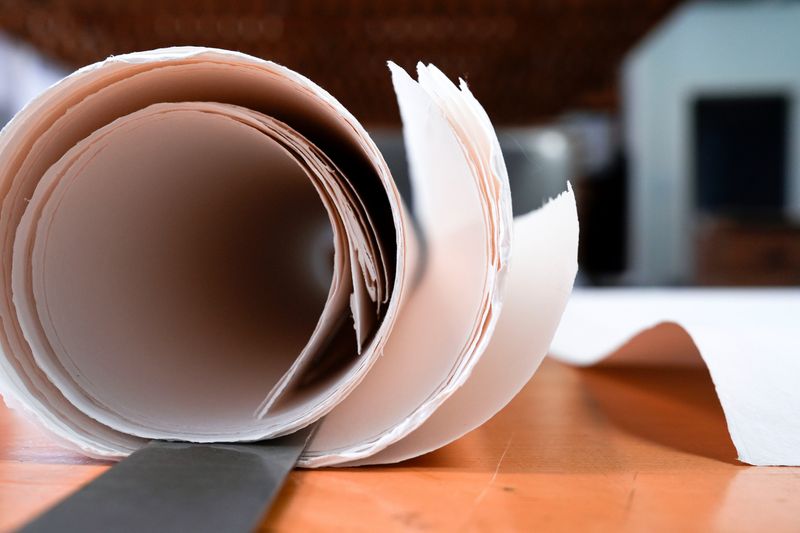
The parchment Thomas Jefferson used for the Declaration of Independence was likely Dutch — but the archival paper protecting one of America’s most important documents was made in Iowa City.

In fact, Iowa City’s Center for the Book made the archival papers for all three pieces that comprise the Charters of Freedom — The Declaration of Independence, the Constitution and the Bill of Rights.
By the late 1990s, the original encasements housing the founding documents had begun to show signs of deterioration. To ensure their preservation, the National Archives enlisted the services of the University of Iowa’s Center for the Book, a graduate arts and research program specializing in the arts of printing, binding, papermaking, and calligraphy.
“They weren’t at a point where they thought these documents were in imminent danger,” said Timothy Barrett, professor emeritus at the University of Iowa’s Center for the Book and the School of Library and Information Science. “But they were concerned that we should make sure that they weren’t in any immediate danger, and, more importantly, build state-of-the-art encasements for them.”
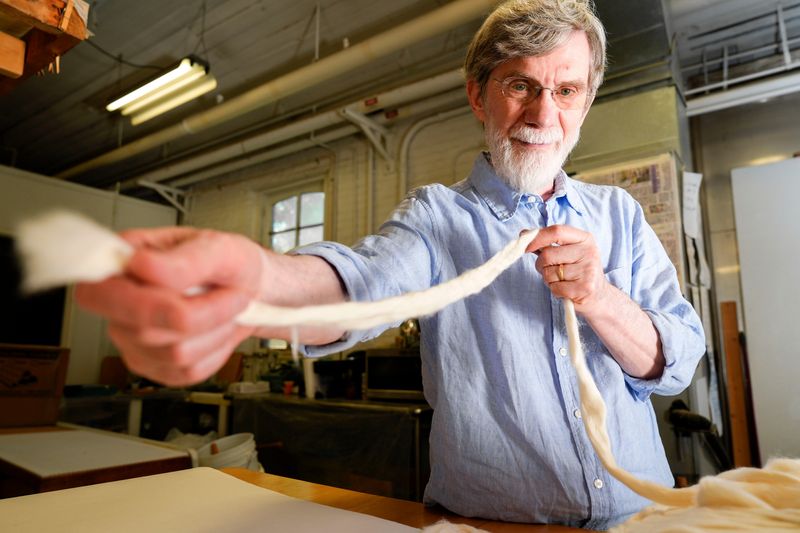
Barrett, who was a recent director of the Center for the Book, specializes in Japanese and early European papermaking, led a team of 10 students up to the challenge.
“First, I suggested maybe we would make multiple sheets of quite thin Japanese conservation-quality paper,” Barrett said. “The head of the conservation team, who was British, said, ‘Tim, come on, man, can’t you do better than that? This is an American project.'”
Making the special paper in Iowa City
Last year, Barrett was experimenting with making archival paper out of American-grown cotton — the paper that now lines the encasements.
The primary requirement for the project was that the archival paper have the same mass as the parchment. To accomplish the project, the team followed eight crucial steps over several weeks.
The process began with selecting the highest-quality raw material that will “last a millennium.” The cotton is then processed into a pulp and suspended in a vat, a large tub filled with water and the pulp.
A sieve-like device is dipped into the vat to gather the pulp, forming thin sheets then pressed against a damp felt. The process repeats until 12 or 15 sheets are sandwiched together to form a single, durable sheet, then laid to dry for 24 hours.
The paper needed to be oversized, so the center built a custom 40-inch by 40-inch press to accomplish the project. The press took about two months to produce 25 sheets of the custom-made paper, designed to enhance the original parchment and stabilize the humidity in each encasement.
Barrett and the team did not “dwell on the honor and focused on doing it right, since it was a rare time that the center knew what the paper would be used for.
“We took real pride in knowing that it was being used in the conservation of artifacts that historians, curators and other specialists have long since decided were important items to preserve,” Barrett said. “It was rewarding enough without us knowing specifically what it was used for.”
Decades later, Barrett says it’s something everyone in Iowa can take pride in, especially as the United States celebrates its 250th anniversary.
“American history is still very much there, and if you are from the state of Iowa, you can go to the national archives, tilt your head to the side, and see that paper underneath those documents,” Barrett said. “It still is an honor and a pleasure, especially for Iowans … none of this would have happened if it wasn’t for the state of Iowa, who fund the University of Iowa and made the Center for the Book possible. It is something we all can be proud of.”
Jessica Rish is an entertainment, dining and education reporter for the Iowa City Press-Citizen. She can be reached at JRish@press-citizen.com or on X, formerly known as Twitter, @rishjessica_
This article originally appeared on Iowa City Press-Citizen: How the University of Iowa helps preserve U.S. founding documents
Reporting by Jessica Rish, Iowa City Press-Citizen / Iowa City Press-Citizen
USA TODAY Network via Reuters Connect
By Jessica Rish, Iowa City Press-Citizen | USA TODAY Network