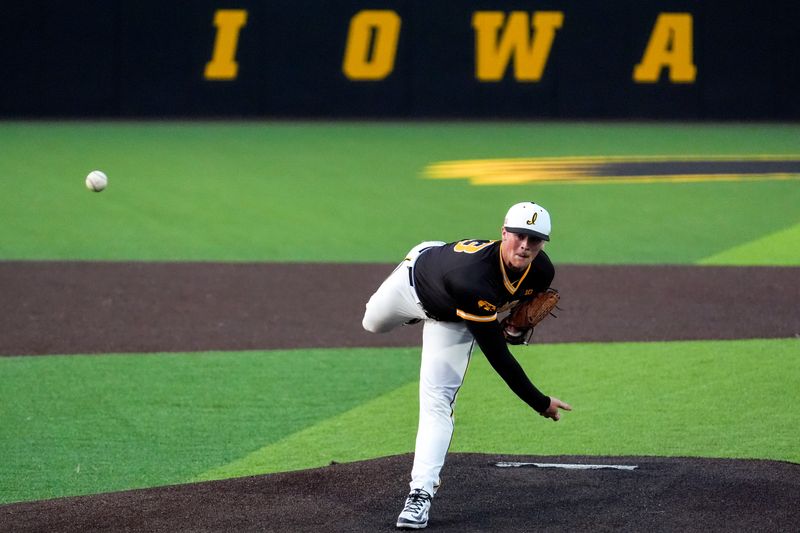
IOWA CITY — There’s no manufacturing motivation when it comes to solving Iowa baseball’s pitching puzzle. Opportunity is right in front of any hurler who wants to snatch it.
Friday night anchor, Sunday savior, late-inning stabilizer — all occupations on the mound are up for grabs in 2026, as Hawkeyes coach Rick Heller charges toward an unprecedented pitching reset.

“All the major roles are going to be new guys to those roles,” Heller said. “That’s really the first time that’s happened for us. There usually have been one or two (returning) guys you could hang your hat on who’d been out there with the lights on before.”
Of the 16 arms who appeared in a game last season, only four of them are back this year and collectively return just 52 2/3 innings. No one from that quartet — Tyler Guerin, Justin Hackett, Ganon Archer and Jaron Bleeker — started more than five games or threw more than 20 frames in 2025. More than 425 innings must be replaced.
Exhausted eligibility accounted for most of that hefty roster turnover, coupled with the MLB Draft expectedly scooping up Iowa’s top arms running out of financial leverage. Seniors-to-be Cade Obermueller (2nd round, Philadelphia Phillies), Aaron Savary (13th round, Cleveland Guardians) and Anthony Watts (14th round, St. Louis Cardinals) piled up 200-plus innings last season before all signing professionally.
Adding to the reboot is another offseason with a pitching coach change. Considering Sean Kenny’s departure to Arizona came during the semester break, Heller pivoted well to move Wes Obermueller over from director of player development in early January. The Iowa alum and five-year MLB vet should add stability to a pitching staff that has a ton to figure out in the early going.
“It’s going to be pretty fluid right now,” said Obermueller, who pitched for the Royals, Brewers and Marlins from 2002-07. “There should be a lot of motivation for these guys to be the man. That doesn’t matter about age. Sometimes you’ve got to grow up fast, but these guys do have good heads on their shoulders. They’re really hungry to achieve really good things.”
For as much forecasting done through fall scrimmages, winter workouts and preseason practice, every college baseball coach across the country won’t fully know what he has until that first pitch is thrown. At places like Iowa, where that reality is intensified, expect plenty of mound maneuvering these first few weeks.
Sophomore Tyler Guerin and FIU transfer Logan Runde will get first cracks at the weekend rotation in Iowa’s season-opening weekend at the MLB Desert Invitational. Guerin will start Feb. 13 vs. Kansas State, while Runde gets Air Force the following day. The Hawkeyes still have the Feb. 15 finale vs. Northeastern as TBD.
Guerin and Runde operate from different ends of the experience spectrum. The former is a 6-foot-6 two-way weapon who threw just 16 2/3 innings last season. The latter is a Dubuque Hempstead product back in his home state after one year at FIU, following JUCO stops at Iowa Western and Kirkwood. Early-season reliability from either or both would be a nice first step toward clarity on the mound.
“Being that we’ve got a lot of young guys who are going to throw a lot this year,” Guerin said, “the motivation is guys just want to prove themselves.”
Dictating roles from there will hinge on consistency with versatility. It’s easy to envision multiple arms beginning in the bullpen and ultimately jumping into a starting role, either on the weekend or in the midweek. While Heller would like to keep roles defined, particularly in high-leverage relief situations, the action on the field may not give Iowa that luxury.
The 16 players listed as full or part-time pitchers who didn’t have a 2025 outing break down like this: eight true freshmen, four redshirt freshmen who were in the program last year and four upperclassmen transfers. Heller highlighted a few who are trending toward significant roles somewhere:
Along those lines, Iowa will need several arms from the true freshmen group to perform largely right away. Heller hammered home that reality in the fall and was pleased with the response from his most inexperienced newbies.
“Them knowing a lot of young guys are going to have to have big roles is a different mindset than a young guy coming in with an experienced staff, knowing he’s got to fight like crazy to beat an older guy out,” Heller said. “Us being able to play on that … changed the way they looked at it.”
While roster turnover has never been more relentless than right now in the transfer-portal and NIL era, Iowa plows into this campaign with more questions to answer than usual.
The speed at which Iowa can mold mound cohesion together alongside its veteran position-player core will determine how high the Hawkeyes can rise in 2026.
“I think the only way we’re going to find out where we are,” Heller said, “is to go play.”
Dargan Southard is a sports trending reporter and covers Iowa athletics for the Des Moines Register and HawkCentral.com. Email him at msouthard@gannett.com or follow him on Twitter at @Dargan_Southard.
This article originally appeared on Des Moines Register: How quickly can Iowa baseball solve its pitching puzzle in 2026?
Reporting by Dargan Southard, Des Moines Register / Des Moines Register
USA TODAY Network via Reuters Connect