As news of the shooting of conservative activist Charlie Kirk spread last fall, social media filled with competing reactions almost as quickly as television networks broke into programming with coverage from Utah Valley University.
Kirk, 31, was pronounced dead shortly after he was shot while speaking at a campus event Sept. 10. Prosecutors have said they will seek the death penalty against suspect Tyler Robinson, whom authorities say admitted to being the shooter. Kirk co-founded Turning Point USA, which grew into a prominent conservative youth organization with chapters on hundreds of college campuses.

As people across the country posted reactions online, some comments drew swift backlash and pressure mounted on employers to respond — including from Vice President JD Vance and Iowa Gov. Kim Reynolds.
In Iowa alone, the Des Moines Register identified at least 10 public employees who were investigated over posts tied to Kirk’s killing, most of whom faced discipline and later filed lawsuits or administrative appeals alleging violations of their First Amendment rights.
Nationally, a USA Today analysis found more than 100 people nationwide were terminated or faced other consequences for comments made in the first week after Kirk’s death, including at companies like Microsoft and Delta Air Lines and at public institutions like Clemson University.
As lawsuits advance through Iowa and federal courts, attorneys and experts say the rulings could reshape the legal boundaries governing public employee speech, raising a central constitutional question: when does public employee speech cross the line into a punishable offense?
Iowa cases at the center of the dispute
Eight of the 10 cases in Iowa involved teachers or employees at school districts or universities. Seven employees filed lawsuits.
The cases are:
Attorneys, judges and outcomes diverge
Two attorneys described the Iowa cases through the same legal framework but emphasized different fault lines — particularly how courts decide when public backlash crosses into legally meaningful workplace “disruption.”
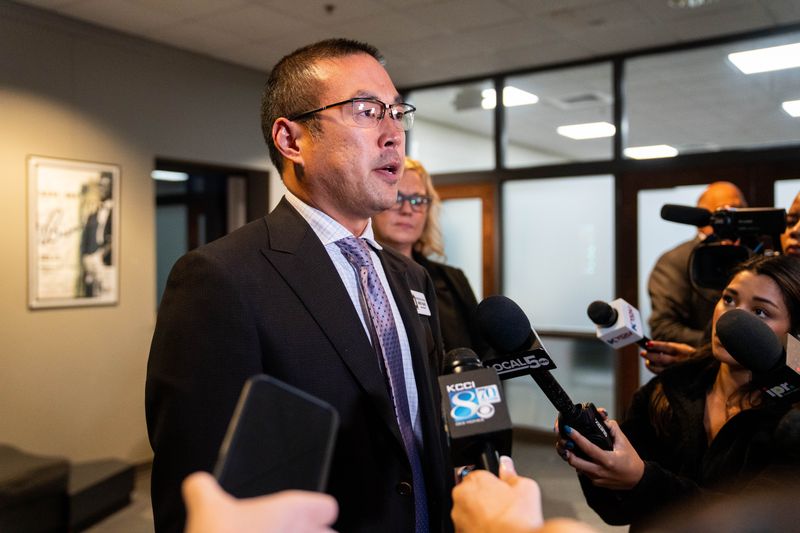
Alan Ostergren, an Iowa attorney who leads the conservative Kirkwood Institute, said courts begin by distinguishing public employees from private workers and by asking whether the speech is tied to the employee’s job.
“There’s no clear-cut answer,” Ostergren said. “Courts will look to whether the employee’s speech related to their official duties or was something that was purely private.”
Aaron Terr, director of public advocacy at the Foundation for Individual Rights and Expression, agreed that the threshold question is whether the employee was speaking as part of their job or as a private citizen, but he emphasized the strength of off-duty speech protections.
“Under long-established First Amendment doctrine, public employees don’t surrender their free speech rights when they’re off the clock,” Terr said. “They retain the right to speak as private citizens on matters of public concern, even when their comments are controversial or unpopular.”
Both attorneys pointed to Garcetti v. Ceballos, a 2006 Supreme Court decision holding that public employees are not speaking as private citizens when their speech is part of their official job duties, limiting First Amendment protection in those situations.
Ostergren said that distinction explains why courts scrutinize how closely speech connects to an employee’s work, noting that speech connected to official duties is more likely to justify discipline.
If speech is not treated as job-related under Garcetti, the lawyers said courts next apply Connick v. Myers, a 1983 case limiting First Amendment balancing to speech on matters of public concern rather than internal workplace disputes. Terr said that step is rarely contested in these cases.
“The death of a public figure like Charlie Kirk is obviously a matter of public concern that generated immense media coverage and national interest,” Terr said.
Once speech is classified as private-citizen speech on a public issue, courts apply the balancing test from Pickering v. Board of Education, weighing the employee’s speech interests against the government employer’s interest in effective operations.
At that stage, Terr said, the burden shifts to the employer. “To justify discipline, the employer would have to prove that the speech was so disruptive to its operation or to the employee’s ability to do their job that it outweighs the employee’s strong interest in exercising their First Amendment rights like any other citizen,” he said.
Terr added an example. “If you had a police officer saying on social media that they ignore complaints from minorities, the police department could have a very strong argument,” he said. “That kind of statement directly relates to their job, even though it was made in their personal capacity on social media outside of work.”
Ostergren agreed that generalized controversy is not enough. “These cases are going to turn on what evidence is there of actual workplace disruptions,” he said, adding that courts look for “an actual, verifiable impact on the employer’s operations.”
Recent Iowa rulings illustrate how similar public reactions can be treated differently depending on the forum and the legal question being decided.
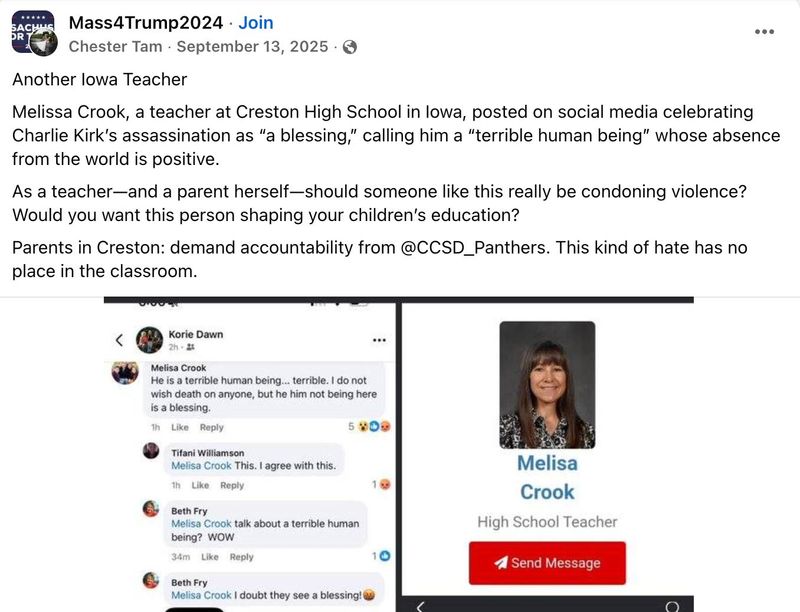
In Crook’s case, U.S. District Judge Rebecca Goodgame Ebinger wrote in a temporary restraining order that blocked the Creston Community School District from firing her that Crook “is likely to succeed in showing (Superintendent Deron) Stender took adverse action against her in response to exercise of her First Amendment rights” and that she “spoke as a citizen on a matter of public concern when posting her Facebook comment.” The order remains in effect as the district contests a preliminary injunction.
Court records show that after Crook’s post became public, the school district received more than 111 emails and 140 telephone calls, including threats, with one reading, “We would like her head on a platter.” Some comments were made by people outside of Iowa.
Ebinger stressed that the post was made away from work and treated complaints originating outside the district as limited evidence of disruption.
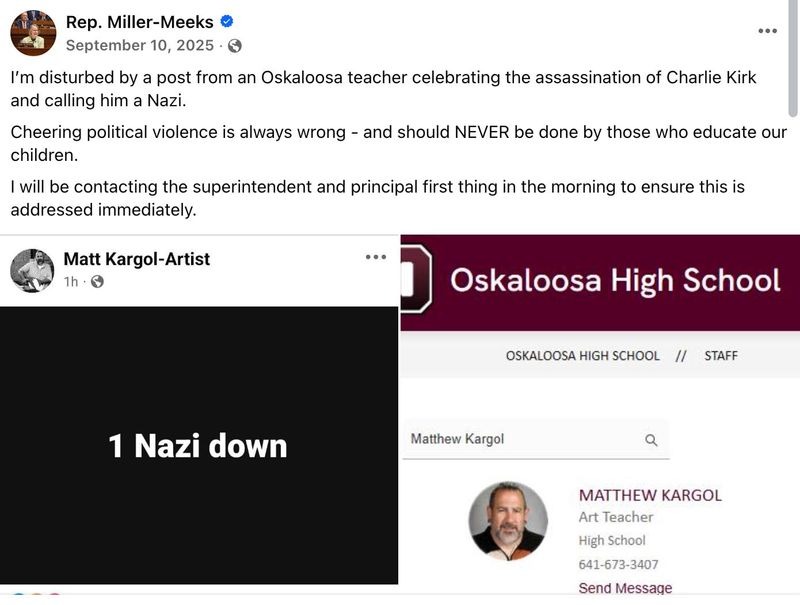
In a separate administrative proceeding involving Kargol, Administrative Law Judge David Steen stressed operational burden, describing the volume of communications and the diversion of staff time and security resources following the post. Steen stated he was not deciding the constitutional question but treated those impacts as relevant to whether Kargol qualified for unemployment benefits under Iowa law.
Those outcomes track the attorneys’ competing views of disruption.
Terr said angry calls and emails alone should not tip the scale, arguing that “fleeting public anger” is not the same as actual workplace disruption and that courts warn against a “heckler’s veto,” where speech is punished because of a hostile audience’s reaction.
Ostergren said an employee’s role affects how easily an employer can justify discipline. Teachers and school administrators may face greater scrutiny, he said, because posts after Kirk’s shooting on a university campus can be seen as “celebrating a school shooting,” while an employee in an unrelated field, such as someone in a city fire department, may not have the same direct connection.
Employers moved ‘rashly,’ and Supreme Court may be ultimate decider
Both attorneys said public employers rushed to discipline after the posts surfaced.
“I’ve been a lawyer for governmental bodies before, and I certainly would have hoped in these situations that somebody talked to their lawyer before they did something,” Ostergren said. “I don’t doubt that some of these decisions were made perhaps more quickly than they should have been.”
Terr said that speed was likely often driven by backlash, which he said is going to work against public employers in some cases.
“Employees will have a strong argument that the decision was not made after a deliberate, good-faith evaluation,” Terr said. “Rather, it was simply an attempt to placate powerful politicians or public anger.”
Ostergren said most cases are likely to never make it to trial and likely will be settled.
Even without definitive rulings, Terr said the consequences extend beyond individual outcomes.
“The investigations and discipline of public employees themselves create a chilling effect, even if some employees ultimately win in court,” he said. Political pressure, he added, amplifies that effect. “It sends a message that if you express the so-called wrong opinion about a public figure, especially one beloved by one side of the political spectrum, you need to fear for your job.”
Both attorneys said that dynamic could force courts to confront broader questions about public employee speech.
Ostergren noted that the U.S. Supreme Court’s governing precedent, Garcetti v. Ceballos, was decided in 2006 by a narrow 5-4 vote. Ostergren said the Court’s makeup has changed since then, and that could matter if a new public employee speech case reaches the justices.
“I think today’s Supreme Court, with different judicial philosophies, would probably decide it in a different way and look for a more bright-line rule,” he said, adding that the court has recently shown more interest in taking free-speech cases.
Terr said that possibility carries significant risk for public employees.
Allowing discipline based on public outrage, he said, would empower outside pressure over constitutional protections.
“If that works, it creates a terrible incentive,” Terr said. “It ultimately means the employee is being punished not because they are bad at their job or hindered public services, but because their views upset people on the internet.”
Nick El Hajj is a reporter at the Register. He can be reached at nelhajj@gannett.com. Follow him on X at @nick_el_hajj.
This article originally appeared on Des Moines Register: How Charlie Kirk lawsuits in Iowa could reshape public employee speech
Reporting by Nick El Hajj, Des Moines Register / Des Moines Register
USA TODAY Network via Reuters Connect