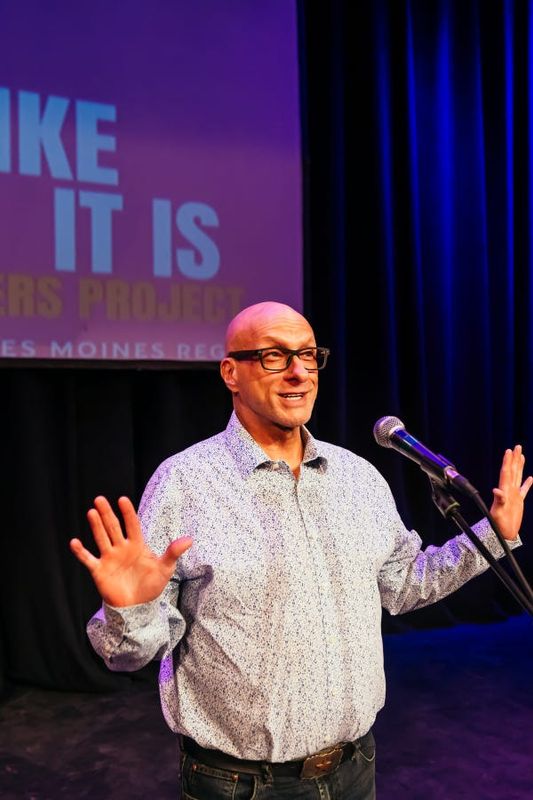
This “Hearts on Fire” story was told Feb. 10 as part of Tell It Like It Is: Iowa Storytellers Project, funded by the Hoyt Sherman Place Foundation in partnership with the Des Moines Register. These stories can be republished by any Iowa newspaper. The next storytellers event is “Search and Rescue” on June 2 at Hoyt Sherman Place. If you have a story to tell, reach out at stories@hoytsherman.org. Hoyt Sherman Place Foundation has donated a portion of the proceeds to help finance Register internships.
Ryan Siskow as told to Kim Norvell.

The view from my apartment on the 32nd floor in Hell’s Kitchen is effervescent: Floor-to-ceiling windows with an unobstructed view looking north across the most magical city in the world, New York City. It’s energetic. It’s vivacious. It even feels kind of bubbly, like when you pour 7-Up into a glass full of ice.
Here’s how cool the view is. The USS Intrepid is docked in the Hudson River, right below my window. A few weeks ago, I stood right here and watched the Pointer Sisters, on the aircraft carrier, sing their hits like “Jump For My Love,” “I’m So Excited” and “He’s So Shy.”
With music like that and a view like this, it feels like you can almost see forever.
But when I walk across the hall, the view looking south from my friend Greg’s apartment is anything but effervescent. It’s dark and melancholy. It feels like hope has left us.
Like Dickens’ A Tale of Two Cities, the view looking north is the best of times, and the view looking south is the worst of times.
It’s Sept. 14, 2001.
It’s been three days since the world caught fire and collapsed 40 blocks from where I stood on that bright Tuesday morning of Sept. 11, and I still haven’t been able to reach my parents.
I punched the digits into my cellphone — again — expecting to receive the same cordial message: “We’re sorry, all circuits are busy.”
I tried again.
Nothing at first. Then the familiar and comforting ‘ring…ring…ring ring.’ I could see the phone ringing far away in my parents’ kitchen in Iowa.
“Hello?” my Mom answered. It was a timid question, really. It sounded like she was on another planet. In another universe. Far, far away.
“Mom,” I whispered, barely able to get that one word out.
“Tom, it’s Ryan!” my Mom interrupted with a scream — a shriek, really — a tone in her voice I had never heard before. “Tom, it’s Ryan,” she said again as she began sobbing.
My Dad picked up the other phone. “Ryan, we’re so happy to hear from you.” I could hear my Dad’s voice crack as he tried to keep it together with the stoicism that had always defined him in my eyes.
My Mom started asking questions in rapid succession until she realized that I couldn’t say anything. The sadness was stuck in my heart, in my throat, leaving me barely able to breathe. The fire, smoke and ash that had engulfed my city were smothering me in grief.
I can’t remember much more from that call. In fact, I can’t remember much from that day or the days that followed.
But here’s what I do remember: Standing on the West Side Highway that morning of Sept. 11, 2001. Burned into the embers of my memory — playing back in perpetual slow motion — are the two towers of the world, burning and then disappearing in a plume of smoke and ash, 40 blocks from where I and thousands of others, stood, watching helplessly.
I didn’t sleep. I couldn’t sleep for days.
Instead, I was bombarded with what felt like nightmare after nightmare.
I learned my friend Graham died when United Airlines Flight 175, traveling from Boston, crashed into the south tower of the World Trade Center.
I saw my cousin, Bill, on the national news speaking about his brother–in–law, Captain Jason Dahl. Capt. Dahl was the co-pilot on United Airlines Flight 93 that crashed in a field in Pennsylvania.
I confronted death and sacrifice every time I walked out of my apartment building and past New York Rescue Company Number One. Eight firefighters from Rescue One lost their lives on that day.
I felt anxious every time I heard a plane or a siren in the distance.
I searched for fellow New York friends who I had not yet heard were safe.
All of that, and more, forever changed my life.
I did much more than cry. I wept.
I had never known — truly — what the word ‘wept’ meant. Of course, I knew it from the Bible. Jesus wept. But until that day, when the world caught fire and fell to the ground, I could not fathom its significance.
I wept until I could sleep again.
Over the course of those three days and in those sleepless moments, when I could barely speak, something remarkable happened. I found my voice…in writing. Writing became my therapy, my way of processing what had happened, and I wrote this poem:
I cry by the river, along the highway, 40 blocks from HellIn the city, the New Colossus, that never sleepsI’m alive, but I cannot breatheI stand here frozen and can only weep.
I am lost on the highway, 40 blocks from HellI have not seen her since the mighty fellIn my dreams, she makes no soundShe lies broken and on the ground.
I run along the highway directly to HellI seek comfort in the story only she can tellWhen I am close to zero, and where once there were twoI look up to see if she has abandoned me, too.
Through tears, I see her, the Lady in the SeaShe rises before me, and I can finally seeHer torch blazing brightly across the land of the freeShe leans forward and whispers to me.
When I wrote that poem 25 years ago, I was lost and adrift. My world had literally, and metaphorically, burned to the ground. I now realize that, as in the poem where I was searching for a light to guide me, it was my “anchors” that got me through those turbulent times.
Author Jane Bradish describes anchors in our lives as those things that keep us steady during life’s challenges, much like a ship’s anchor prevents it from drifting in rough waters.
Life anchors can be many things: a favorite song or book, a pet, and, of course, people. In my life, these anchors are my relationships with my family, friends, mentors, and James Taylor (my cat). They offer comfort, confidence and help me feel safe when life gets scary.
But what I especially like about the imagery of anchors is that they allow for movement.
If you think about a ship, they have anchors on board. They go with you. Anchors not only keep you steady and in one place when needed, but they also help you go with the flow by giving you a little extra slack here and there.
For me, my parents have always been my core anchor. They helped me grow and thrive while staying true to my goals, values and relationships.
And when I needed safe harbor, when life’s storms threatened to pull me under, they were also my anchor. Those three days of waiting for a simple phone call to go through from New York City to Iowa felt like an eternity. I was a grown man, 32 years old. But life got really scary, and I needed my parents.
My Mom has left us, but my Dad is still here. And he’s still the anchor he’s always been.
Just a few months ago, my Dad, sisters and friends dropped anchor one more time as I struggled with a life-threatening illness. Because of them, and here’s my Barry Manilow reference: I made it through the rain.
From that dark day of Sept. 11 to the present moment, it’s become clear to me just how important anchors are in our lives. We all need anchors, whether we’re thriving in calm waters or struggling to stay afloat in the midst of a storm.
So, I’ll leave you with this challenge.
Look around you. Shore up the anchors in your life, and look for opportunities to be an anchor for others.
When all is said and done, we are stronger together when we take care of each other. It’s that fundamental truth that gets me through every day… until I can sleep again.
This article originally appeared on Des Moines Register: He lived blocks from Ground Zero on 9/11. How he found solid ground
Reporting by Des Moines Register / Des Moines Register
USA TODAY Network via Reuters Connect