Rockwell City — After a record-setting 193 days, Central Iowa Water Works turned off the nitrate removal facility that’s enabled the regional authority to meet federal safe drinking water limits for roughly six months.
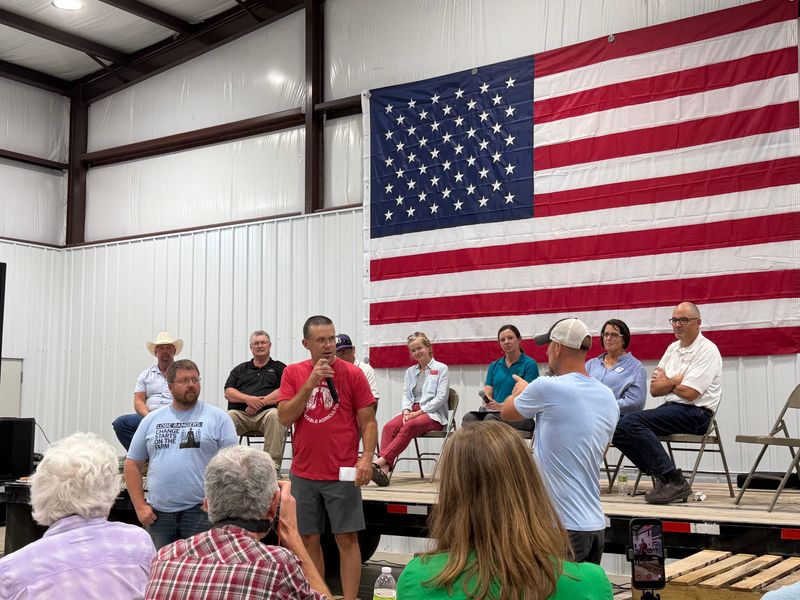
Amy Kahler, Des Moines Water Works CEO, told a group of farmers, legislators and political candidates in northwest Iowa Saturday, July 25, that the drinking water utility stopped running central Iowa’s large nitrate removal facility on Thursday, July 23.

Des Moines Water Works, one of 12 members of CIWW, operates the nitrate removal plant, while the regional authority is the governing body that owns the asset.
Previously, the longest the nitrate removal plant had operated was 177 days in 2015.
“It has been running virtually… all year,” said Kahler, who participated in discussion about water quality at the field day, organized by three north Iowa farmers who call themselves the Lobe Rangers.
The farmers — Matt Bormann, Zack Smith and James Hepp — use social media to urge fellow growers to adopt conservation practices that reduce fertilizer losses that contribute to high-nitrate levels and harmful algal blooms in Iowa’s waterways that downstream utilities struggle to treat. The field day Saturday was their first.
“We’re trying to point out simple things that are obvious, but work… cover crops, in-season nitrogen, reduced tillage,” said Bormann, adding that the men are talking with gubernatorial candidates, Democrat Rob Sand, the state auditor, and Republican businessman Zach Lahn, about what farmers can do to cut fertilizer losses.
Cover crops help hold fertilizers in place in the fall and spring when heavy rainfall can pull them into Iowa’s waterways; fertilizing crops in the spring or during the growing season, instead of the fall, reduces runoff and gives plants the nutrients they need while they’re growing; and reducing tillage can cut erosion and build soil health, the men told those attending the field day.
“None of this costs us yields or hurts our bottom line,” Bormann said. “We’re still in business. We’re not broke. … We’re proof that it works.”
Bormann said farmers likely will face future government regulations if they don’t adopt conservation practices that improve water quality. “We have too many people who are choosing not to play ball,” he said.
Communities across Iowa have struggled with high nitrate levels, microcystins that can emerge with toxic algal blooms and other pollutants.
On June 8, Central Iowa Water Works banned customers from watering their lawns, with spiking demand threatening to outstrip the utility’s ability to treat high nitrate levels. It was the second year in a row CIWW issued the summer lawn watering ban.
Des Moines Water Works has struggled with high nitrate levels in the Des Moines and Raccoon rivers, the primary drinking water sources for 600,000 central Iowa customers. Nitrate levels in the Raccoon River, for example, lingered around 15 milligrams per liter for much of the year, data from the U.S. Geological Survey shows, and only recently fell to 5 milligrams per liter.
The federal safe drinking water limit for nitrates is 10 milligrams per liter. High nitrate levels are dangerous for infants and have been linked to some cancers.
Iowa has the nation’s second-highest cancer rate and is only one of three states with rising new cancer rates.
The regional authority lifted the lawn watering ban for residential customers on July 1 and pulled the order for businesses and governments on July 20.
State Sen. Dennis Guth, who farms in north-central Iowa, asked Kahler what it cost to run the nitrate removal facility and if it wasn’t more cost-effective to treat nitrates at the plant, rather than pay for conservation practices or infrastructure like wetlands or bioreactors that clean water.
“I had an agricultural engineer tell me that if you figured out how many people you served, and how it’s divided all out, it amounts to about two or three dollars per person, per year,” Guth, R-Klemme, said. “It seems like it’s a whole lot cheaper to remove the nitrates than it would be to build treatment out in the rural areas.”
While the nitrate removal costs for haven’t yet been fully calculated, Kahler said last year, the nitrate removal plant expense reached $1.6 million.
The Iowa Nutrient Reduction Strategy estimates it would cost about $750 million annually over five decades for farmers to meet the state goal to cut by 45% the nitrogen and phosphorus levels that leave the state and contribute to a dead zone in the Gulf of Mexico, renamed the Gulf of America by the Trump administration.
Farmer participation, however, is voluntary and encouraged through state incentives. Even though gains have been made, critics say they’re not at the scale needed to make improvements. For example, the strategy calls for about 13.8 million corn and soybean acres to be planted annually in cover crops, but only about 3.8 million acres were in 2023.
In May, Gov. Kim Reynolds announced Central Iowa Water Works would receive a $25 million grant to expand and upgrade its nitrate removal facility, part of a statewide overhaul of Iowa’s water quality funding.
Kahler told Guth that relying on utility treatment doesn’t improve the health of the state’s rivers, lakes and streams that Iowans also rely on for recreation like fishing, swimming and boating.
And Catherine DeLong, Iowa State University Extension’s water quality program manager, said utility treatment doesn’t help rural residents who rely on wells for drinking water but struggle with pollutants like bacteria, nitrates and arsenic.
“They’re the ones directly accessing source water” and paying for treatment if problems are discovered, said DeLong, who urged rural residents to get their wells tested annually, a process that can be done at no or little cost through Iowa’s counties.
Donnelle Eller covers agriculture, the environment and energy for the Register. Reach her at deller@registermedia.com.
This article originally appeared on Des Moines Register: Central Iowa Water Works shutters nitrate removal plant after 193 days
Reporting by Donnelle Eller, Des Moines Register / Des Moines Register
USA TODAY Network via Reuters Connect
By Donnelle Eller, Des Moines Register | USA TODAY Network