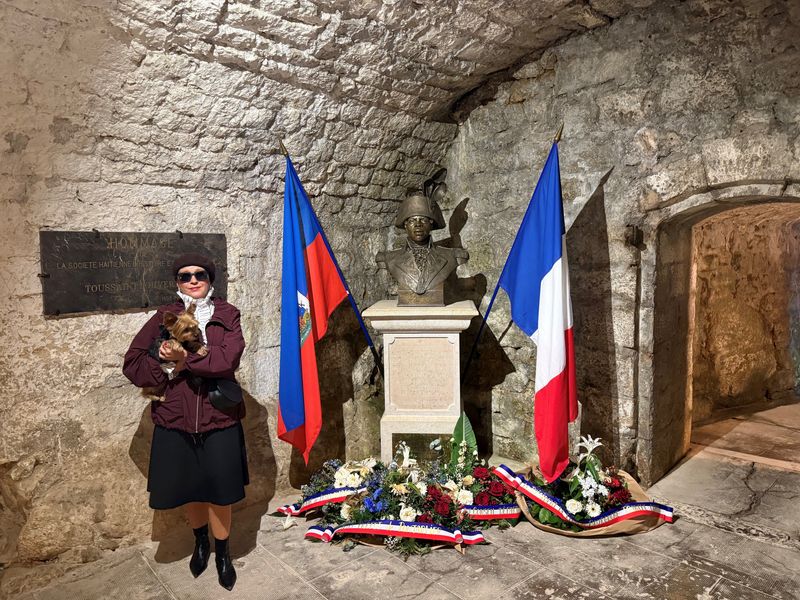
As I descended into the cavernous underground passages of Château de Joux, my arthritic joints screamed in despair. The damp, sepulchral atmosphere was oppressive in this stone grave that buried the charismatic and controversial leader of the Haitian Revolution, Toussaint Louverture (1743-1803).

For it was here, in a French fortress on the Swiss frontier, that Louverture died in 1803, imprisoned on the orders of France’s First Consul Napoleon Bonaparte (1769-1821). The cell where he spent his final months witnessed the composition of his autobiography, written in a futile attempt to engage Napoleon in negotiations over the fate of Saint-Domingue, today’s Haiti, a French colony since 1659, which launched the only successful slave-initiated revolution in the world.
The 1789 French Declaration of the Rights of Man and of the Citizen, drafted by the hero of the American Revolution, Marquis de Lafayette (1757-1834), with assistance from the author of the Declaration of Independence, Thomas Jefferson (1743-1826), proclaimed equal rights for all and ignited the abolition movement in Saint-Domingue. The American Revolution of 1776, which triumphed over an imperial superpower, was another source of inspiration. Saint-Domingue’s 1791 slave uprising pressured the French National Convention to abolish slavery in all French colonies in 1794.
The most profitable colony in the world, Saint-Domingue, accounted for fifty percent of France’s transatlantic trade, supplying half of the sugar and coffee consumed in Europe. The French economy imploded during the revolutionary 1790s, and Napoleon, who became the First Consul in the aftermath of the Coup of 18th Brumaire in 1799, reestablished order in Paris and proceeded to reform France’s laws and finances. With French economic, political, and structural integrity at stake, Napoleon regained control of French Louisiana, lost to Spain during the Seven Years’ War (1756-1763), and reestablished slavery in 1802 in an attempt to restore French control over revenue-generating colonies.
To underscore the personal importance of the matter, Napoleon dispatched his brother-in-law, General Charles Leclerc (1772-1802), to neutralize the Saint-Domingue national liberation forces, led by the Black general Toussaint Louverture. Briefly allied with the Spanish military and the French revolutionary government and serving as the island’s governor since 1797, Louverture was under the impression that Leclerc was authorized to conduct negotiations. Instead, Leclerc had Louverture arrested and deported to France.
Reversing the Atlantic Ocean crossing of his West African parents, who were sold into slavery in their native Benin and transported to the sugar plantations of Saint-Domingue, Louverture was hoping to secure a meeting with Napoleon as he arrived at the French Atlantic port of Brest. Instead of negotiations, he was transported to Château de Joux in France’s Jura Mountains, a forbidding fortress as distant from the French coastline as possible to prevent an escape.
Leclerc’s Saint-Domingue expedition was a disaster. His wife, Napoleon’s sister Pauline Bonaparte (1780-1825), returned to France in December 1802 with the remains of her husband, who succumbed, along with eighty percent of his troops, to yellow fever. This military fiasco necessitated French disentanglement from North America and the subsequent sale of French Louisiana − which at the time extended from Montana’s border with Canada to New Orleans − to the administration of Thomas Jefferson, on April 30, 1803.
A memorial cross unveiled in 1954 by Léon Thébaud, Haiti’s Ambassador to France, marks the possible location of the final resting place of Toussaint Louverture, who was buried in an unmarked location, away from friends and family and the brilliant sunshine of Haiti, which birthed him. Did Napoleon remember Louverture during his first exile, to the Island of Elba, where the only sibling who paid him a visit was the loyal Pauline, an eyewitness to France’s defeat in Haiti? And did Napoleon appreciate the tragic irony of his own final exile to the distant Atlantic Island of Saint Helena, where he died away from friends and family, meeting the same fate he allotted to the leader of the Haitian Revolution?
On Jan. 1, 1804, in the aftermath of Toussaint Louverture’s death, Saint-Domingue declared full independence under the leadership of Jean-Jacques Dessalines (1758-1806), was renamed Haiti in honor of its indigenous Taino name, and became the first country in the Western Hemisphere to abolish slavery permanently. France abolished slavery after the establishment of the Second Republic in 1848.
Commemorating the bicentennial of Toussaint Louverture’s death, James Mastin’s (1935-2016) bronze bust, donated to the Château de Joux by the Republic of Haiti in 2003, displays Louverture’s prophetic words:
“By overthrowing me, they cut down in Saint-Domingue the trunk of the Tree of Liberty for Black people; it will grow back from its roots because they are deep and numerous.”
Professor Anna Barker teaches in the UI College of Liberal Arts and Sciences Russian Program. She is a Fellow of the International Napoleonic Society and serves of the Board of Directors of the Napoleonic Historical Society. Her book “13 Notes from Napoleon, Iowa: Musings on the Edge of the French Empire” was published in 2025 (Ice Cube Press).
This article originally appeared on Iowa City Press-Citizen: Age of Revolutions: The Haitian Revolution and Toussaint Louverture | Column
Reporting by Anna Barker, Special to the Press-Citizen / Iowa City Press-Citizen
USA TODAY Network via Reuters Connect

By Anna Barker, Special to the Press-Citizen | USA TODAY Network