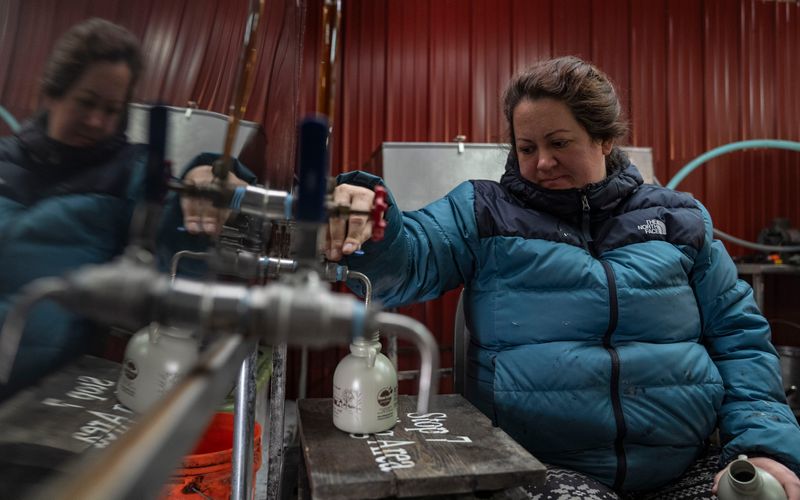
On dark winter nights, Indiana sugar maker Emily Blackman sometimes finds her husband, Robert, pacing the floor of their home in Clark County, anxiously thumbing through the forecast on his cell phone, checking to see what the weather might have in store for the family’s maple trees.
Syrup production is a fickle business, subject to the whims of the climate — and Emily has known this for most of her life. She and her sister, Jen Reisenbichler, grew up tapping trees and chopping firewood on the family’s Salem maple farm. When their parents sold the property in 2013, the sisters and their husbands snatched it up. The two families have been running LM Sugarbush ever since.

Most people don’t associate maple syrup with Indiana, but after decades of dormancy, the once-booming industry is now making a comeback. The state ranks as the tenth largest maple syrup producer in the country. Roughly 200 farms produced about 24,000 gallons of maple syrup in 2025, up from below 12,000 gallons a decade prior.
But that does not mean sugar makers have it easy. They are at the mercy of an unpredictable and evolving climate.
Researchers fear that maple syrup production could become impossible in Indiana by the end of the century as climate change shrinks the window of time when maple trees produce sap. This could strike a devastating blow to an Indiana industry that has just barely been resuscitated after a century of deforestation. For now, all sugar makers can do is adapt to the uncertainty, even if it means more work and less syrup.
A delicate dance between maple trees and weather
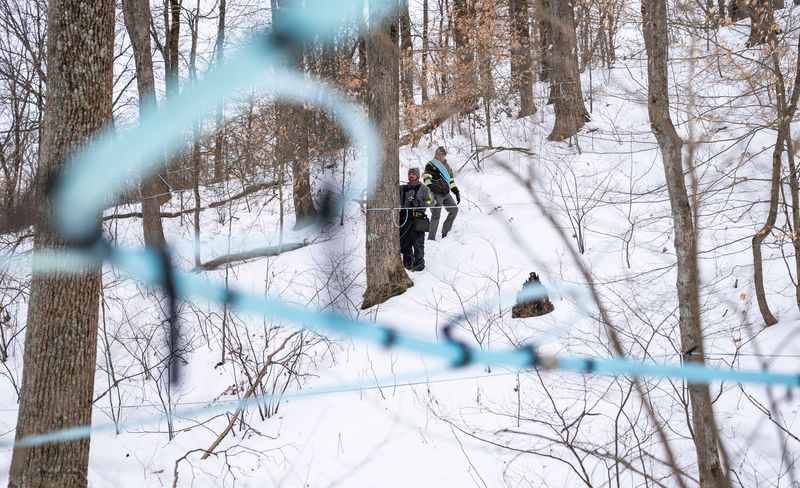
At LM Sugarbush each winter, the two families, aided by friends and farm dogs, hop on a fleet of bright red UTVs and spend a weekend on 140 acres of steep, snowy hills to drill and hammer spigots into 3,000 maple trees.
Maple syrup production relies on the delicate interplay between late winter’s frigid nights and balmy days. The freeze and thaw cycle creates a pressure-and-release system inside a maple tree, sending sap flowing up and down its innards. Sugar makers have to harvest the liquid before the trees bud out and their sap runs sour.
So timing the tap just right makes or breaks a season, Emily Blackman said. Over the past five years, her family has adjusted the tapping schedule as needed, sometimes starting two weeks earlier than usual.
“The gradual transition from winter to spring seems to be going away,” Emily Blackman said.
Dan Winger, the president of the Indiana Maple Syrup Association, has seen the same trend..
He thought this season might be better, but the taps on his 300 maple trees in North Manchester have yet to produce much sap. And he’s not impressed with the sugar content of the little sap he has seen. Low-sugar sap means it will take more to produce the same amount of syrup.
“This warm spell might help,” he said. “But if the sap shuts off now, we’re in trouble.”
Indiana was once a powerhouse maple sugar producer
Indiana residents first produced maple syrup centuries ago. Indiana state archaeologists have documented dozens of sugar camps across the state, some dating back to at least the 1830s. Many were operated by Native Americans, who introduced the art of sugar making to European settlers.
By the mid-19th century, Indiana was a maple syrup powerhouse. Thanks to its vast maple-beech forests, sugar makers produced upwards of 300,000 gallons of syrup and 1.5 million pounds of maple sugar cakes in 1860. According to the North American Maple Syrup Association, Indiana produced more maple syrup than any other state in the late 1910s.
Then, the tide shifted. Hoosiers lost farms during the Great Depression, and decades of deforestation razed almost 20 million acres of woodland. Indiana sugar makers produced less than 50,000 gallons of syrup in 1940.
“There were no resources or trees available for tapping anymore,” said Mo Zhou, a forest economist at Purdue University who studies Indiana’s evolving maple syrup industry. Production in the state dwindled so dramatically that the USDA didn’t bother to record it until 2016, she added.
But in the past decade landowners across the state found their way back to the sweet stuff. Many Hoosiers, like Emily Blackman’s parents, eased into the industry by tapping a few trees at a time. Then they realized their land held a viscous sort of riches.
A battle against time — and the climate
The question remains how long the sugar makers will have to enjoy their bounties. Indiana sits at the edge of the continent’s maple syrup production range — travel much farther south and it becomes difficult to find the frigid nights and warm days necessary for sap flow.
Researchers think climate change, which leads to both warmer and more unpredictable weather, could throw a wrench into Indiana’s freeze-thaw cycle.
“There will be a huge impact on the length of the tapping season,” Zhou said. “Landowners probably won’t have enough days to have the best, optimal sap flow.”
In 2019, a team of researchers from universities across North America published a study examining maple syrup stands from Virginia to Quebec, including a stand near Lake Michigan in Indiana. The team created a model based on greenhouse gas emissions trends to model what sap production might look like by 2100. While the results weren’t all dire (the study found that syrup production in Quebec might improve), tapping seasons across the continent are generally expected to begin earlier and end sooner.
The future could be bleak for Indiana: Researchers concluded that sap production in the state could almost entirely cease by the end of the century.
Zhou concurs with the predictions based on her own research, and she fears production instability could make it hard for sugar makers to stay in the industry.
“They are dealing with fluctuating production,” she said. “That is a major hurdle for long term investment.”
For now, most sugar makers are trying to make the most out of a sticky situation by maximizing their sap intake.
Emily Blackman’s family, for instance, upgraded their sap retrieval system by installing new vacuum pumps and improved tubing across the farm.
“I don’t know if we’re keeping up with it,” Emily Blackman said, acknowledging the changing climate. “But we’re trying.”
Winger, on the other hand, said he’s not concerned about the future of the weather after 28 years of producing maple syrup in Indiana. He just wants to keep doing what he’s doing as long as he can.
“We could tap earlier and start earlier. Or we’ll hang it up and get out of it,” he said. “But I think we’ll keep on plugging on.”
The stakes are different for Blackman. She’s hoping her seventh grade son will still be able to tap on the farm when he is her age, but both mother and son worry climate change could disrupt that legacy.
“It’s possible that if the patterns shift any more significantly, we won’t have the season that we need to make any syrup, which is scary if you think about it,” she said. “I don’t know if we will be able to make syrup on the farm longterm.”
IndyStar’s environmental reporting is made possible through the generous support of the nonprofit Nina Mason Pulliam Charitable Trust.
Sophie Hartley is an IndyStar environment reporter. You can reach her at sophie.hartley@indystar.com or on X at @sophienhartley.
This article originally appeared on Indianapolis Star: Yes, Indiana maple syrup is a thing. But climate woes could change that
Reporting by Sophie Hartley, Indianapolis Star / Indianapolis Star
USA TODAY Network via Reuters Connect