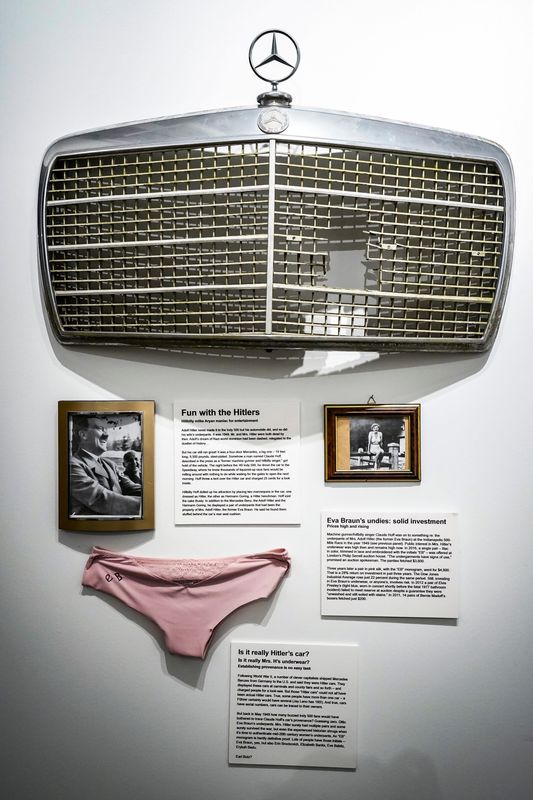
The lacy pink proof might be fake, but the story — Adolph Hitler’s 1938 Mercedes Benz “sport” convertible, the “girl reporter” who rode shotgun and the “former machine gunner and hillbilly singer” who stuck a pair of embroidered underwear to it — is absolutely true.
The “Hitler car” made its way to Indianapolis in 1945 for a war bond rally, former IndyStar reporter Will Higgins wrote in 2017 in a story spotlighting “Indy history, for real,” as so much of his work did in his 26 years at the paper. A particularly entrepreneurial character caught onto the American interest in these cars and stuck mannequins and a pair of “Hitler’s wife’s underwear” (found stuffed between the seats, allegedly) in a duplicate ‘Benz that turned heads at the 1949 Indianapolis 500.

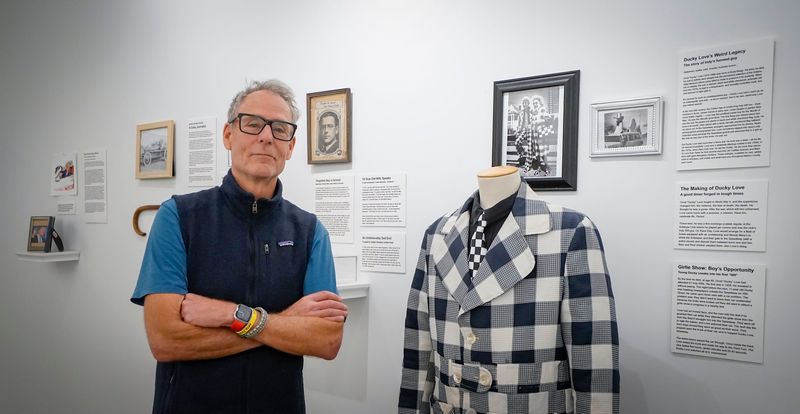
The “Hitler car” saga and other Indy 500 oddities live on decades later in the halls of the Contemporary Art Museum of Indianapolis, or CAMi, where Higgins, 69, has collected nine eclectic stories surrounding the lore of the race in his new exhibit “The Speedway’s Attic.” Higgins’ collection, built entirely from his own research and some creative craft work, is unofficial, unsanctioned by Indianapolis Motor Speedway brass and completely, miraculously true.
The exhibit is on display until Aug. 16.
Ten miles away from the CAMi, the Speedway boasts a newly renovated museum of its own. How does “The Speedway’s Attic” stack up to the verified version? Here’s what Higgins thinks:
“They have the goods, and I would recommend anybody go see it. It’s an incredible thing,” Higgins said of the Speedway museum. “But my stories are better.”
A journalist whose work recalls the gonzo tradition, Higgins made a name for himself as a documentarian of Indiana’s odds and ends during his 26-year tenure as an IndyStar reporter. Often joined by IndyStar photographer Michelle Pemberton, Higgins regularly ventured to all corners of the state in search of the weird and wild, publishing dispatches from Shelbyville’s Electric Bridge and Parke County’s Jungle Park Speedway and Irvington’s haunted house.
The former reporter’s foray into art began with a fortunately pale bottle of fresh-squeezed orange juice that “looked like valuable urine” — so prestigious that he labeled it as Abraham Lincoln’s excretion. With encouragement and guidance from his wife, Indianapolis artists Dorothy Stites Alig, Higgins turned the one-off joke into his 2016 American Society of Presidential Urine Collectors exhibit: jars of colorful liquid attributed to every leader of the free world from George Washington to George H.W. Bush. Higgins rebounded from the blatantly false back to the totally real with his 2025 exhibit “The Museum of Fabulosity,” 16 underground Indy stories on display at the CAMi.
That Higgins would tackle the 500 — a hotbed for ridiculous debauchery — was inevitable. As a lifelong Hoosier, Higgins said the stakes of the Greatest Spectacle in Racing enthralled him.
“It’s like the original X Games. Think how wild it is,” Higgins said. “Unlike a basketball game or a football game, this was like life and death. This was like bullfighting. You go into that ring and you may not come out of it.”
When he unlocked a knack for storytelling, Higgins’ attention shifted from the drama of the race itself to the lore that lurks in its margins. Some of the nine narratives that make up “The Speedway’s Attic” came to Higgins during his reporting career, while he picked up others during research for the exhibit and recalled a few from his childhood attending races.
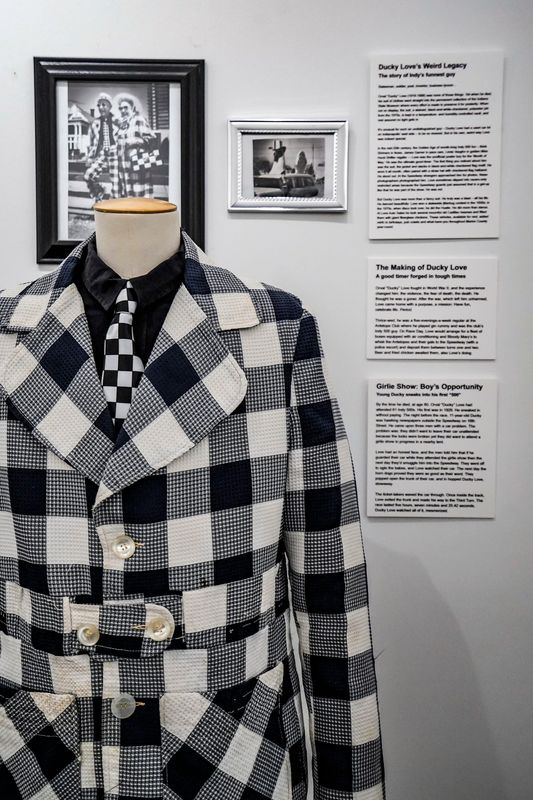
The exhibit houses tightly packed blurbs detailing the 500’s first streaker, the trio of brothers who dealt drugs to finance their spots in the race’s lineup and the nitty gritty of the notorious Snake Pit, among other tales. The artifacts accentuating the anecdotes, like Hitler’s wife’s pink panties or Indianapolis Motor Speedway founder Carl Fisher’s glasses, are artificial — except one: Iconic race day figure Orval “Ducky” Love’s signature checkered suit is authentic, on loan from the Indiana State Museum.
For an exhibit where the wacky reigns supreme, Higgins’ favorite story is surprisingly sentimental. Actor and singer Jim Nabors, best known as Gomer Pyle on “The Andy Griffith Show,” became a 500 legend with 36 performances of the seminal pre-race anthem “Back Home Again in Indiana.” When Nabors announced his upcoming marriage to a man in 2012 and brought his husband to the 500 the following year, Higgins wondered if Hoosiers would still embrace him.
“They loved him just as they always did,” Higgins said. “I thought, ‘What a nice commentary on us.’”
Therein lies what Higgins believes is magic of the 500 — not the oddities and absurdities he’s dug up for “The Speedway’s Attic,” eye-popping as they are, but the race’s power as the great state unifier. It “binds all Hoosiers,” Higgins said: Some 350,000 people every year, decked in their finest checkered attire and ready to get wild, witnessing the pinnacle of automobile achievement. Racers zooming ‘round and ‘round and ‘round until the flags go down and the celebratory milk drenches the victor. The legends and beloved figures that emerge from more than a century of tradition.
The race’s more ridiculous footnotes are a fascinating touch though. Higgins said — and he hopes visitors approach the exhibit with an appetite for absurdity.
“I want them to marvel at the things people will do,” Higgins said. “The more you know about your town, the better you like it.”
The Contemporary Art Museum of Indianapolis is located at 1125 Cruft St. and open from 11 a.m. to 7 p.m. Wednesday through Friday and 11 a.m. to 5 p.m. Saturday and Sunday. Admission is free.
Contact IndyStar Pop Culture Reporter Heather Bushman at hbushman@indystar.com. Follow her on X @hmb_1013.
This article originally appeared on Indianapolis Star: Will Higgins uncovers the Indy 500’s wacky history in new exhibit
Reporting by Heather Bushman, Indianapolis Star / Indianapolis Star
USA TODAY Network via Reuters Connect