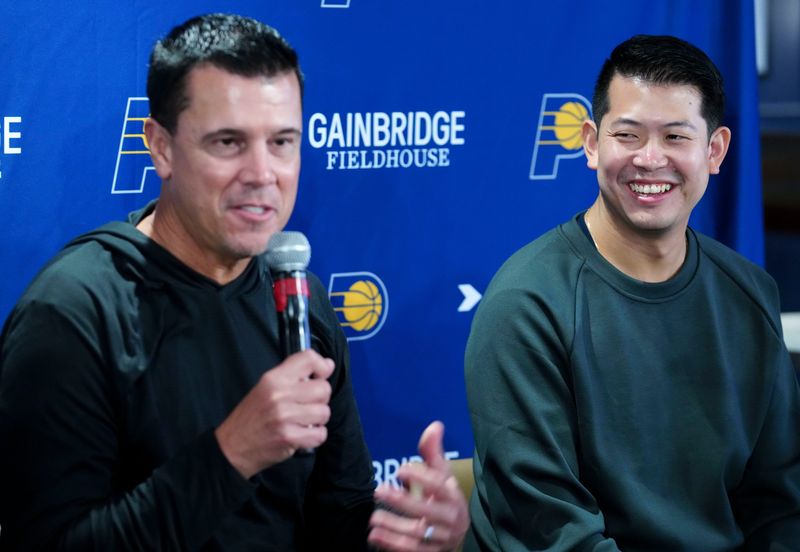
INDIANAPOLIS — The Pacers have never had more of their future riding on ping-pong balls than they will this weekend.
They will enter Sunday’s 3 p.m. NBA Draft Lottery in Chicago with better odds at the No. 1 overall pick and better odds at a top four-pick than they’ve had in at least 37 years thanks to a 19-63 record in 2025-26 that was the worst in franchise history and second-worst in the NBA. However, if they don’t end up with a top-four selection they will lose their pick in this year’s draft entirely.

The Pacers included but protected their 2026 first-round pick in their trade with the Clippers for center Ivica Zubac. The Pacers get to keep the pick if they end up with a top-four selection and would send their 2031 first-round pick to the Clippers instead. However, if the pick lands between 5-9, the pick goes to the Clippers and the Pacers keep the 2031 selection. The Pacers can’t fall back further than sixth.
This is considered one of the strongest top-to-bottom draft classes in recent seasons, so given the potential drama, ESPN should expect a spike in lottery viewers from Indianapolis. The Pacers still maintain most of the core players from a team that reached the Eastern Conference Finals in 2024 and the NBA Finals in 2025 before injuries hijacked the 2025-26 campaign, so the front office believes they can be a contender in the East whether they keep the pick or not. However, the Pacers have never had the No. 1 overall pick in 50 years in the NBA and they haven’t had a top-four pick since they selected center Rik Smits second in the 1988 draft, so their executives know they can take a piece that can set them up for years to come.
BYU wing A.J. Dybantsa, Duke forward Cameron Boozer, Kansas guard Darryn Peterson and North Carolina forward Caleb Wilson appear to be the most likely candidates to be taken in the top four. Though there isn’t a clear No. 1 as there was last season with now-Mavericks forward Cooper Flagg and three years ago with Spurs center Victor Wembanyama, all four are extremely enticing players.
With all that in mind, here’s a primer for Sunday’s NBA Draft lottery, possibly the most important in Pacers franchise history.
How The NBA Draft Lottery Works
Since its inception in 1985, the NBA Draft Lottery has undergone continual adjustments to its format in order to maximize fairness but also discourage tanking and more adjustments appear to be soon to come after five teams lost at least 60 games this season.
Under the current format, drawings using ping-pong balls are held to determine the top four picks with picks 5-14 then determined by reverse order of standings. According to an explanatory piece on NBA.com, the drawing process happens in the following manner.
Fourteen ping-pong balls numbered 1 through 14 are the basis for the drawing. There are 1,001 possible combinations when four balls are drawn without regard to their order of the selection. Before the lottery, tickets with 1,000 of the 1001 combinations are assigned to the 14 teams participating in the lottery who either failed to reach the playoffs or traded for the pick of team that did. The number of lottery tickets assigned to each team are determined by their reverse order of finish. The teams with the three worst records get the same number of combinations and so have the same odds at each of the top four picks. Each team further down the list in the reverse standings gets fewer combinations and lower odds.
The drawing will be held Sunday in Chicago in a separate room from where the results are announced on television. All 14 balls are placed in a lottery machine. According to the NBA.com story, there is a 20-second mix before the first ball is drawn, then 10-second mixes before the drawing of the second, third and fourth ball. The time intervals are monitored by a timekeeper who faces away from the machine and signals to the machine operator that the applicable period of time has elapsed. The team that has been assigned the combination of the four balls drawn from the machine will receive the No. 1 pick.
The ping-pong balls are then placed back in the machine and the same process is repeated for the second through fourth picks. If the combination is owned by a team that has already been selected for one of the previous picks or is the one unassigned combination, then the result is discarded and another four-ball combination is drawn.
The NBA Draft Lottery Odds
The NBA flattened the lottery odds in 2019 so that the teams with the three-worst records have the same odds. So the Wizards (17-65), Pacers (19-63) and Nets (20-62) all have a 14% chance at the No. 1 overall pick and a 52.1% chance at a top-four pick.
The Jazz and Kings both finished 22-60 so they’re next in line with 11.5% chance at landing the No. 1 pick and a 45.2% chance of landing a top-four pick. The Grizzlies have the sixth-best odds at 9.0% and 37.2%. The Hawks own the Pelicans’ pick with the seventh-best odds at 6.8% and 29.3%. The Mavericks, Bulls, Bucks and Warriors occupy pre-lottery positions 8-11. The defending champion Thunder own the Clippers pick with the 12th-best odds. The Heat and Hornets, losers in the Eastern Conference play-in round, occupy positions 13 and 14. The Hornets have the lowest odds of any of the participating teams with a 0.5% chance at winning the No. 1 overall pick and a 2.4% chance at any of the top four.
The NBA Draft Lottery Stakes
The lottery serves as an unofficial beginning of the pre-draft process with the NBA Draft Combine continuing the rest of the week in Chicago. There’s ample opportunity for movement between the lottery and the draft with the first round being held June 23 and the second round June 24 at the Barclays Center in Brooklyn.
Still, there’s some level of consensus among draft experts about who the top four picks will be, but the order could end up being determined by how the lottery shakes out.
A.J. Dybantsa, a 6-9 wing who played his lone college season at BYU, seems to be the current frontrunner to the No. 1 pick. The 19-year-old from Boston led Division I in scoring with 25.5 points per game and was named a consensus first-team All-American, first-team All-Big 12 and the Big 12 Rookie of the Year. He struggled somewhat from 3-point range, making 33.1% of his shots from beyond the arc, but proved to be a capable scorer at all three levels. He has a remarkable handle for a player with a wingspan estimated at about 7 feet that allows him to get to his spots at will.
Dybantsa may have the highest ceiling in the draft. Cameron Boozer appears to have the highest floor. The Duke big man doesn’t have run-and-jump athleticism that matches Dybantsa’s, but he was the most effective player in college basketball this season, earning national Player of the Year honors from every major service. Boozer led Duke to an ACC championship, a No. 1 seed in the NCAA Tournament and the Elite Eight before the Blue Devils lost in a dramatic, heartbreaking regional final to No. 2 seed Connecticut. Boozer, the son of 13-year NBA big man and two-time All-Star Carlos Boozer, averaged 22.5 points, 10.2 rebounds and 4.2 assists in his lone college season, showing remarkable physical and mental maturity. He’s 6-9, 250 pounds with a powerful, sculpted frame though the won’t turn 19 until July.
Kansas guard Darryn Peterson is one of the most controversial prospects in the draft. He arguably had the most momentum as a potential No. 1 overall pick when the season started but trouble with cramping led him to ask out of games. He appeared in just 24 of Kansas’ 35 games during the season. He still averaged 20.2 points but his efficiency numbers (43.8% from the floor, 38.2% from 3-point range) weren’t quite what he and talent evaluators had hoped. Still, he’s a talented scoring 2 guard which would be the most direct fit for the Pacers’ roster needs.
North Carolina forward Caleb Wilson seems likely to be picked fourth. He might not have all the tools to be a franchise player, but he plays with a lot of energy and athleticism which could make him valuable on both ends. The 6-10, 215-pounder made just 7 of 27 3-point attempts (25.9%) but he made 61% of his 2-pointers and averaged 19.8 points per game with an ability to play above the rim and also hit mid-range jumpers. He’s a capable passer with 2.7 assists per game, an excellent rebounder with 9.4 rebounds per game and a defender who can guard in the perimeter and the post, averaging 1.5 steals and 1.4 blocks per game. He played just 24 games with North Carolina thanks to a fracture in his left hand and then a broken right thumb, but the Tar Heels were 19-5 in those games and 5-4 in the games he missed.
What if the Pacers miss a top 4 pick?
If the Pacers whiff in the lottery and end up without a pick, they still will have a strong core and some limited ability to add to the roster, though the draft would be their best opportunity to add talent.
All-Star point guard Tyrese Haliburton is expected to return after missing all of 2025-26 with a torn right Achilles tendon suffered in Game 7 of the 2025 NBA Finals. With him back, the Pacers will return four of their five starters from the playoff run with the others being All-Star power forward Pascal Siakam, small forward Aaron Nesmith, and combo guard Andrew Nembhard, who can play shooting guard next to Haliburton but also handled the point this season with Haliburton out. The addition of Zubac gives the Pacers a sturdy center to replace Myles Turner, who left for the Bucks in free agency in July. The Pacers also still have veteran point guard T.J. McConnell and forward Obi Toppin, two of their top three bench scorers in the 2025 playoffs.
They could use a scoring guard to replace Bennedict Mathurin, who was included in the trade for Zubac. They could also use some depth at center and point guard and possibly a bigger wing. They might not have much to work with in terms of roster space. Forward Kobe Brown, who came from the Clippers with Zubac, is the only unrestricted free agent. The Pacers could chose to make center Micah Potter a free agent if they don’t pick up his club option. They also have two guards on partially guaranteed contracts in Quenton Jackson and Kam Jones, but everyone else has a guaranteed deal and even if they waived them to open up a roster spot they would still have dead money counting against the salary cap. That’s an issue, because they’re already brushing up against the luxury tax and are well over the soft salary cap.
Still, they could have access to the taxpayer’s mid-level exception which would allow them to sign a veteran player with a starting salary around $6 million per year. They could also package together players in trades to move out some higher salaries in exchange for slightly smaller ones, and they do have access to most of their upcoming first-round picks in future years available as an incentive to make moves.
Still, adding a top-four pick in the lottery could strengthen a chance at a title run next season and also give Haliburton an All-Star caliber running mate for the future when the 32-year-old Siakam starts to show his age. If they get such a player, this could be the most consequential lottery in Pacers history.
Dustin Dopirak covers the Pacers all season. Get more coverage on IndyStarTV and with the Pacers Insider newsletter.
This article originally appeared on Indianapolis Star: What Sunday’s NBA Draft Lottery means for the Pacers
Reporting by Dustin Dopirak, Indianapolis Star / Indianapolis Star
USA TODAY Network via Reuters Connect