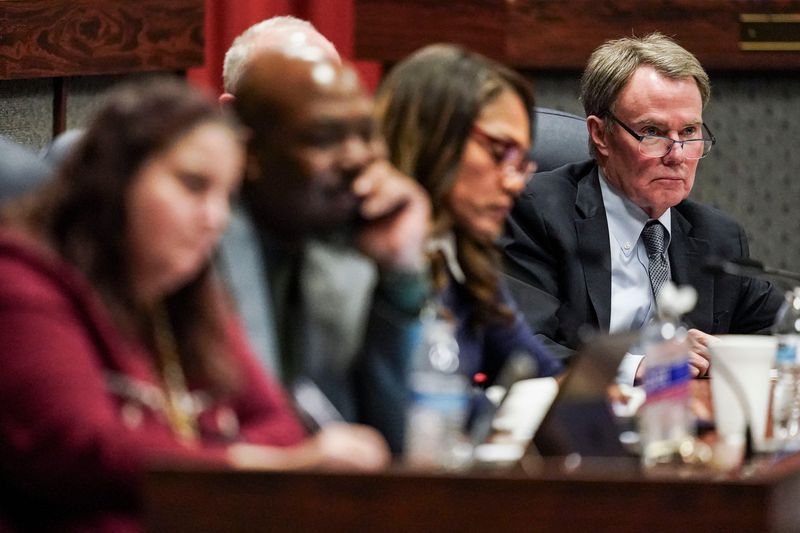
An effort to transform Indianapolis public education brewing in the Indiana Statehouse would weaken the Indianapolis Public School Board and transfer significant power to an independent entity controlled by the Indianapolis mayor.
To many of the teachers, parents and advocates of traditional public schools, such a dramatic shift could be the final nail in the coffin for Indiana’s largest public school district, which has long been subject to legislative intervention with little success. For years the district has been at the center of the debate over charter schools that crosses party lines.

“I think this may be the last straw for IPS,” Rep. Cherrish Pryor, D-Indianapolis, said during testimony against House Bill 1423 in the House’s education committee. “I fear that if this were to go into effect, what they’re really doing is setting up IPS for failure.”
HB 1423 is the culmination of a months-long effort by the Indianapolis Local Education Alliance, which was charged by the legislature with assessing current school facilities and creating a framework for how to fairly share revenue with charter schools. In an 8-1 vote in December, the local group recommended the legislature create the Indianapolis Public Education Corporation, a nine-member independent entity with the power to levy and distribute property taxes, oversee transportation and facilities and create standards for both charter and traditional public schools within IPS district boundaries.
The legislation is a win for most Indianapolis-based charter schools, whose leaders mainly testified in support of the bill due to the transportation benefits it would provide to charter schools.
But some traditional public school advocates saw merit in the bill, too. It repeals the $1 law, which requires schools to make unused buildings available to charter schools for one dollar, and limits the number of charter authorizers for schools within the district. Rep. Ed Delaney, D-Indianapolis, said the legislation will help increase oversight of charter schools while creating savings opportunities for IPS, even though he opposed last session’s revenue-sharing requirement.
“I share your concern,” Delaney told one Hoosier who testified against the bill. “I’m just stuck with the fact that we’re giving IPS’ money away, and we have to figure out what to do about it.”
A more powerful mayor
One of the biggest concerns of traditional public school advocates was how the bill gives Mayor Joe Hogsett and future mayors full power over the board’s composition.
The nine members would include three current IPS board members, three charter school leaders and three additional appointees who either have expertise in the logistics of school operations or experience working with “vulnerable student populations.”
Some advocates feared this would insulate IPEC members from accountability and encourage “mayor-appointed privatizers.”
“By creating an appointed board,” said Kristen Phair from the IPS Parent Council, “it will strip parents of their power.”
Some testifiers pointed out Hogsett’s administration has been at the center of some controversies, a reference to allegations of sexual misconduct within his administration. Others requested amendments that would require members of the corporation to file economic interest forms and ensure the corporation is subject to Indiana’s Open Door Law.
Rep. Bob Behning, the bill’s author and House Education Committee chair, had previously expressed reservations about giving the mayor full authority to appoint members of the corporation. But the mayor’s control over the independent corporation was a key part of the vision of early education reformers like the pro-charter nonprofit The Mind Trust, whose 2011 report House Bill 1423 appears to mimic.
It’s not a novel concept, either. Both Chicago and New York City mayors wield significant power over schools, though Chicago will soon transition back to a fully elected school board while NYC’s system continues to field criticism for neglecting teacher and parent input.
A troubled past
The legislation that created ILEA passed the same legislative session that another, more controversial bill — one that would dissolve IPS entirely — failed.
For some Indianapolis-based lawmakers and advocates, the bill was a signal of what could happen if IPS did not compromise. So instead, lawmakers passed legislation to require public schools to share property tax revenue with charter schools.
The legislature’s focus on IPS stems from decades of challenges. The district has lost 87,000 students since 1971 and closed dozens of schools. The district was the subject of a desegregation court order in 1971, during which already falling enrollment continued as White families fled the district and some Black families moved away when they could no longer send their children to neighborhood schools.
Though IPS’ enrollment problems have slowed, the district faces a rocky road ahead. Projects will run out of money when referendum funds expire in 2026, and the district will have to begin sharing property tax revenue with charter schools in 2028.
Tina Ahlgren, an IPS teacher who was the sole member of the ILEA to vote against the recommendations, is well aware of the district’s fraught history. Though she sees merit in what the bill could do for IPS, she said she worries that the shift may be too rushed.
“My nightmare again is that we wake up in a decade and we’re in the same place,” she said, “or worse.”
Contact breaking politics reporter Marissa Meador at mmeador@gannett.com or find her on X at @marissa_meador.
This article originally appeared on Indianapolis Star: ‘The last straw for IPS’: Indianapolis mayor would wield greater power under education bill
Reporting by Marissa Meador, Indianapolis Star / Indianapolis Star
USA TODAY Network via Reuters Connect