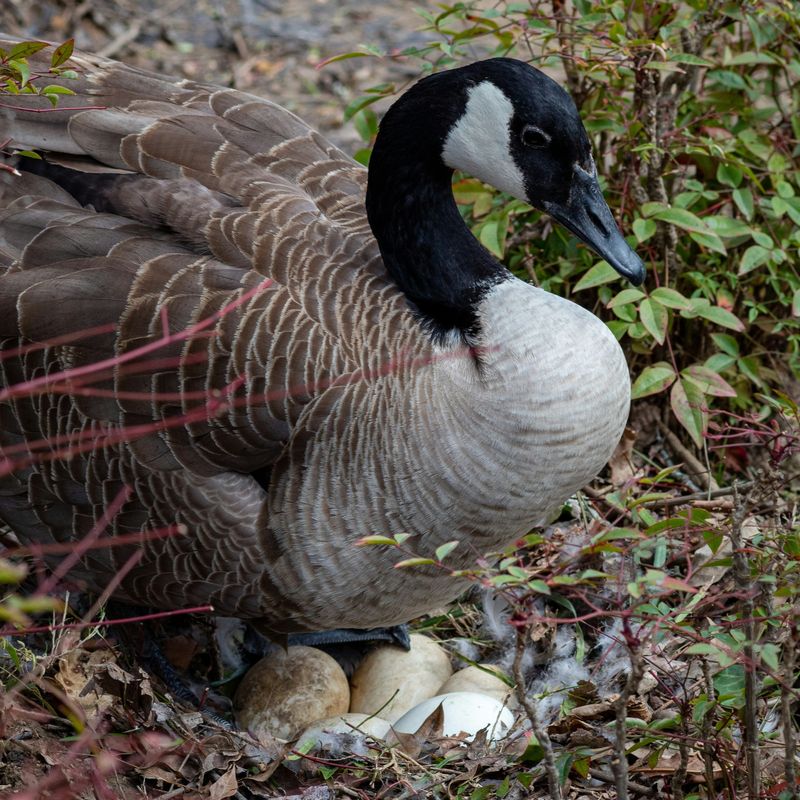
This spring, I set out to observe the mothers of nature. What could I learn from the wild, bold and nurturing inhabitants of my back yard?
In April, I was delighted when a pair of geese arrived to explore our yard as a potential nesting site. They were accompanied by a pair of very shy wood ducks who didn’t seem to mind the geese but flew off every time we stepped outside. Eventually, I realized the wood duck had started a nest 40 to 50 feet above the ground in a large white oak tree next to the pond.

The mother goose explored every corner of our property before settling on a patch of grass near the pond, about 20 feet from the bird feeders. She laid one egg, then two, then three. Then, in the middle of the night, she was attacked. Thankfully, she survived. My husband heard the commotion and spotted a pair of eyes darting near the fence line, likely a raccoon gathering food during peak birthing season.
The next morning, the pair wandered the property again, searching for a safer place to rebuild. But they never did. They flew off that afternoon. They’ve returned occasionally since, though less often as time passes, stopping to feed and sometimes pausing near the nest that once held the promise of a family. I still smile when I hear geese calling in the morning and hope they’ve found a safer place nearby.
Meanwhile, I’ve been watching the wood duck daily through binoculars, waiting for “jump day,” when, within 24 hours of hatching, the ducklings leap from the nest. I can see her soft white feathers at the edge of the cavity in the oak, a hollow likely carved years ago by a pileated woodpecker. The mother leaves about once a day in the evening, and her partner joins her as they fly toward the river before she returns at dusk.
Last week, the harsh caw of a crow drew me outside. I watched as she chased a sharp-shinned hawk weaving through the trees. The crow’s eggs have likely hatched by now, and her young will remain in the nest for about a month before fledging in early summer. The hawk, likely a smaller male, may have been hunting to feed his mate as she incubates their own eggs nearby.
What can we learn from these mothers of nature? Nature is not a nursery rhyme. Survival requires knowledge, skill and a measure of luck. It also requires habitat.
When we moved here five years ago, the land looked pristine but lacked life. Years of pesticide use had left the soil tired and dry. The pond’s edge was bare, the grass uniform, the forest floor sparse.
Over time, we began working with nature instead of against it, allowing spaces to grow wilder, planting native wildflowers, adding bird feeders and removing invasive species like honeysuckle, garlic mustard and autumn olive. Slowly, the land began to change.
Now, the mothers of nature are moving in. There is still competition for food and shelter, but our small patch has become part of a larger quilt of habitat that birds, butterflies and other wildlife can depend on.
This spring, remember the mothers of nature and consider what you can do to expand the wild spaces they need to raise the next generation. One way to begin is through Growing Home, Red-tail Land Conservancy’s program that helps Indiana residents create their own pocket nature preserves using the same restoration principles we do. Learn more at Growing Home Habitat Certification – Red-tail Land Conservancy.
For those ready to take the next step, join us May 20 at 6 p.m. at Mounds State Park for an introductory workshop on the certification process, why it matters, and how easy it is to get started. Space is limited. Register at Events from September 27, 2025 – April 25 – Red-tail Land Conservancy.
For help identifying the birds you hear, download the Merlin Bird ID app by Cornell Lab of Ornithology.
Aleece Raw is operations and membership coordinator for Red-tail Land Conservancy.
This article originally appeared on Lafayette Journal & Courier: Red-Tail Land Conservancy: Pay attention to the ‘mothers’ around us
Reporting by Aleece Raw, Muncie Star Press / Lafayette Journal & Courier
USA TODAY Network via Reuters Connect