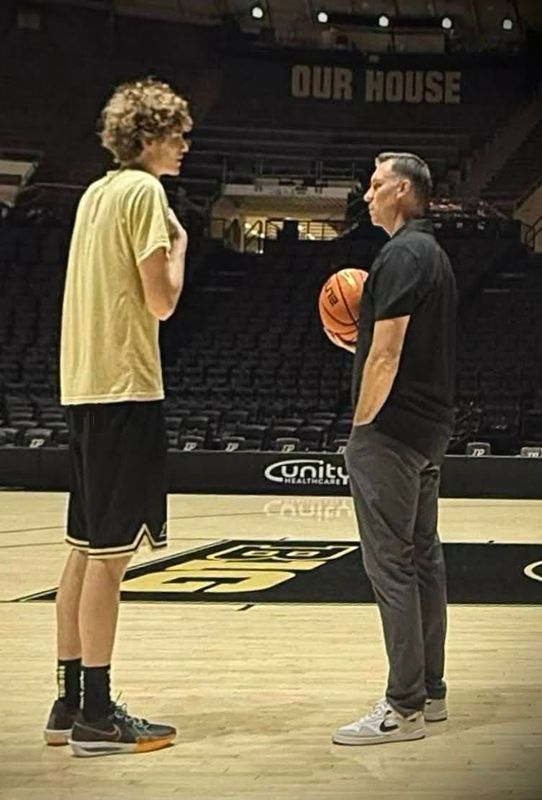
Purdue men’s basketball freshman Jacob Webber learned important basketball lessons in the drive-thru lane.
The future Boilermaker and his father, John, carried a postgame tradition from Arizona to Nebraska. They always went out to eat after Webber’s high school games. That sometimes meant grabbing Taco Bell at 11 p.m. after late returns from road trips.

On those nights, father and son talked through the key moments, the emotions, the identities of the college coaches watching from the stands. John Webber stepped back from coaching his son to serve as a different kind of resource.
For years, he instructed his son in the finer points of shooting technique – as he’s done for hundreds of players across the country. As the physical form developed, so did the mind of a competitor.
“He has that ability to forget the last play, the last game,” John Webber said. “Get me the ball. I will hit my numbers.”
Matt Painter signs at least one elite shooter in almost every recruiting class. For 2026, that’s Webber, who Painter called both the best move-and-shoot player and most prolific shooter in the country.
That did not happen by accident. Webber was raised by a pair of former college basketball players, including a father who makes his living teaching a scientific route to shooting excellence.
In younger years, Webber did not always appreciate the attention to minutiae of a father who bills himself “The Shooting Scientist.” He now recognizes the nitpicking about footwork and finger pressure led him to join Painter’s recent lineage of shooting brilliance.
“I’m really grateful for overall him teaching me the mental stuff, my jump shot – everything,” Webber said. “It’s really got me to where I am today.”
Purdue freshman Jacob Webber’s path to becoming an elite shooter
John Webber once thought he was raising a future baseball player. He said his son could swing a broomstick and hit pebbles in kindergarten. He foresaw a smooth transition to the mound, whipping fastballs with his tall, lanky frame.
In reality, Jacob Webber was destined to follow the family tradition.
His father grew up in central Ohio and began his own collegiate career at Westark Community College (now Division II Arkansas-Fort Smith). Then came a year at Alaska-Anchorage, a “redshirt year” coaching at another junior college to correct his eligibility, then two years at Division II Nebraska-Kearney.
There he met a women’s basketball player named Lee Ramey. They married, and when a knee injury nudged him out of the pro career he had begun in Greece, John Webber pivoted to coaching.
While coaching at various colleges for a decade, his reputation as a shot doctor began to spread. He started traveling across the country for individual training sessions, eventually making shooting coach his full-time business.
Webber spent most of his childhood in Marshall, Illinois, a town of around 4,000 people about 20 minutes southwest of Terre Haute. A basketball court in the backyard became the home base for dad’s lessons.
Webber’s own development began to take off as well. His first 50-point game came when he was a fourth-grader playing against sixth-graders. That coordination dad recognized early, along with a naturally tall, lanky frame, meshed with a scorer’s mentality.
“Jacob is someone who could have ugly form or unorthodox form and still be able to make shots because of his hand-eye coordination,” John Webber said. “When you add someone’s hand-eye coordination like his with proper form, that’s when they become elite shooters.”
Right as Webber began to grow into a prolific junior high scorer came another move. Lee Webber’s work in the medical field took the family to suburban Phoenix. He arrived with the confidence of someone accustomed to dominating the competition in his small hometown.
The big city served as an eye-opening experience – a welcome one, too. On the summer circuit, Webber faced bigger athletes and more skilled opponents from California to Las Vegas.
“I’ve always been a good shooter, and I always knew I was good at basketball, but I think going over to Arizona was really the first time I had seen a lot of other players that were at my level,” Webber said. “Instead of going to recess and playing against my friends that I grew up with that I know I can beat, going to recess and playing against other DI prospects and other athletes.”
Webber was already a prospect when the family moved back to Nebraska after his freshman year of high school. By the time he committed to Purdue in September, some considered him the best shooter in the 2026 class.
How Purdue freshman Jacob Webber benefited from a ‘shooting scientist’
Webber made 171 3-pointers over his sophomore and junior seasons for Kearney (Nebraska) High School, making 42% of his attempts. He made 39% of his 104 attempts last season for La Lumiere in 15 EYBL Scholastic competition.
Even the best shooters in the country have homework – especially when their father’s website is shootingscientist.com. Webber can’t help but discuss shooting in the most esoteric terms. There’s always one person who knows his shot from set-up to release to follow-through even better than he does.
“He can tell anything,” Webber said. “After a game, he’ll come up to me: ‘You know, you were shooting off your middle finger. That’s why your backspin was off.’
“He’ll break it all down. He’s the best, obviously, I’ve ever seen – and I’ve seen a lot of shooting coaches.”
John Webber earned All-Rocky Mountain Athletic Conference honors in both of his seasons at Nebraska-Kearney. He was, as you might expect, a high-volume 3-point shooter. His 44.4% career mark behind the arc ranks third in program history for players with 300-plus attempts.
The elder Webber’s fascination with shooting grew over the course of his coaching career. His website includes a testimonial from the mother of former Baylor star MaCio Teague, whose 3-point percentage jumped 40 points between his junior and senior seasons.
John Webber wanted to approach the craft with objective data, not subjective concepts. Get him started talking about shooting and the conversation could touch on any number of scientific disciplines. Anatomy, including the way the eyes take in information and process it through the central nervous system. Physics, and why efficient energy transfer is crucial to elite shooters such as Stephen Curry.
And, of course, psychology. Webber says the mental approach he learned from his father has been as crucial as the pointers on technique.
“He’s elite at thinking just one shot, one life,” La Lumiere coach Pat Holmes said. “Just move on, move on. He doesn’t dwell on the past, and that’s why he made a bunch of big shots for us this year.
“He had some slumps and it’s like, ‘Man, he didn’t shoot well,’ but then you look at it and he shot 6 of 13 from 3 – because you expect every one to go in, because he’s so damn lethal.”
John Webber calls his son’s ability to shoot on the move while not squared up “his superpower.” He also sees a frame capable of adding weight in a college training program. He projects more explosiveness offensively, bigger rebounding contributions and better defensive mechanics.
The postgame meals will be less frequent for a few years. The shooting tips, though, will never stop.
“As good as my jump shot is now, he still finds little things to tweak and stuff,” Webber said. “So I think it helps, just having that in my corner.”
Nathan Baird and Sam King have the best Purdue sports coverage, and sign up for IndyStar’s Boilermakers newsletter.
This article originally appeared on Indianapolis Star: Purdue freshman is ‘damn lethal’ thanks to growing up with the ‘Shooting Scientist’
Reporting by Nathan Baird, Indianapolis Star / Indianapolis Star
USA TODAY Network via Reuters Connect
By Nathan Baird, Indianapolis Star | USA TODAY Network