Andrew Filler first learned about a data center proposed for the cornfield directly across the street from his home when he opened his mail.
That was February.

Since then, Filler quickly became a local activist who corralled hundreds to oppose and ultimately defeat the project. Now, he’s fielding calls from people in Kentucky, Arizona, Oregon, Pennsylvania and Washington asking him how they can do the same.
“We’re neighbors working together to fix an issue and have community involvement,” he said. “That was the main goal at the end of the day.”
As multimillion-dollar projects backed by big-name companies entice leaders and businesspeople across the state, citizens are showing up to local government meetings and using public comment to push back against projects they see as unfit for their communities.
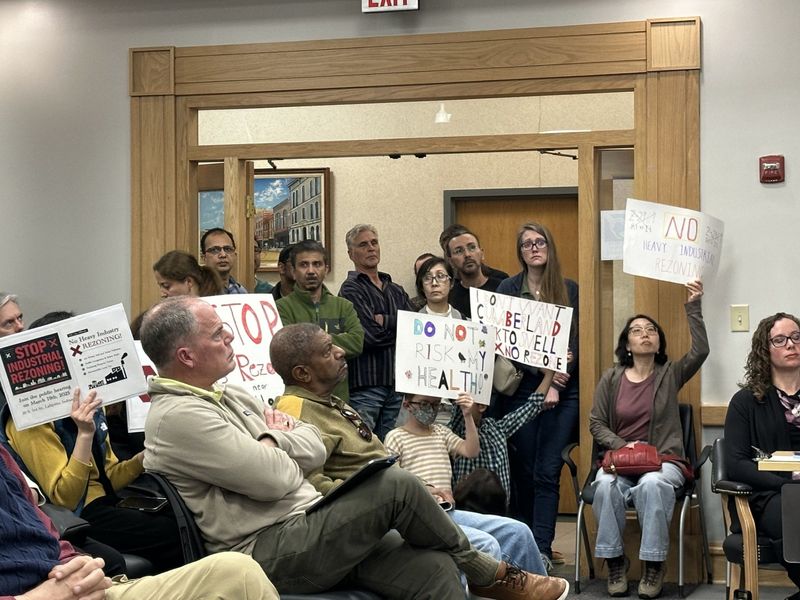
Google, for instance, sought to build a $1 billion, 467-acre data center in Franklin Township on the southeast side of Indianapolis. The company pulled its petition in September just before it was scheduled for a final Indianapolis City-County Council vote in front of a packed gallery and multiple rooms of overflow seating.
“That was probably the most proud moment I’ve had on the council, just for the fact that people were engaged and they were part of the process,” said Councilor Michael-Paul Hart, who represents the district were the data center was proposed. “I think the reason that the petition was pulled that night was because there were 400 people in the room.”
However, the question remains over how influential this form of civic engagement is in local government’s decision-making. As local leaders weigh the pros and cons, some residents are fighting to feel heard — and heeded.
Earlier this year, the West Lafayette City Council approved rezoning land for a $4 billion investment from a South Korean semiconductor producer SK hynix after an emotional seven-hour meeting. Several councilors expressed their appreciation for the 400 people who showed up — largely to oppose the project — but said the opportunity was too great.
“We were stunned, and then we just felt like, OK, this was already decided,” West Lafayette resident Helen DeMarco said. “For us to sit here until 1 in the morning or whatever was just a bad joke. We felt like they were not listening when the vote was taken.”
From out of the loop to activist leaders
Filler and about four others formed Protect Franklin Township, a citizen-led group stood up to fight against the project. They want to see the land developed, he said, just not with a data center.
To get the word out, Filler said, he passed out about 3,000 flyers and posted on whatever social media platforms he could. The group also placed billboards along Interstate 465.
“Our mentality through this whole thing is we’re not giving up until there are for-sale signs on our front yard,” Filler said.
The anti-SK hynix crowd has the same mentality and is still fighting the West Lafayette council’s approval months later. The success of resident pushback in places like Franklin Township and elsewhere are motivating them to keep fighting.
“For us to see other people be successful, it gives us hope,” DeMarco said. “We just think, ‘OK, we have to just keep fighting. Don’t give up the fight because we have seen logic prevail in other places.'”
DeMarco first learned about the project about a half mile from her home when someone put a flyer in the door, but she said she didn’t understand the weight of the project until she listened to testimony on the project at the DATE plan commission meeting.
She hadn’t been plugged into local government prior to fighting on this issue, and her first experience testifying in public comment was during the May 5 meeting that stretched into the early hours. She and others brought up a host of complaints — traffic, the environment, health and aesthetics — but thought the project would be better placed elsewhere in the community.
After the vote in May, residents opposed to the project have repeatedly shown up at council meetings and held protests. Three residents filed two lawsuits alleging misconduct in hopes of blocking the project.
A balancing act
The impact of public comment varies from case to case, experts said: It solely depends on how leaders sort through stakeholder input. Council members and local government experts said there is no hard and fast process to digest public comment and turn it into policy.
“There’s no handbook on how to be an elected official,” local government expert Mark Levin said. “You learn by doing, listening to your colleagues. … There’s all sorts of other inputs, but nobody can tell you this is the right way to do your job.”
It can be difficult to judge whether public comment represents what the majority of residents want, Levin said. Speaking at a public meeting requires a person to know about their right to do so and have the time and ability to be there. He said other methods, like statistically sound surveys, are a better barometer of how a community as a whole feels about an issue.
Proposed economic development projects can put local leaders at a crossroads where a company promises an influx of new jobs and tax revenue, but residents vehemently oppose it for a myriad of reasons. When it comes to finding that balance, local government advocate Jennifer Simmons said, it really depends on a leader’s mindset. Some leaders believe it’s their responsibility to vote in the best interest of the community, she said, while others vote the way their constituents want.
The council is like the middleman when making decisions, Indianapolis’ Hart said. They have access to information, resources and leaders that the general public doesn’t, he said, and they have to take a holistic view to consider other issues, such as declining property tax revenue.
Still, community feedback is top of mind for the Republican. To get a sense of where his community stands, Hart attends community and homeowner association meetings. He measures how his community feels about an issue by tracking not just how many people show up but how often they do.
“I have to almost put it all on a scale in your mind, and I do give more weight to the input of the direct constituents,” he said. “That has more weight than anybody because it’s their spot. They live there. They were there first.”
On some projects, including when he thinks a proposal would be a net positive but community members don’t agree, he said, he tries to provide more information to constituents to show where his head is at. Overall, he said consistent communication builds mutual trust when he and constituents converge.
To figure out what her constituents thought, West Lafayette councilor Kathy Parker kept a book where she tracked people who reached out, their position and if they lived in her district. Her log grew to a couple of hundred names, largely in opposition, and 60% of whom were in her district.
“I fundamentally believe that elected people should represent the people and should vote the way the people in their district want them to vote,” she said. “I hold no grudge against those who voted ‘yes’ because they are thinking of their districts or they’re thinking of the whole city, but I had to represent my district.”
Transparency and misinformation
Often, during the public comment period of a meeting, residents will complain that local officials aren’t providing enough transparency. This was a major point of contention in West Lafayette, where residents’ questions weren’t answered due to the information being considered trade secrets — very common in economic development deals.
Local government provides much more opportunity for public discourse compared to other levels of government, Levin and others said, since the process requires several meetings and vetting.
Still, DeMarco said that she and others believe that the city and SK hynix are not being truthful when discussing the project, especially about what chemicals will be present at the facility. At this point, she said, she thinks the council is disconnected and that their concerns aren’t being addressed.
As tensions rose, Parker said, several people made incorrect claims that council members signed non-disclosure agreements and took bribes. Neither is true, she said, and they corrected people at the next council meeting.
Local leaders are having more and more of a difficult time maintaining and growing trust within their communities, Simmons said. They recommend hosting frequent community events and taking advantage of social media, but that doesn’t mitigate the larger trend of mistrust in institutions, especially when local issues are difficult to explain.
“It’s easy for someone to say, ‘Government’s bad. Government overspends,'” Simmons said, “but it’s really hard to explain the maximum levy growth quotient.”
The USA TODAY Network – Indiana’s coverage of First Amendment issues is funded through a collaboration between the Freedom Forum and Journalism Funding Partners.
Have a story to tell? Reach Cate Charron by email at ccharron@indystar.com, on X at @CateCharron or Signal at @cate.charron.28.
This article originally appeared on Indianapolis Star: Public comments stopped Google in Franklin Twp. Does that always work?
Reporting by Cate Charron, Indianapolis Star / Indianapolis Star
USA TODAY Network via Reuters Connect