This is the second story of a two-part series. Read part one here.

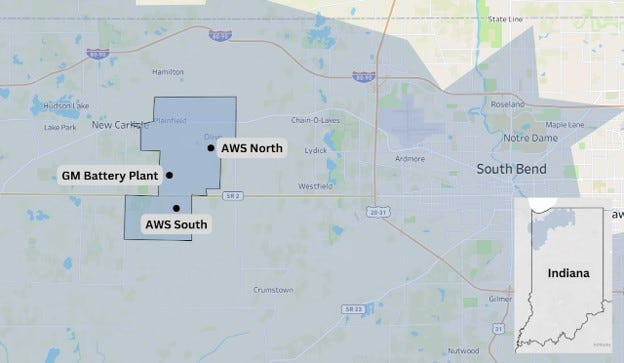
NEW CARLISLE — On the frigid morning of Jan. 27, the Department of Energy ordered Amazon’s massive data center in northern Indiana to cut off 50 megawatts of electricity, about the amount needed to power 40,000 homes for one hour.
Backup diesel generators fired up, but the outside air was so cold that air lines froze in five of them. Cold lines disrupted the generators’ pollution control equipment, causing three pollutants that contribute to smog, acid rain and respiratory irritation to waft into the wind for five hours.
Bob Humbarger, who lives just east of the data center, said he was never notified of the leak that morning. But he knows the winds blow east toward the house where he’s lived for more than 50 years. Now, he’s worried about the lack of protections guarding him and his neighbors from big tech and county government interests.
Humbarger, 85, said his monthly electric rates have increased 9% from February 2023 to February this year. Meanwhile, he has watched from his front window as Amazon Web Services’ (AWS) $26 billion hyperscale data center expands just south of State Route 2, near his 20 acres of farmland. He spent dozens of hours at zoning meetings over the last year, voicing concerns that he and other members of his community feel aren’t being adequately addressed.
“I wasted a lot of my time going to public hearings,” he said. “The people who live below State Route 2 are sacrificial lambs.”
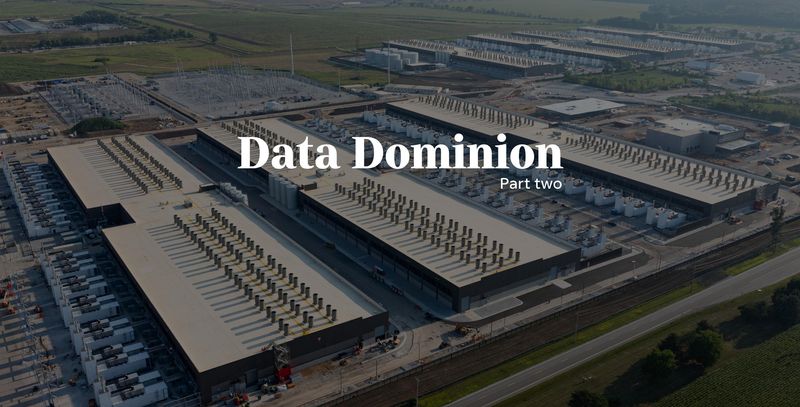
Once the other 14 of the project’s 32 buildings are built on its 1,200-acre New Carlisle campus, the development can consume up to 2.25 gigawatts, enough to power more than 1.4 million homes, or around half of the state of Indiana’s residential households. At $11 billion, the AWS data center announced in 2024 that it was the largest private investment in state history, and then the plan grew by another $15 billion the next year.
Local residents are concerned that its colossal energy needs will increase their utility rates and spike demand for dirtier forms of energy. They don’t feel they have any control over how their hometown is changing.
In many ways, the experience of New Carlisle residents is a sign of things to come for Hoosiers across the state, including in the Indianapolis area. Residents successfully pushed back against a proposed Google data center in Franklin Township, but plans for other data centers in Martindale-Brightwood, Decatur Township and near Irvington are still on track. And Meta is planning a $10 billion hyperscale development in Lebanon.
Ben Inskeep, program director of the advocacy group Citizens Action Coalition (CAC), said the public wasn’t informed about the January grid emergency at the Amazon facility, and he only found out because the state requires a pollution emissions report.
“To my knowledge, this is the first specific instance of a data center in America being ordered to temporarily reduce their power consumption from the grid by utilizing their onsite emergency backup generators to help maintain grid reliability during an extreme weather event,” Inskeep said.
In an email response, AWS spokesperson Adrienne Talbot said Amazon serves millions of customers and must maintain service to continue life-saving care, emergency communications and vital infrastructure. “Total emissions remained below 1 percent of our annual permitted levels,” she wrote.
Last December, a petition to rezone more New Carlisle farmland — making way for an unidentified company’s proposed data center near Amazon’s — failed. Since then, locals have continued to oppose big tech’s momentum. Microsoft is poised to develop another data center in Granger and forego potential tax incentives or abatements.
As tech firms eye Indiana for its economic incentives and natural resources, Indiana Michigan Power (I&M) is poised to triple its electricity sales to nearly 35 terawatt-hours — more than demand of Ireland in 2024 — within the next four years.
As many as 120 built or proposed data center buildings across Indiana will cause state power use to nearly double within 10 years, according to a report by Purdue University that sourced data from the utility companies.
“What we’re seeing in the state is unprecedented load growth,” said Timothy Phillips, lead analyst for the State Utility Forecasting Group that conducted the report. “We have a situation where Indiana Michigan Power’s electricity demand is going to double or more in the next five years.”
Other Midwest states are coordinating response efforts to circumvent troubles in meeting this surge. In central Ohio, a new hub for big tech, electricity bills have spiked 10% year-over-year, but billions of private dollars are funding upgrades to the electric grid to prevent blackouts.
In Wisconsin, a community passed a measure requiring voter approval for developments valued above $10 million to receive tax incentives, after a hyperscale data center moved into town. In Illinois, Champaign County banned data center infrastructure for 12 months.
But in Indiana, the state Senate rejected a bill that would have required centers to disclose how much power and water they are using.
Across the country, wholesale electric prices, which are eventually passed on to customers, have risen by as much as 267% over the last five years in areas around data centers that consume a substantial amount of resources, according to a Bloomberg report.
“Grid experts are very worried about these data centers,” Inskeep said, “because they’re unprecedented stressors on the grid.”
In an email, Amazon wrote that its data center would receive power from I&M’s regional grid. That grid relies on a mix of power sources, including renewable energy, but the Cook Nuclear Plant in Michigan represents “a significant part of I&M’s generation portfolio.”
Many living or working in New Carlisle and South Bend say they want safeguards for their electricity bills, environmental regulations, higher power rates for AI industries, and legislation enacting higher hurdles for AI firms to develop.
Some protections currently exist to prevent disruptions on locals. A tariff structure imposed by the Indiana Utility Regulatory Commission (IURC) imposes a minimum monthly payment of 80% of expected grid demand from hyperscalers, a 12-year minimum contract term, and a large exit fee costing up to five years of electricity demand.
American Electric Power, the parent company of I&M, says they’re looking to cut rates for all customers across their network in an IURC filing that will be heard this summer, said Bill Schalliol, St. Joseph County’s executive director of economic development.
Reduced rates are possible because large load users like Amazon have paid millions to upgrade the regional grid, Schalliol and Amazon said.
But a promise to reduce rates isn’t enough to calm residents.
Fulfilling promises
St. Joseph County has granted property tax abatements totaling over $9 billion over 35 years for AWS’s data center. An additional 85% sales tax break exists on technological hardware, including specific computer hardware and powerful cables to support Amazon’s many processing chips.
“I don’t think we have a comprehensive tally of just how much we’re subsidizing this,” Inskeep said. “These subsidies are going to one of the wealthiest corporations in human history while a lot of Hoosiers are struggling to put food on the table.”
Previously, AWS agreed to help pay for improvements on certain public works, including water treatment plants and grid infrastructure upgrades. Amazon also said they would fund $7 million for road improvements, according to local reports.
“All of those costs are required by the state to be paid by AWS,” Schalliol said.
Schalliol said that AWS is bringing substantial benefits to the county tax base at a time when it is facing a projected shortfall due to changes in state property tax collection. Even with the tax breaks, each data shell is projected to bring the county more than $1 million in taxes. Then there are payroll taxes from about 4,000 construction jobs, hotel taxes from non-local technicians, and all the support services that benefit from a huge investment.
It’s unclear how future utility rates will change for New Carlisle users. Utilities themselves cannot raise rates; they must seek approval from the IURC, which holds hearings and approves measures.
For the last year, rates have increased among all five of Indiana’s major utility providers. I&M residential bills increased 4% year-over-year starting July 1, 2024, according to a survey. This summer’s rate case is the newest battleground for data center opponents to clash with pro-development local officials.
“That’s really where rubber is going to be hitting the road,” said Inskeep, whose nonprofit group opposes rapid expansion. “I&M is going to have to put forth a lot of evidence, open their books, provide a cost of service study where you can really trace the math, to make sure the data centers are paying their fair share.”
Talbot, the AWS spokesperson, said the company’s investments and guaranteed payments are driving the potential rate reduction.
“Amazon’s energy agreements are structured to benefit the communities where we operate, and we are committed to ensuring our presence delivers tangible benefits to local ratepayers,” Talbot wrote in an email.
To meet larger demand, I&M is looking to buy existing gas plants and keep aging coal plants online, Inskeep said. It’s unknown when new energy sources will be built. Nuclear power may help charge the electric grid and support tech firms, but it also creates inefficient water use and redirects power from existing customers.
“These data centers are going to use enormous amounts of energy and the significant portion of that is going to be coming from fossil fuels,” Inskeep said. “So we have a really big concern about how data centers are taking us backwards away from sustainability.”
Power dynamics
All of these changes, planned or enacted, have happened because of strained dynamics among environmental advocates, residents and local officials. Residents have faced conflicting statements on the topic of power: officials promise rate reductions and enormous economic benefits, while critics warn of double-dipping water use and higher utility bills.
“It’s driving prices higher across the market at the same time it’s increasing pollution,” said Inskeep. “And that’s because all of these data centers are taking a lot of power plants off the market for citizens.”
County leaders have long boasted about the surplus of jobs created from Amazon’s construction, but it’s unclear how long those jobs will last.
“The project itself was required — per the development agreement — to provide 1,000 jobs for the project,” said Schalliol. Of those new jobs, about 80% are Hoosiers. Around 60 workers are expected to be employed per building constructed, he said. Every direct job usually supports an equal number of indirect jobs.
“We believe that number will exponentially grow,” Schalliol said.
Inskeep said there may be a large boom in short-term jobs, but AI is designed to eliminate the number of long-term jobs across the country, especially as the technology yields stronger capabilities. He also said similar industrial projects, such as the nearby electric battery plant, bring in far more jobs with far less power usage. CAC estimates that data centers create a quarter of a job per megawatt of energy used, compared to an average of 41 jobs per megawatt in other industries.
Another gray area is how sustainable the project’s power is.
“This is the biggest energy-using facility I had ever heard about in my entire career,” Inskeep said. Despite this new demand — roughly 18% of the state’s daily consumption — no clean energy requirements were written into Amazon’s tax abatement plan.
Brian Will, co-leader of the South Bend chapter of Citizens Climate Lobby, said the gas power plants to expand the regional grid emit methane, which contributes to climate change. The challenge is exacerbated because state and federal laws were changed this year to make enforcing many pollution standards voluntary rather than mandatory.
“Data centers aren’t necessarily bad, but what we are realizing as a society is that they have a huge environmental footprint that we can no longer tolerate,” Will said.
Amazon previously said that the grid will expand capacity by 3 gigawatts to exceed its added demand. The company also said their commitment to the area “includes enabling four solar farms and a wind farm” that would serve less than 30% of its added demand.
AWS isn’t the only tech company building data centers. The expected energy demand of nine new hyperscale projects, including New Carlisle, is projected to consume half of Indiana’s total electric output, according to 2023 data from the U.S. Energy Information Administration.
This has kept locals worried about their future and vocal during zoning hearings, where they have the most leverage.
Public pushback
The tension between residents and powerful economic development interests was palpable at a hearing in December for another hyperscale data center in New Carlisle with an unidentified owner. Dozens of residents raised their concerns about big tech taking swaths of farmland and stressing their utilities and aquifers. The meeting lasted until 4 a.m.
“I would rather pay the property tax than to have you guys destroy beautiful property out here,” said Sandra Ralph, a New Carlisle resident. “We don’t need another data center to poison our land.”
A week prior to the meeting, South Bend Mayor James Mueller, Mishawaka Mayor Dave Wood and three county commissioners signed a letter supporting the proposed data center that would provide millions of dollars in taxes and infrastructure funds. Two are Democrats and three are Republicans.
Later, it was revealed that Larry Garatoni, an influential businessman and charter school operator, hired a right-wing public relations firm to write the letter.
“The money is going to win out,” said Steve Sass, a New Carlisle resident, at the meeting. “These people have all been bought off. It’s all a predetermined deal. And you know that’s heartbreaking to our democratic process.”
Brandon Dickinson, an attorney based in Indianapolis who represents the development, said that a swarm of misinformation about the project’s footprint has poisoned social media. He also said recent surges in electricity rates were from EPA compliance rates and decommissioning coal plants, not from AWS.
But faced with public opposition, the St. Joseph County Council struck down the rezoning plan in a 7-2 vote.
Marcy Kauffman, New Carlisle’s council president, said the town deserved time to “absorb the impacts” of Amazon and other existing projects “without having to accommodate an unplanned, inappropriately placed second data center.”
Despite public outcry dragging into the morning, Bill Shalliol believes the proposed nearby project will return for a second try.
“We think there’s an opportunity again based on the utility infrastructure that’s been built,” Schalliol said. “I’m an economic development guy; we always want more.”
Future infrastructure
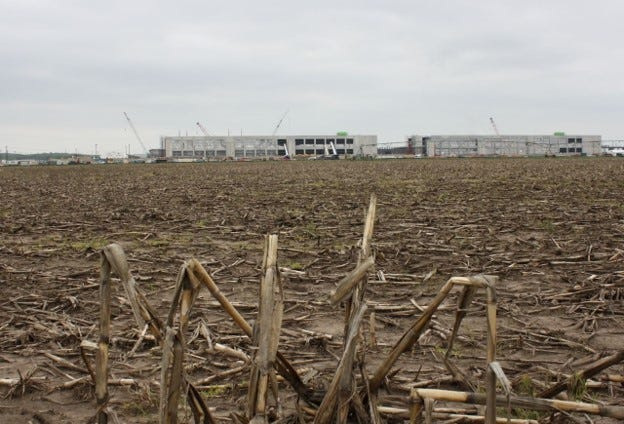
New Carlisle hasn’t felt the full effect of AWS’s data center. With the project being about half completed as of May, residents say disruptions to their daily life outweigh any monetary benefits for the county. Roads are blocked. Traffic congests an otherwise rural town. Bob Humbarger pointed to tire tracks plowing right through his roadside garden.
Other aging infrastructure projects — once promising to be an economic boon for the region — now lay abandoned. The College Football Hall of Fame convinced city and state officials to provide generous tax incentives, then moved to Atlanta and left an empty building downtown.
While artificial intelligence is driving much of the investment in Indiana and across the nation, residents and consumer advocates worry that rapid shifts in the nascent industry could leave them saddled with the costs of expensive energy upgrades.
“One of our big concerns is the uncertainty of the industry,” Inskeep said. “We’re going to need 2,250 megawatts, but what happens if they end up needing half that?”
Over Bob Humbarger’s farmland, industrial light leaks into the night sky. Chris Humbarger, his son, lives nearby and said he used to be able to see the Milky Way but now can’t see any stars. He worries about the environmental impacts the nearby developments could deliver.
He and his father have voiced their concerns, but they feel like it’s a losing game. “We don’t have any political clout,” Bob Humbarger said.
Editor’s note: This story was produced by students in the Gallivan Program in Journalism, Ethics, and Democracy at the University of Notre Dame. The students spent about three months gathering data, interviewing sources and writing and editing stories under the guidance of Brendan O’Shaughnessy, a former IndyStar reporter now teaching at Notre Dame.
This article originally appeared on Indianapolis Star: Power needs, pollution and local politics collide at Amazon data center
Reporting by Redmond Bernhold, Alyssa Sirichoktanasup and Andy Caron, University of Notre Dame Gallivan Program in Journalism, Ethics, and Democracy / Indianapolis Star
USA TODAY Network via Reuters Connect
By Redmond Bernhold, Alyssa Sirichoktanasup and Andy Caron, University of Notre Dame Gallivan Program in Journalism, Ethics, and Democracy | USA TODAY Network