This is the first story of a two-part series. Read part two here.

NEW CARLISLE — For 18 months, Patsy Bode lived without running water. She boiled store-bought gallons to shower, dumped bottles into her toilet’s tank and washed her clothes at the local laundromat.
“Living without a well is hell,” Bode said.
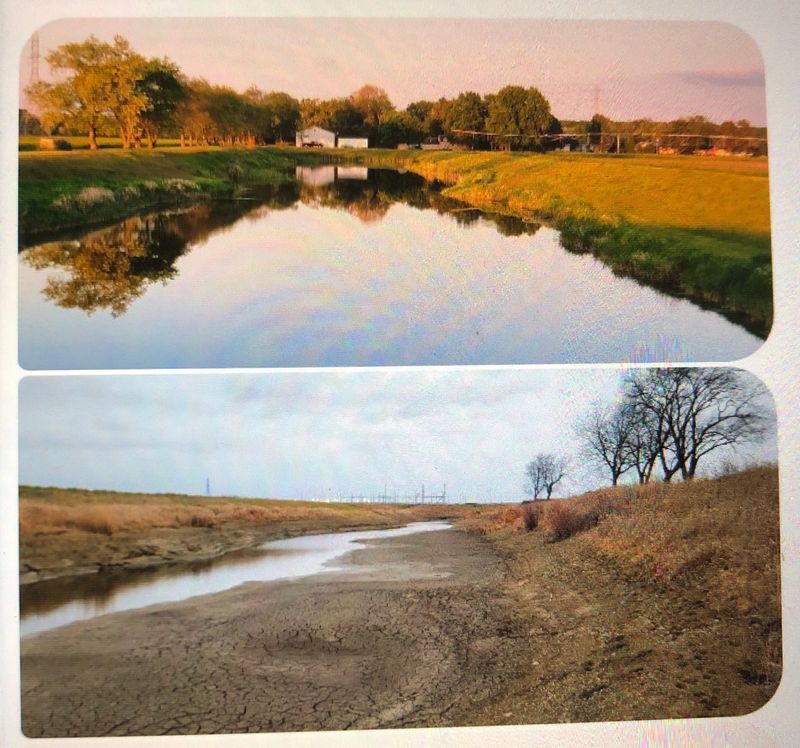
Bode, 66, said she’d lived in her house in New Carlisle, west of South Bend, for 26 years and never had a problem with her shallow well until Amazon Web Services (AWS) began building one of the country’s largest data centers next door.
Yet officials from the Indiana Department of Natural Resources concluded that drought — not the data center — was the culprit for dry wells like Bode’s and about a dozen neighbors. A DNR spokesperson said there are no written reports from their investigation.
Neither AWS nor the government would offer Bode, who lives on disability payments from a work injury, compensation for her lost water. She was forced to sell her home because she couldn’t afford about $7,000 to drill a deeper well.
Bode’s well may be a single case, but many Hoosiers across the state wonder whether they will fare any better at protecting local resources against the massive water and power needs of a data center boom driving the rising stock market and national economy.
At least 120 data center buildings have been proposed, approved or built in Indiana as of May, according to Data Center Map. Cheap land, water and power make the state an attractive option.
Many Indiana residents fear that the enormous companies building data centers, as well as state and local officials trying to lure jobs and economic development, will prioritize profits over public interest.
Yvette Van Lue, one of Bode’s neighbors, also suffered from a dry well and pond. Despite speaking to several reporters, she didn’t receive any help either. She decided there was no point in continuing to raise her complaints in the media.
“Nothing will ever come of it ‘cause it’s her against Big Company,” wrote Jeff Wilcox, her son-in-law, in a text explaining why she gave up.
Amazon responded by citing the unwritten DNR report, noting that the company respects “the integrity of that independent regulatory process.”
“We are sorry to hear about the hardship faced by that resident, and our hearts go out to anyone experiencing challenges with their water supply,” wrote Adrienne Talbot, a spokesperson for AWS.
Alan Hamlet, a hydrologist and professor of civil and environmental engineering and earth sciences at the University of Notre Dame, said when there is competition for water, “the lowest well wins.”
“I think that blithely saying it was drought when there hasn’t been a major reduction in precipitation is questionable,” Hamlet said. “I’m concerned about the balance of power, and I’m concerned about Indiana just acquiescing to everything that the data centers want, because that means a lot of other people are going to be hurt.”
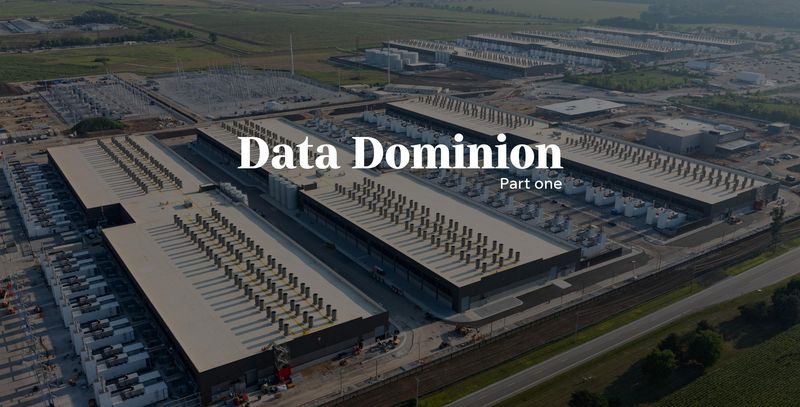
This battle between homeowners and big companies has sparked concerns over how AI data centers will transform Indiana. The hyperscale AWS data center a dozen miles from South Bend occupies 1,200 acres of former farmland to help power Anthropic’s Claude AI tool.
The Indiana Enterprise Center (IEC) — a rural industrial zone that includes AWS and a new General Motors/Samsung electric vehicle battery plant — requires enormous power and water needs, causing conflicts with local residents trying to protect their way of life.
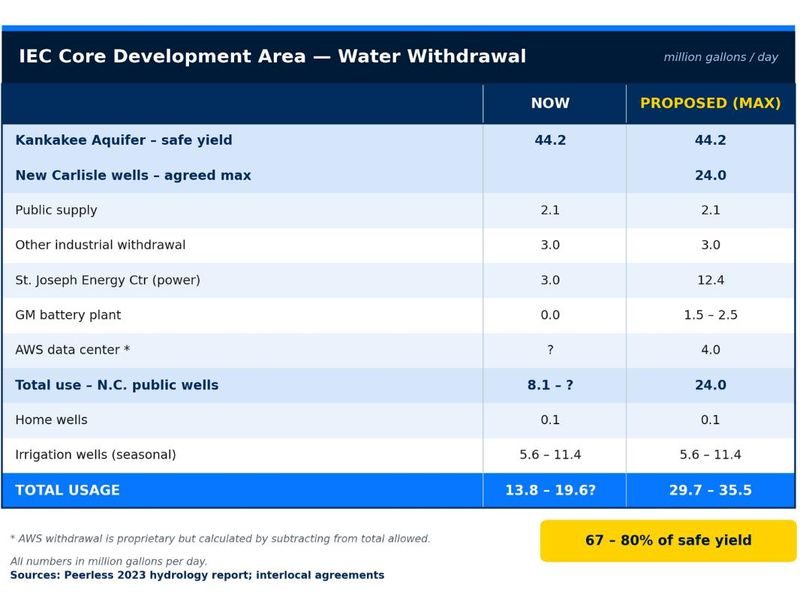
A three-month investigation by students in Notre Dame’s Gallivan Program in Journalism, Ethics, and Democracy found that water needs for the IEC are greater than previously known. While local development officials and politicians backing the project have publicized that they will cap local water use at 24 million gallons per day, the investigation revealed that the actual peak stress on the Kankakee Aquifer, which provides the region’s drinking water, could be up to 35.5 million gallons a day. That amount is 80% of the aquifer’s safe yield, which is the amount of water that can be withdrawn without impacting the water level in the aquifer.
Hamlet said 80% withdrawal is risky because in an extended drought, a decrease in water recharge could combine with an increase in water demand. “The concern is that water extraction could exceed renewable supply, impacting access to water for all users at a time when it is most needed,” he said.
Amazon’s data center was originally projected in 2024 to cost $11 billion, making it the largest private investment in the state’s history. A year later, AWS announced another $15 billion expansion at the New Carlisle site and surrounding region. Eighteen of the development’s planned 32 buildings – each the size of a Walmart Supercenter – are built, and construction is expected to finish within two years. Seven buildings are operating in early July. For contrast, Notre Dame covers the same amount of land, but required 180-plus years to develop.
It’s hard to exaggerate the project’s size. When completed, the IEC development will have a peak power rating of up to 2.25 gigawatts of energy, enough to run half the residential homes in the state. Its water needs could also be considerable, yet local residents and media have struggled to find answers about whether it will deplete the aquifer that supplies their water.
The publicized cap of water withdrawal at 24 million gallons a day encompasses the IEC and all projected users of two public water supply plants, but not irrigation systems and domestic wells, according to a report from Peerless Midwest, a local water contractor. During the warmest summer days, irrigation systems boost the proposed water use toward 80% of safe yield.
Amazon said in an email that each of its New Carlisle data center buildings plans to use 18 million gallons of water a year, the equivalent of 162 households, or less than a standard golf course. The company also said they are funding two water replenishment plants that would help supply at least 100 million gallons of water each year back into the Kankakee Aquifer, making their operations water positive in the future.
But local opponents don’t trust the corporate promises. They worry that the promises don’t match the preparations and seem masked in secrecy. A public hearing about a second new data center near the AWS project and run by an unidentified company lasted over 10 hours last December.
Hundreds of residents blocked the rezoning of more than 1,000 additional acres of farm land in New Carlisle for constructing this second new data center. They said data center development creates traffic, replaces swaths of valuable farmland, and stresses the region’s power and water supply.
In the past five years, a glut of data center buildings sprouted across the state. Power use to support data centers is expected to double the current energy use in Indiana over the next four years, according to the most recent Indiana Electricity Projection study conducted by Purdue University.
The explosive growth in the last few years of the nation’s nearly 4,000 data centers are currently propping up the shaky national economy. Amazon, Meta, Google and Microsoft are all racing to build data centers to power AI technology, betting big on its future. AI investments have fueled the stock market while other investments have been shaky. Taxes from AI firms have garnered millions of dollars for local economies.
But that’s not enough to convince most locals their water and electricity aren’t threatened.
Why here?
Amazon came to New Carlisle for many reasons. Besides affordable land, water and utility rates, a state reputation for lax regulation and generous incentives — including a 50% property tax abatement for 10 years on each of its shells — allows AWS to develop a large campus for less money.
Accessibility also played a major role. Interstate highways and fiber optic cables connecting New York and Chicago are routed through this region and transfer people and data at a rapid pace. Indiana is also a water-abundant state, allowing millions of gallons to be withdrawn from naturally refreshing aquifers. And while tornadoes are a threat, the region does not face hurricanes, earthquakes or wildfires that increase risk.
The size and speed of Amazon’s development is possible because it doesn’t rely on chips produced by Nvidia, the tech giant facing a global shortage for its ultra-efficient chips. Instead, Amazon manufactures weaker chips at a high quantity, which are packed in each building to streamline construction on Amazon’s timeline.
County officials supporting AWS have cited its economic benefits, especially in light of state legislation that will decrease the local tax base. Even with abatements, data centers bring in millions of dollars in new tax revenues. Temporary construction jobs and permanent high-tech jobs also provide a boost.
Farm fields in St. Joseph County rank 79th in crop production in the state of Indiana out of all 92 counties, said Bill Schalliol, the county’s economic development director. Developing multi-billion dollar facilities on less profitable farmland is a smarter investment. He has noted that each data center shell is projected to bring the county more than $1 million in taxes.
“The farmland that we’re losing is fractional compared to what we really need to produce crops,” Schalliol said.
Established in 1987, the IEC is an industrial park within the New Carlisle Economic Development Area. Its Core Development Area has expanded several times. AWS and GM join other firms — including American Electric Power, Cleveland-Cliffs and St. Joseph Energy Center — on thousands of acres of former farmland.
During the first stages of construction, AWS removed water from the soil to strengthen its foundation for building, as well as to lay underground utility pipes. Local residents like Bode suspect it was this standard dewatering process that made about a dozen local wells go dry.
One day in late 2024, Bode noticed that her sink was only delivering a trickle. That evening, she drove to town and saw something that stopped her short.
“I noticed that this giant pipe had all this water flowing out of it,” she said. “And I thought, oh my God, I wonder if that’s why my water’s acting crazy.”
Water loss isn’t distributed evenly. DNR officials investigating her dry well told her it would take two years to study the cause of the well failure. “Two years additional to what I had already waited was just way too much,” she said.
Computer cooling
Data center computers produce a considerable amount of heat. Amazon said it uses a hybrid system of air cooling and evaporative water misting to cool its processors. An Amazon press release in June said that its data centers use cool air from outside 90 percent of the time. But when the temperature is more than 85 degrees, hot air is run through a water-soaked “sponge” that pulls heat from the air in a mechanism like sweating.
Confusion arose because some early reports claimed the center would use closed-loop cooling, a process where a small amount of water is continuously cooled through a circular pipe running deep underground.
However, Brandon Oyer, Amazon’s head of water and energy, told WSBT 22 in October that all water used for cooling and sanitary uses is later pumped through South Bend city sewers to a water treatment plant. That answer indicates an open-loop cooling system where large amounts of water are pumped up for cooling and then discarded.
Amazon has repeatedly told local residents that how much water the facility will use is proprietary information, and revealing it could tip off their competitors about the technology they are using. This secrecy has led to conflicting numbers in local media reports and frustrated residents concerned about overuse of this shared resource.
“All political stripes are concerned about this kind of development,” said Helena Volzer, senior source water policy manager at Alliance for the Great Lakes. “Largely because of the lack of transparency.”
But Schalliol acknowledged that it would be possible to figure out how much AWS would be allowed to use by subtracting from the 24 million gallons a day cap. Accounting for all other users would leave up to 4 million gallons a day for AWS.
According to Oyer and Schalliol, max water use would be rare because the center will cool with outside air for 98% of the year. Water-based cooling will only occur 2% of the time, projected to be less than 10 days in the summer. This is when irrigation also peaks.
Golf courses and farm irrigation could use more water per year than data centers, Schalliol said. “When you look at water use in the totality of an annual use perspective, it paints a different picture,” he said.
But data centers double dip on water, because they require immense amounts of electricity from energy plants that cool their turbine generators with more water. AWS in New Carlisle will draw power from a variety of regional plants.
“A lot of times, the industry will like to say, ‘We use zero water,’” Volzer said. “Well, they’re not accounting for indirect water use that’s occurring in power generation.”
Schalliol said the AWS facility will draw most of its energy from a nuclear plant in Michigan. Nuclear energy demands the most water during production in comparison to gas, coal and oil plants, according to a 2024 research report by the Lawrence Berkeley National Laboratory and Polytechnic Institute and State University.
Kankakee Aquifer
The Kankakee Aquifer covers about 84 square miles stretching from South Bend southwest into Illinois. An aquifer’s safe yield is calculated by multiplying the aquifer’s land area by the average annual recharge (11.1 inches) from precipitation, equaling just over 44 million gallons a day for this aquifer.
Aquifers are separated into two levels: unconfined and confined. The unconfined level rests above a layer of natural clay, typically around three meters thick. The bottom of the confined aquifer is a bedrock layer.
Precipitation naturally refills both aquifers, quickly raising the water table in the unconfined aquifer. It takes more time for water to seep through the clay barrier and refill the confined aquifer below. Snow is better because it seeps slowly into the ground, whereas a hard rain may largely run off into sewers and streams.
Residential well depths in St. Joseph County average 25 to 50 feet, according to DNR data. Bode’s well was only 15-feet deep, and Schalliol noted that most of the dry wells around AWS were built before 1985, when standard code required new wells to be at least 25 feet deep, which is what the Van Lue well is. Commercial-use wells can run deeper than 100 feet, often in the confined aquifer.
The water table is normally high in the New Carlisle region because it was part of the Grand Kankakee Marsh, a massive wetland drained to create farmland around the turn of the 20th century. Hamlet, the water expert, said getting the equilibrium right is tricky. After an ethanol plant southwest of South Bend shut down, basements near the plant flooded because it was no longer pumping large amounts of water.
On the other extreme, aquifers can be taxed so much that they become dry or unaffordable.
Long-term, coordinated research is needed to calculate water consumption and take major drought conditions into consideration. For St. Joseph County and the Kankakee Aquifer, Hamlet said that hasn’t happened yet.
Jared Huss, New Carlisle’s town engineer and an engineering consultant, disagrees. He said the Peerless Midwest report shows that the town, IEC and Amazon did extensive research, including a consideration of drought conditions.
“If you’re in industry and you’re going to build the largest economic development project in the state’s history and water is a lifeblood of how you manage it, I think you’re going to have a vested interest in ensuring that that water also is maintained,” Huss said.
But Hamlet said aquifers are too large and unpredictable for studies of small areas. Other states like Illinois conduct broad and unified studies to plan water use. He has reviewed the Peerless report, and he called safe yield a “misnomer” because it’s based on average conditions rather than drought.
“There’s a lot of uncertainty,” Hamlet said. “What makes me nervous is that Indiana, in comparison to other states, seems to be making an end run around those safeguards, which may cause vulnerability for all users.”
Huss is confident that town and county officials are protecting the aquifer. In early April, he said that all user withdrawal wasn’t “even close” to 21 million gallons a day, which would be the max capacity for public usage but doesn’t include farm irrigation. “We have monitoring established on these industrial sites that will continue to be collected for years into the future, that will be part of the continuous aquifer modeling,” he said.
Future plans
Despite being blocked last December, the proposal by an unidentified company for a second hyperscale data center in New Carlisle could return for another try this year if county officials and big tech can win over locals.
More recent public filings by Amazon have raised new alarm bells. In one, AWS filed a permit in April to build a sewer pipe to drain cooling water that could peak at 1.6 million gallons per day – for just two buildings. At 32 buildings, that would come out to 25.6 million gallons a day because the permit says “data centers use a large amount of water during hot weather.”
In another, builders asked the county drainage board for a dewatering permit to solidify the foundation for more construction. A modified plan to pump up to 31 million gallons a day from the aquifer for a year and a half passed in early May after being tabled twice.
As firms eye Indiana for its incentives, other Midwest states have eyed protection from data center proliferation. In Ohio, experts are investigating the impact of data centers on the environment. In Wisconsin, legislation has aimed to limit non-disclosure agreements used in data center plans and negotiations.
Despite bills to either incentivize or curb data center growth in the state, the Indiana legislature this year passed neither, leaving residents to fight back on their own. If water becomes scarce and some users need to be cut off, who will get the water they need — residents or the powerful company? Is that a fair fight?
For her part, Patsy Bode was forced to sell the house where she helped raise her three grandchildren, whose growing heights were proudly marked on the garage drywall. Now, she lives in a small retirement apartment about five minutes away. At her old home, the new owner installed a 30-foot well and plans on flipping the house for a higher price.
“Nobody wanted to buy it without a well,” Bode said. “They wanted me to put the well in, and if I could put the well in, I wouldn’t have moved.”
“I practically gave it away. But you got to do what you have to.”
Editor’s note: This story was produced by students in the Gallivan Program in Journalism, Ethics, and Democracy at the University of Notre Dame. The students spent about three months gathering data, interviewing sources and writing and editing stories under the guidance of Brendan O’Shaughnessy, a former IndyStar reporter now teaching at Notre Dame.
This article originally appeared on Indianapolis Star: Dry wells and water supply fears surround Amazon’s massive Indiana data center
Reporting by Redmond Bernhold, Alyssa Sirichoktanasup and Andy Caron, University of Notre Dame Gallivan Program in Journalism, Ethics, and Democracy / Indianapolis Star
USA TODAY Network via Reuters Connect
By Redmond Bernhold, Alyssa Sirichoktanasup and Andy Caron, University of Notre Dame Gallivan Program in Journalism, Ethics, and Democracy | USA TODAY Network