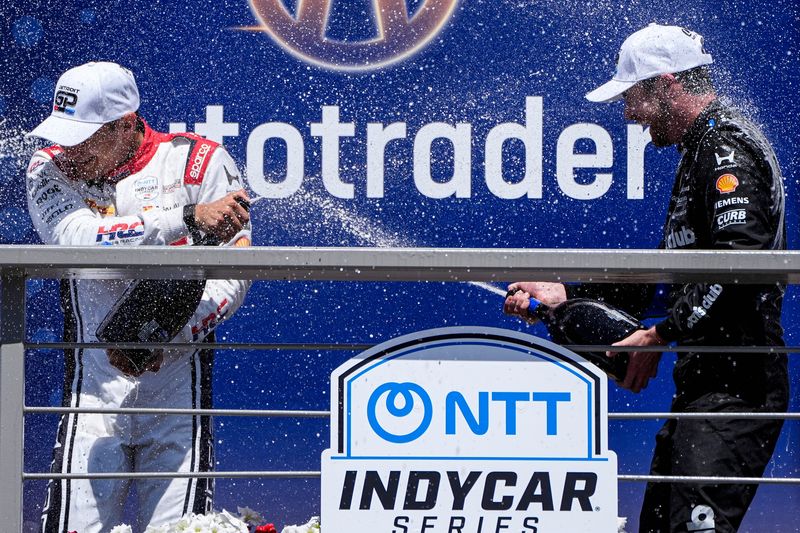
DETROIT – Alex Palou’s car was not always the fastest at the Detroit Grand Prix but it was, again, an edge in strategy that got him the win in his No. 10 Chip Ganassi Racing Honda.
The Detroit Grand Prix was the first street or road course race IndyCar held after IndyCar Officiating enacted an “operating and process update” following the Sonsio Grand Prix at the Indianapolis Motor Speedway road course on May 9. After Ed Carpenter Racing’s Alexander Rossi was stranded on the front straightaway following a hybrid failure, IndyCar’s race control deployed just a local caution, to Rossi’s dismay.

IndyCar Officiating, which is in its first year as an independent entity from IndyCar and Penske Entertainment, announced that, moving forward, pit windows and the running order of cars on track won’t be taken into consideration when race control decides whether to deploy a full-course caution or a local caution. Sunday’s race was the first with the new procedure in place, and Palou and CGR took advantage.
Palou did his second and final pit stop of the 100-lap race on Lap 64, 30 after he and Andretti Global’s Kyle Kirkwood’s first pit stop. Kirkwood, who was driving his No. 27 Honda on primary tires that degrade slower than the alternate tires Palou was using, stayed on the track and took his first lead of the day.
Two laps later, a caution came.
Kirkwood was always going to stay out at least one extra lap than Palou due to his tire advantage, but he and his Andretti Global crew — led by strategist Bryan Herta — wanted to use Lap 66 to clear Kirkwood of Palou and ensure he’d be in front of Palou after exiting pit lane. But when Santino Ferrucci and Rinus VeeKay made contact in Turn 5, Kirkwood’s strategy was destroyed.
Kirkwood finished the race second behind Palou and returned to second in IndyCar’s championship race (behind you-know-who). He and his crew tend to extend pit windows and save fuel as much as possible, but it came back to bite them with race control’s new process.
“To be honest, when you get ridiculed and criticized so much by the media, the drivers, everyone involved, that’s what you expect from race control — is to throw cautions when there’s incidents,” Kirkwood said. “Do I think it was the right idea? No. But at the same time, it seemed like they got way too much pressure for leaving a driver on the front straight that was kind of in a safe position, 25 or 26 competent drivers that weren’t going to hit him.
“It wasn’t like it was raining. There was 100 yellows out there. This is what happens when you guys rip into them, to be honest. It was disappointing to see. … But I understand their position. You guys all called for yellows, so they’re going to throw yellows.”
Herta, who has been the strategist for two Indy 500 victories, felt race control was being too cautious when incidents occurred.
“I know IndyCar said we’re just going to go yellow as soon as a hot dog wrapper blows on the track, but it turns the race into something that isn’t based on merit, and I don’t love that,” Herta said during the caution on Fox. “The last two yellows we had, the incident cleared within seconds. And I just think there’s got to be a middle ground to not ruin the race for people based on something that doesn’t really need to be a full-course yellow.”
One team criticized. The other capitalized.
Palou, like Herta, tends to stretch out his pit windows to his advantage. But with the new procedure in place, Palou pitted earlier than he might have in the past. He likes that he and his crew now know what to expect from race control, rather than guessing which cautions will be local or full-course.
“Now it’s going to be beneficial to go crazy, pit early and hope for a yellow,” Palou said after winning the pole on Saturday. “At least it’s going to be the same for everyone.”
“I would say if I were to reflect back on all the yellows that came today, they had to happen when they did right away,” said Barry Wanser, the strategist on Palou’s No. 10 car. “I don’t think it was a change of procedure where they would have necessarily waited for everyone for an opportunity to pit, and with the previous procedures, when you look at where some of those yellows happened and stuff, there were still cars behind, so cars come around blind corners.
“But we had prepared, and we’re always on the lookout for diving in the pits, so we know the yellows will come sooner than they have.”
Kirkwood’s car was probably more suited to win this race than Palou’s, as evidenced by Kirkwood’s win in Detroit last year. But Wanser and Palou’s ability to adapt and play the cards correctly put them ahead.
Performances like Sunday are why CGR has won eight IndyCar championships since Andretti Global (then Andretti Autosport) last won one in 2012. It goes beyond just talented drivers and quick cars, which Andretti Global typically has. One team executes at the highest echelon of the sport — regardless of changes in rules and regulations — while the other has its moments of inconsistency.
At one point in Sunday’s race, Palou dropped back to fourth, as another Andretti Global entry — Will Power’s No. 26 — led for 18 laps. But the mix of CGR’s strategy, Palou staying out of heavy traffic and flawless pit stops got Palou his fourth win this year.
“I did a couple mistakes on track on the first stint, and the team alone, they put me from fourth to first,” Palou said. “And that was just with a strategy call, which that’s our first step, but then you need all the crew, as well, to execute and to give you a great pit stop. For sure, we have a great package. … You need so much to go right for you to end.”
Things “go right” for Palou far more than they do any of IndyCar’s other 24 full-time drivers, but that’s because the four-time IndyCar champion and his team create their own luck. Palou’s smarter, more efficient style of racing is often the separator.
In the first two races of May, Palou was unlucky. He, like Kirkwood, was left hung out to dry when there was confusion surrounding whether race control deployed a full-course yellow as Rossi stalled at the Sonsio Grand Prix. At the Indy 500, Palou’s front wing had an assembly error that slowed his car and eventually led to a minor penalty from IndyCar Officiating. But even in those two races when Palou was unlucky, it ended in a pair of top 10 finishes, because the crew on the No. 10 car does enough right to counter any bad fortune or slight mishaps.
Whether or not Kirkwood and Andretti Global agreed with race control’s new procedure was trivial once the green flag waved at the Detroit Grand Prix. The new process was known, and Palou and CGR seized the moment, as they do so often.
Zion Brown is IndyStar’s motorsports reporter. Follow him at @z10nbr0wn. Get IndyStar’s motor sports coverage sent directly to your inbox with our Motor Sports newsletter. Subscribe to the YouTube channel IndyStar TV: IndyCar for a behind-the-scenes look at IndyCar and expert analysis.
This article originally appeared on Indianapolis Star: One team criticized. The other capitalized. How Alex Palou won IndyCar’s Detroit GP
Reporting by Zion Brown, Indianapolis Star / Indianapolis Star
USA TODAY Network via Reuters Connect