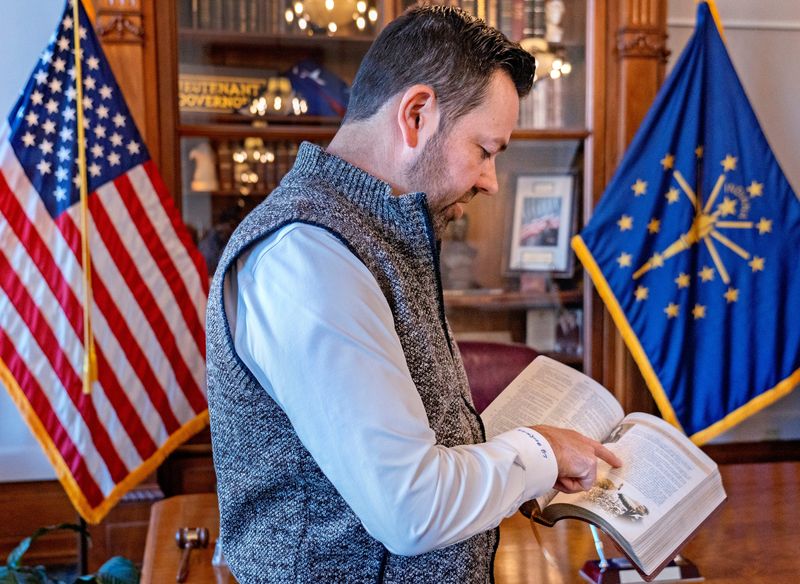
Lt. Gov. Micah Beckwith is no stranger to espousing Islamophobia — and many other -phobias and -isms. But this time, his anti-Muslim rhetoric comes on the heels of a tragedy in San Diego, when Islamophobia is already at record levels.
Beckwith made comments on a Christian program called FlashPoint about how he hates Islam and believes it’s a “demonic death cult.”

He says he loves Muslims, though. Why? Because we apparently make “great Christians” when we find Jesus.
Beyond the fact that Jesus is an important and highly respected prophet in Islam, Beckwith’s comments are deeply troubling.
Anti-Muslim hate is at record-breaking highs. The Council on American-Islamic Relations received over 8,600 complaints nationwide in 2025, the highest the organization has recorded since its first civil rights report in 1996. The American Muslim community is still grieving the fatal shooting of three Muslim men at a San Diego mosque.
Beckwith’s comments manufacture fear and dehumanize Muslims. Calling the faith that I share with tens of thousands of Hoosiers “demonic” normalizes violent behavior and derogatory language.
On social media, Beckwith doubled down, calling again for Muslims to consider converting to Christianity.
Beckwith on May 29 tripled down on a 92.3 FM WOWO radio show. “This is not a religion,” Beckwith said. “This is a political and military movement.”
Beckwith said he’s glad to get national attention for his comments and that he’s going to continue to keep speaking out against the faith.
In response to a question about the Council on American-Islamic Relations’ calls for Beckwith to visit a mosque, the lieutenant governor said he’s visited the mosque in Fishers and is open to visiting again, but this time he “might wear a crusader’s outfit.”
Anti-Muslim hate is normalized
Beckwith’s comments aren’t all that surprising; he’s one of many elected officials publicly spewing anti-Islamic rhetoric.
U.S. Rep. Randy Fine, R-Florida, has compared Muslims to dogs and called for the destruction of “mainstream Muslims” on social media. U.S. Rep. Andy Ogles, R-Tennessee, posted on social media about how “Muslims don’t belong in American society” and that “pluralism is a lie.” U.S. Rep. Andrew Clyde, R-Georgia, called for denaturalizing and deporting Muslim immigrants on social media.
Social media posts and the language we choose to use don’t exist in an insulated bubble. There are real consequences when elected officials and conservative influencers stoke fears and spread lies about Islam. It becomes easy to stomach the violence and derogatory behavior Muslims experience when you’re constantly surrounded by it.
If there were a time when severe anti-Muslim sentiments were fringe politics, I can’t remember it. Muslim academics, scholars and advocates have spent decades trying to deconstruct the idea that Islam is something unnatural to be afraid of. That tired narrative should have ended a long time ago.
During Beckwith’s recent tirade, he again called out Shariah and jihad — phrases that evoke fear in the minds of many Americans.
During Beckwith’s radio show appearance, he said he hopes to see legislation that bans Shariah law. It’s incompatible with the Constitution, according to Beckwith’s shoddy understanding of Islamic law.
Words don’t automatically become scary when they’re in Arabic.
Shariah guides my pizza order, not yours
Shariah is Islamic law, and it’s like any other religious legal framework.
“In Arabic, Shariah means the path to a source of water,” Imam Anisse Adni of Al Salam Foundation told me in an email. “Shariah refers to the guiding principles that guide people toward justice, service and devotion … One of the principles of the Shariah is to respect the laws of the places where we live as Muslims and to serve our societies.
“Hoosier Muslims are educators, doctors and small business owners, and Shariah is the moral framework that guides them to be upstanding citizens who contribute to the well-being of our great state.”
Shariah is based on the Quran, the Islamic holy book; the Sunnah, the practices of the Prophet Muhammad; and external scholarly sources and opinions. It was developed after the death of the Prophet Muhammad as scholars began to develop rulings that addressed Muslims’ legal and ethical questions.
When Muslims opt for veggie pizza over pepperoni, when Muslims choose to not drink alcohol or gamble, when Muslims pray their five daily prayers and when they fast during Ramadan, all of that is guided by Shariah.
A bizarre double standard
Jihad is another religious term, and its literal meaning is to strive or exert effort, Adni said. There are two types: internal and external.
Internal jihad includes things like trying to overcome selfishness and striving to do good for others, whereas external jihad relates to military action that defends life, Adni said.
“These days, the later evening prayer is around 10:45 p.m. while the morning prayer at dawn is around 5 a.m.,” Adni said. “It’s a real struggle, a jihad, to sleep so late and wake up so early to offer prayers on time.”
Like any legal system, there are nuanced provisions in Shariah that pertain to war and punitive measures — much of which isn’t relevant for Muslims living in America. And contrary to popular belief, a significant portion of Shariah is focused on how Muslims should navigate interactions with others, their families and themselves.
“Arabic is a language like any other,” Adni said. “It would be ridiculous to fear terms like pro bono or Kosher because they’re not originally English.”
Even making these concessions demonstrates how there is a bizarre double standard that Muslims must adhere to. We bear the responsibility of justifying and clarifying complicated Islamic concepts that non-Muslims are uninformed about. People of other faiths rarely need to do this, and this only exacerbates the narrative that there’s something about Islam that’s different or wrong.
It’s not necessary for this legal framework to be passed by legislative bodies to be followed, so it’s unclear what a ban on Shariah would even look like.
Does Beckwith urge us to disavow the basic tenets of our faith? Do we give up our daily prayers because the lieutenant governor thinks they don’t align with the Constitution?
In his own words, it’s evident that Beckwith won’t be giving up the anti-Muslim rhetoric anytime soon. And only time will tell what the consequences will look like for Hoosier Muslims.
Part of me is frustrated that I still have to prove the humanity of my Muslim sisters and brothers. It’s tiring to try to convince people that we’re deserving of respect and of our First Amendment rights.
If something about Islam confuses you or makes you uncomfortable, approach the subject with genuine curiosity and questions. Reach out to local mosques in your community to learn more.
Muslims are your neighbors, colleagues, friends and community members. We’re here to stay, and we certainly won’t apologize for it.
Contact IndyStar opinion fellow Sadia Khatri at sadia.khatri@indystar.com.
This article originally appeared on Indianapolis Star: Micah Beckwith wants Muslims to find Jesus. We just want respect. | Opinion
Reporting by Sadia Khatri, Indianapolis Star / Indianapolis Star
USA TODAY Network via Reuters Connect