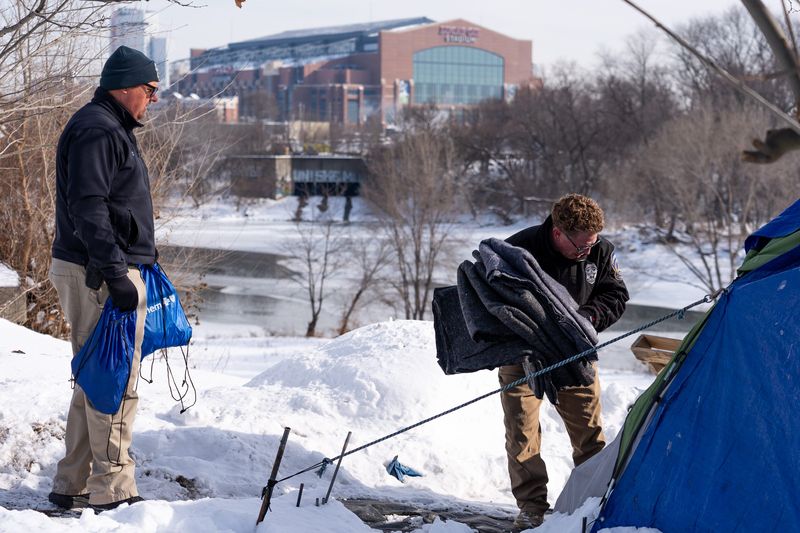
Indiana lawmakers have joined a handful of states in passing a statewide ban on homeless camps on public property, a policy that critics fear will push many Hoosiers living outdoors into the criminal justice system and complicate their search for housing and jobs.
The Indiana Senate on Feb. 26 narrowly approved Senate Bill 285, which outlaws long-term camping on public property like sidewalks, riverbanks and bridge underpasses unless that use has been authorized by law. Local police must remove people within 48 hours of a warning, and violators could face fines up to $500 or jail time.

The bill, which divided Republicans in a 28-22 vote, now heads to Indiana Gov. Mike Braun for final approval, with the statewide ban expected to take effect July 1, 2026.
As housing costs and homelessness have surged nationwide since 2020, at least six other states with Republican-majority legislatures, including nearby Kentucky and Tennessee, have approved similar statewide camping bans. And at least 150 local governments banned homeless camps after a 2024 U.S. Supreme Court ruling allowed cities and towns to outlaw living on public property.
Indiana Republicans who backed the proposal — inspired in part by a conservative Texas think tank called the Cicero Institute — say that outdoor camps endanger not only homeless people who live there but also nearby neighbors, business owners and passersby. The ban isn’t meant to punish homeless people, they say, but to force them under threat of a Class C misdemeanor to finally seek the help they need.
State Sen. Cyndi Carrasco, a Republican representing parts of Marion and Johnson counties, rejected the idea that the proposal she authored will put more people in prison. Rather, she said she believes it will save lives.
“I think people on all sides of the issue agree that jail is not always the right place to get help,” Carrasco said earlier this month. “This misdemeanor provision exists to create a moment where outreach, diversion and connection to services can occur to move individuals to a healthier and more stable life.”
Critics fear camping ban will deepen homelessness
But Democrats and social service providers say the camping ban could trap many of the more than 1,500 Hoosiers who live unsheltered in a vicious cycle between the criminal justice system and the streets. Critics including law enforcement officials say the money spent prosecuting and jailing homeless people would be better spent on housing and supportive services.
Republicans note there are several “off-ramps” before charges can be filed. The law requires police to first determine whether to force someone into a medical facility because they’re in severe distress. People living outdoors can avoid the misdemeanor charge if there’s a shortage of beds in nearby shelters or treatment centers, or if they were released from involuntary commitment due to health issues less than six months prior.
Moreover, local governments can establish programs to provide housing or shelter instead of charging people. But critics of the law say that because the state commits no money to support more housing or social services, it’s an “unfunded mandate” that will leave many shuffling between outdoor camps.
The law’s supporters don’t expect it to lead to tickets or arrests for the vast majority of people living outdoors because there are opportunities to get help first. But there’s contrary evidence in Kentucky, where about one in five unsheltered residents in the state were cited for unlawful camping in the year after the state’s ban took effect, according to the Kentucky Center for Economic Policy.
“If there is not housing and services at the end of those off-ramps, then the road is closed and the only road is back onto the highway leading to misdemeanors,” Andrew Bradley, policy director of Prosperity Indiana, told IndyStar.
Texas think tank pushes new approach to street camping
Bradley and others say the statewide ban is the first step in upending local homeless service provider networks in favor of different models for dealing with homelessness like city-managed camping sites.
Indiana’s new law appears to allow both the state and local governments to form authorized homeless camps on public property. The Cicero Institute advocates for designated outdoor camps with sanitary stations and on-site security as an alternative to less regulated street camps, an approach that’s seen some success in cities like Portland and Denver.
Indianapolis considered designated camp areas during the pandemic before opting instead to build a low-barrier homeless shelter, set to open in 2027, with $20 million in state funding. Since then, the city has funded an $8.1 million public-private partnership called Streets to Home Indy that’s gradually closing the city’s homeless camps and aims to move roughly 330 unsheltered people into housing by this summer.
Homeless advocates generally agree that the way to end homelessness over the long term is not with managed encampments, but by putting more money toward housing and supportive services.
The Housing First approach has led to dramatic reductions in veteran homelessness since 2010 for organizations like Helping Veterans and Families in downtown Indianapolis, which has received more federal dollars and an influx of specialized housing vouchers that help veterans pay rent. Whereas nearly 400 veterans were homeless in Marion County in 2015, just 125 were homeless in the most recent count last year — a 70% reduction over a decade.
“We know through the work that we do each day that the solution to homelessness is housing with supportive services,” HVAF CEO Emmy Hildebrand said recently. “It would be unfair to charge veterans who are working towards housing and waiting for openings in programs around our state.”
Email Indianapolis City Hall Reporter Jordan Smith at JTSmith@usatodayco.com. Follow him on X @jordantsmith09 and Bluesky @jordanaccidentally.bsky.social.
This article originally appeared on Indianapolis Star: Indiana passes statewide homeless camping ban. Here’s what will change
Reporting by Jordan Smith, Indianapolis Star / Indianapolis Star
USA TODAY Network via Reuters Connect